Showing posts with label Commissariat Général aux Questions Juives. Show all posts

08 October 2018

It is not heirless unless we say it is

by Marc Masurovsky

In late January 2015, HASHAVA sponsored a visit to the kibbutz of Ein Harod and its museum of Jewish artists near Mount Gilboa. It turned into an opportunity to celebrate one painting in particular, The Beggar, by Eugeniusz Zak. Zak was a reknown Jewish artist who worked and died in interwar Paris. This magnificent, broody painting ended up at Ein Harod after following complicated paths by which hundreds if not thousands of works and objects of art displaced during the Holocaust had traveled to Israel from the site of their plunder. The uniqueness of this Zak painting lay in the visible and clear stamp on the back of its frame, indicating that it had been stolen during Mobel-Aktion in German-occupied Paris and catalogued at the Jeu de Paume Museum as MA-B 1330.


You can view the Zak painting under two different lenses: under one lens, it has no owner. It is heirless. It has a home in Israel where it is well cared for, as a living testament to the tragic events of the wartime occupation of France and to the physical disappearance of 76000 Jewish men, women, and children. Therefore, it serves a dual function: as a work of art and a memorial to lost lives.

Under another lens, the Zak painting’s provenance, its ownership history, is incomplete and requires further work in the hope of finding a pre-war owner with a view to returning it. All that was known about the painting’s history at the time of its discovery, aside from the name of its author and the painting’s characteristics, is that it was seized in the spring of 1944 in Paris, processed at the Jeu de Paume in June 1944 by Dr. Borchers, a senior ERR official. The painting was recovered by French resistance troops in late August 1944 and most likely sold by the French government on the postwar Paris art market.

The research involved in uncovering the rightful owner of this painting and therefore erase its “heirless” or ‘ownerless” label, involves, in part, the following steps:

1/ since there were few collectors in Paris who appreciated Zak’s works, it would be wise to draw up such a list because it might help us zoom in on a potential owner, especially if he/she was Jewish. Zak’s widow, Hedwige, would have been the more likely and near-exclusive source of Zak paintings in Paris. It would also be good to understand the Parisian market for such works. 

2/ Once the painting is located either at the scale of a city or of a neighborhood within a city, archival resources falling outside the narrow strictures of art history need to be consulted. In the case of the Zak painting, the research points us in the direction of Mobel-Aktion and its coordinator in wartime France, the Dienststelle Westen which was itself an offshoot of the Einsatzstab Reichsleiter Rosenberg (ERR), Alfred Rosenberg’s Europe-wide specialized plundering task force. The Dienststelle Westen oversaw the day-to-day operations of Mobel-Aktion from 1942 until 1944. That involved: identifying the location of Jewish “residences”, placing seals on the doors of those residences—a cheeky German way of telling the Vichy French that they had no jurisdiction over the contents of those apartments—sending one or more teams of specialists to those apartments to survey their contents and prepare them for crating and removal; transferring the contents onto one or more trucks which would deliver them to Lagers throughout Paris, where plundered Jewish property was sorted and processed by Jewish slave labor, drafted for that purpose from the transit camp of Drancy in the northern suburbs of the French capital. 

The fruits of Mobel-Aktion either went to Germany or remained in Paris to be further examined because of their perceived quality, workmanship, or value and importance. In other words, they were transferred to the Jeu de Paume where an additional selection took place. The Vichy French agency responsible for surveying Jewish residences in France, was the notorious anti-Jewish Commissariat Général aux Questions Juives, otherwise known as the General Commissariat for Jewish affairs. Its main task, from 1941 to 1944, was to oversee the material, economic expropriation of the Jews of France, seize and liquidate their property for the benefit of Vichy and Aryan non-Jewish owners. A working partnership tied the Commissariat to the Dienststelle Westen whereby French anti-Semitic agents would provide Dienststelle officers with names and addresses of Jews who had “abandoned” their apartments—either because they had fled or they had been arrested and interned, or worse, were already dead. The commissariat routinely published annotated lists of Jews with their last known addresses, sharing them with their Mobel-Aktion colleagues. Hence, from an archival standpoint, one should look for addresses and names of individuals whose apartments or houses had been fingered by Vichy agents and sealed off in late 1943 and early 1944. These records are located at the Memorial de la Shoah in Paris and at the US Holocaust Memorial Museum in Washington, DC. This would be one way of narrowing down the list of potential owners of the Zak painting. Then, one could take those names and look for postwar files submitted by individual victims or their heirs to the French government for purposes of restitution. These files are housed at the archives of the French Ministry of Foreign Affairs at La Courneuve, north of Paris. Those archives have allowed us, so far, to link 10 to 15 per cent of the so-called heirless or ownerless objects collected under Mobel-Aktion with their rightful owners. Hence, identifiability is not just a concept, it is a highly probable outcome of meticulous international archival research.

In order to fold this type of non-art historical research into the portfolio of a museum professional, the institution as a whole must make an explicit commitment to promote such research, through adequate funding, resources, and training. Such an institution must committed to the outcome of such research, retracing the intricate paths of ownership through and time and space of an object, regardless of its outcome, be it restitution, repatriation, or maintenance in the collection as a result of a negotiated settlement with the identified owner to his/her satisfaction.

No object is heirless unless it is labeled as such. Every object begins with an owner who happens to be its maker or creator. Once the object leaves its original, primal owner and the place where it sat or hung, the path of the object will either be licit or illicit depending on the circumstances of its removal, transfers, and the transactions that it was subjected to and the larger historical context in which these movements or translocations took place. Those are the objective facts which surround the life of an object and its peregrination through time and space. That is what constitutes the provenance of an object. To put it simply, every object is connected at any given point, to a person, to a location and to a date.

In my view, the paradox is as follows: An object becomes heirless because it has been labeled as such for reasons having nothing to do with the object itself. On the other hand, an object always has an owner, whether identified or not.

If one looks at the so-called MNR works—Musées Nationaux Récupération-- which currently sit in dozens of cultural institutions scattered throughout France, one realizes how foolhardy it is to treat art objects as wholesale bulk commodities. These works include paintings, works on paper, furniture, decorative objects and the like. They were retrieved by specialized French units from German and Austrian collections after 1945 and repatriated to France whereupon they were placed in an odd limbo-like category as of the early 1950s. The French government considers itself the custodian of those objects, although it has behaved more like an owner. In the late 1990s, a number of organizations clamored for France to release the MNR works—over 2000—so that they could be sold for the benefit of the Jewish people. The reigning assumption being that these objects had all been looted from Jewish owners. Nothing could be further from the truth as demonstrated by the French government’s painstaking research into these objects Although the research is far from over, it is safe to say that many of the MNR objects were owned and sold by them to the German occupiers on the wartime French market between 1940 and 1944. Hence, a rush to judgment based on a misunderstanding of the history of looted objects motivated by political expediency leads to inevitable miscarriages of justice and incoherent decisions.

Public and private collections worldwide contain an unknown number of objects for which there is no provenance, no history, therefor no understanding of who owned these objects. Take the countries that were part of Yugoslavia until its breakup in the early 1990s and apply that knowledge to Eastern European nations in the wake of the Second World War, you will soon realize that the problem of unidentifiable cultural assets sitting in those collections may be significant. Recent research conducted by a EU-funded provenance research project, TransCultAA, confirms that many postwar museum collections in the former Yugoslavia were largely comprised of unidentifiable looted cultural assets. The same logic applies to other countries in Eastern Europe, subject to additional long-term research.

Our functioning premise is that every object has an owner. To be true to that axiom, research has to be conducted into the history of the objects for which nothing is known so that something is known. And if it means dusting off a skeleton or two that brings back to the forefront some of the ugliest moments of recent history, then so be it. Regardless of who was responsible for the thefts and murders, the Ustasha, the Milice, the Rexists, the Einsatzkommandos, local townspeople abetted by their notables and their religious leaders, regional and State officials, paramilitary forces, anyone who partook in the commission of a crime against humanity—physical elimination accompanied by wholesale plunder—we need to have the maturity and presence of mind to tell the stories of these so-called “heirless” objects which are in our collective custody; they command us to do so. Their stories are our stories, our past, and therefore our present. If we choose to ignore them and pretend that the stories did not occur, we are simply lying to ourselves. 

When a museum refuses to publish the provenance of an object in its care, regardless of its motivations not to do so, it is behaving unethically and denying our peers, our children, and grandchildren, the privilege of understanding where these objects came from, what they endured and how they ended up where they are today.



15 April 2018

La "question juive" et le marché de l'art en France, 1940-1944

by Marc Masurovsky

[This paper was delivered in French at an international conference in Bonn, Germany, on November 30, 2017. The conference focused on plunder and art trafficking in wartime France, 1940-1944, and was sponsored by the Deutsches Zentrum Kulturgutverluste.]

J’ai choisi de vous parler de la « question juive » et du marché de l’art à Paris pendant l’occupation de la France par les troupes et services du Reich allemand, de mi-juin 1940 à la fin du mois d’août 1944.

Pourquoi un tel sujet ? 

Je me suis demandé, peut-être naïvement, s’il était utile d’associer la “question juive” au marchéde l’art en France sous Vichy et l’occupation allemande. Mon intention était de proposer la notion suivante : la campagne antijuive, antisémite, menée en tandem par la France de Vichy et par l’occupant allemand, a changéde manière radicale le comportement des gens en France en injectant la « question juive » dans leur quotidien, leur vécu, leurs échanges, leurs rapports personnels et professionnels. Avant juin-juillet 1940, on ne prenait pas de décisions dans un contexte juif/non-juif ou aryen. Mais pendant quatre longues années, cette dualitéjuive/aryenne ou juive/non juive fit partie de la vie quotidienne de ceux et celles qui vivaient en France et surtout dans les villes où on pouvait trouver une communauté juive.Mise en pratique dans le monde de l’art, dans le marchéde l’art, la question juive, àmes yeux, devient pertinente.

Que veut-on dire par la “question juive” ?

Cette expression suggère une remise en cause, la nécessitéde questionner ce qui est « juif », la qualité de « juif, » la spécificité« juive. » C’est une question qui se pose différemment selon que l’on soit juif, ou non juif.

Le débat sur la question juive a été lancé par des philosophes allemands dans la première moitié du 19ème siècle, dans un contexte tout autre, à savoir l’émancipation des juifs vivant dans les provinces allemandes.

En 1843, Karl Marx rédige une « Réflexion sur la question juive » qui prend à partie un pamphlet polémique « La question juive », rédigé la même année par un de ses anciens professeurs, Bruno Bauer. Ce dernier était opposé à l’émancipation des communautés juives implantés en terres allemandes. Dans sa réplique à Bauer, Marx associe indissolublement la qualité de juif à une activité économique. Autrement dit, on ne peut être juif sans être producteur de capital, de richesse économique. Si on suit le raisonnement de Marx, l’émancipation des juifs, le règlement de la question juive ne peut s’accomplir que si les juifs abandonnent délibérément leur qualité de juif telle qu’elle est supposée être conçue dans un contexte capitaliste. Cela reviendrait à dire qu’une communauté juive émancipée accepterait de perdre son essence juive, qui, elle, est liée à une activité spécifique de production de capital. Même si Marx pensait honnêtement que son projet était humaniste et séculier, ma vulgarisation de ses propos avancés en 1843, soit cent ans avant la Shoah, démontre comment un tel argument pouvait être complètement dénaturé un siècle plus tard par la montée des idéologies fondées sur l’inégalité des races et la supériorité de la race aryenne qui trouveront leur écho dans le national socialisme allemand et ses variantes antisémites dans l’extrême-droite française. Je ne suis pas ici pour faire le procès de Marx mais je voulais simplement retracer très brièvement la généalogie de cette expression néfaste.

La réflexion de Marx sur la « question juive » remet donc en cause l’essence de la judéité, la qualité de juif, sa substance spirituelle, culturelle, et existentielle. Parler de « question juive » équivaut à questionner la raison d’être « juif ». A partir de 1940, la solution de la question juive implique l’extirpation des juifs de la vie économique de la société civile en leur soutirant leurs richesses et leurs capacités de produire, de consommer, d’exister économiquement, socialement, religieusement et culturellement. Pour moi, la question juive comme notion antisémite s’inscrit dans une interprétation économique de la qualité de « juif. »

L’activité économique qui nous intéresse aujourd’hui est celle qui caractérise le marché de l’art, un organisme complexe, qui ressemble plutôt à un tissu de réseaux et de filaments liant entre eux à des degrés divers artistes, marchands, collectionneurs, courtiers, personnels de musées, de galeries, de maisons de vente, notaires, avocats, banquiers, experts, historiens de l’art dont les compétences aident à soutenir et maintenir ce que l’on appelle le marché de l’art. Ces filaments s’étendent à travers l’Europe—et même au-delà jusque dans les Amériques et l’Asie. Ce monde ne peut fonctionner sans opacité, un monde dominé par le secret d’affaires. Après 1940, tout change. Les marchands, les galéristes, les collectionneurs d’origine juive disparaissent du marché, tandis que leurs inventaires, leurs biens culturels et artistiques s’écoulent par les mêmes réseaux dont ils se servaient avant l’imposition de mesures discriminatoires les excluant de toute activité économique. Vu l’intimité des rapports qui existaient entre tous les différents acteurs du marché de l’art, il est impossible d’exclure la possibilité que les marchands non-juifs n’aient acheté et vendu des objets qui appartenaient à leurs homologues juifs, souvent rivaux et concurrents. Très vite, les réseaux du marché de l’art s’adaptent à la nouvelle réalité—ils se maintiennent et s’épanouissent sous couvert d’une force d’occupation militaire et policière nazie et un régime autoritaire de collaboration qui se déclare français et qui est, par sa nature même, antisémite.

De nouveaux clients se manifestent à Paris. En l’occurrence, des milliers de fonctionnaires civils et militaires qui travaillent pour l’administration allemande, les services de sécurité et les différents ministères du Reich implantés d’ores et déjà en France occupée. S’y ajoutent les effectifs des sociétés commerciales, financières et industrielles des pays de l’Axe en quête de nouveaux clients. Ces nouveaux-venus accroissent la demande pour des objets et œuvres d’art sur le marché parisien. Les reçus des marchands, les factures, les bons de transport, les échanges de correspondance constituent une partie des preuves matérielles qui confirment la multiplication des transactions entre acteurs du marché de l’art en France occupée et une importante clientèle provenant du Reich et de ses territoires annexes.

Si la politique antijuive de Vichy et de l’occupant allemand nécessite la mise en place d’une France ‘judenrein’—sans juifs, qu’ils soient nés en France ou venant d’un autre pays, un marchéde l’art déjudaïsérequiert l’anéantissement de sa composante juive, c’est-à-dire, des membres de l’école de Paris et de leurs œuvres ainsi que l’exclusion des marchands, collectionneurs et autres spécialistes et courtiers qui peuplent ce marchéet qui sont fichés comme appartenant àla communauté juive.

Qui sont ces artistes ?

Installés en France par centaines depuis le début du 20ème siècle, ils avaient quittéleurs foyers en Europe de l’Est et dans les Balkans en quête d’une inspiration artistique qu’ils étaient sûrs de trouver à l’Ouest et plus précisément en France. Ce sont les grands oubliés, les marginaux, pauvres, difficilement intégrés dans la société française, dans les milieux de l’art. Ils s’expriment en yiddisch, en russe, en d’autres langues slaves. Ils fréquentent certains cafés surtout ceux de Montparnasse comme le Dome et la Rotonde. Bien que les grands marchands juifs parisiens les ignorent, ils créent leurs propres réseaux, persévèrent, côtoient de grands artistes comme Chagall, Braque, Picasso, Modigliani et Soutine, ils attirent des collectionneurs et marchands séduits par leur romantisme et le lyrisme de leurs œuvres. La plupart sont des crève-la-faim. Mais ils persistent et arrivent à faire entrer leurs œuvres dans une multitude de salons et d’expositions. Leur présence pose un défi au goût officiel qui met en avant un art « français. » Si bien que lorsque la France tombe sous le joug nazi en 1940, une dualité entre art « français » et art « juif » prend forme. 

Si le goût officiel que prônent les milieux conservateurs plutôt aisés du monde de l’art se démarque de cet art produit par des personnes juives venant de l’Est, l’instauration d’un régime autoritaire et antisémite servira à réaffirmer que ces artistes « étrangers » ne reflètent aucunement les valeurs de la France qu’imaginent les vichyistes. Yvon Bizardel en profita pour définir Vichy en ces termes : c’est la revanche du goût contre les dérives esthétiques qui caractérisèrent l’entre-deux-guerres et le déclin de la troisième république. D’une certaine façon, l’imposition d’une esthétique bien « française » est à l’ordre du jour pendant ces années noires. Mais pour ce faire, il faut se débarrasser des « autres » et les remplacer par des artistes de mérite qui sont, par ailleurs, non juifs et français. En tout cas, c’est comme cela que je le ressens, en particulier, lors de l’annonce de la nouvelle école de Paris en 1941, suite à une série d’expositions regroupant des artistes français à tendance moderne, certains fortement abstraits, d’autres puissamment figuratifs et traditionnalistes dans les thèmes qu’ils explorent. Nouvelle école de Paris. Le choix des mots est particulièrement pervers, quand on sait quelle a été la destinée de la quasi-totalité des membres de l’école de Paris de l’entre-deux-guerres, juive et étrangère, en grande partie massacrée ou morte dans des conditions atroces produites par l’isolement, la terreur, et le manque.

Peut-on argumenter que le renouveau de l’art français sous Vichy constitue une étape nécessaire dans la déjudaïsation de la vie artistique en France?

Faut-il en déduire que l’épuration de l’Ecole de Paris cède la place à cet art « français » non juif sous Vichy et au-delà ?

L’activité commerciale artistique évolue dans un climat de plus en plus sévère. L’Einsatzstab Reichsleiter Rosenberg de concert avec les services de sécurité du parti nazi lancent une campagne systématique visant à extirper de la société française tout ce qui est « juif. » L’ERR cible les collections d’œuvres et d’objets d’art appartenant à des propriétaires juifs--collectionneurs, marchands, et artistes confondus. Le musée du Jeu de Paume, sous la direction des spécialistes de l’ERR en poste à Paris, se transforme dès l’automne de 1940 en centre de triage, de sélection, de catalogage et de traitement de dizaines de milliers d’objets et d’œuvres d’art de toutes sortes, de qualité extrêmement variable, soutirés à des centaines de propriétaires d’origine juive tant dans la région parisienne que dans le Sud-ouest et éventuellement tout au long de la côte d’azur. Paris devient la plaque tournante d’un marché de l’art où pullulent une quantité impossible à chiffrer d’objets et d’œuvres d’art pillés, confisqués, aryanisés. Le Jeu de Paume regorge d’objets ; l’excédent est dispersé parmi une douzaine de dépôts auxiliaires aménagés pour la plupart dans les quartiers huppés de la capitale en particulier dans le 8ème, le 16ème et le 17èmearrondissement. Un réseau d’appartements et d’hôtels complète cette infrastructure de recel d’objets pillés. Tout ce qui n’est pas emballé et convoyé vers le Reich est recyclable sur le marché parisien et de temps à autre à destination de pays limitrophes—Belgique, Hollande, Suisse, Italie, Autriche, même vers le Gouvernement général dans ce qui fut la Pologne. Pouvons-nous parler d’une suroffre d’objets pillés? Il serait facile de dire que l’excédent d’objets pillés fut convoyé à destination des villes allemandes frappés par les bombardements alliés. Mais la situation est bien plus compliquée. Les documents d’époque et les dossiers de restitution d’après-guerre nous laissent croire que la majorité des objets volés chez les particuliers n’ont jamais été enregistrés par les fonctionnaires de l’ERR ou de la Dienststelle Westen. Et pourtant, ces objets ont bel et bien disparu. De nombreux foyers ont subi des actes de pillage répêtés, parfois trois, quatre, même cinq perquisitions, s’étendant sur plusieurs années. Une partie de ces objets seulement furent « traités » au Jeu de Paume. Qu’en est-il du reste ? Comme réponse possible : ils ont été écoulés par des antiquaires, des bouquinistes, des luthiers, des joaillers, des galeries d’art, des salles de ventes, par des ventes improvisées dans des lieux aussi insolites que des hôtels et des restaurants. Ce recyclage nécessita des milliers de personnes disposées à faciliter pour toutes sortes de raisons, la monétisation de la propriété juive. 

La M-Aktion agit comme courroie de transmission entre les agences de pillage et les points de vente ; le Jeu de Paume, comme centre de tri, opère des sélections d’objets à rendre à la M-Aktion pour être ensuite vendus sur le marché. La machine de pillage et de recyclage assure un débit important de produits pillés. Les marchands, en général bien renseignés sur de nouvelles sources d’objets à exploiter, devaient bien se douter que l’origine de tant d’objets en circulation était illicite, le fruit d’une confiscation, d’un prélèvement exécuté par des commandos à la solde de l’occupant ou de Vichy. Le marché noir qu’entretenait différents services allemands, regorgeait lui aussi de biens pillés et fournissait des filières de recyclage qui s’étendaient au-delà des frontières, en particulier vers l’Espagne et la Suisse, animées par la pègre corse, des collabos venant de pays alliés à l’Axe et de temps en temps par des mauvaises graines de la communauté juive, des opportunistes qui se retournèrent contre leurs compatriotes, motivés par l’appât du gain. Quoiqu’ils ne fussent pas très nombreux, leur existence est indéniable ainsi que leur participation au pillage économique et artistique de la communauté juive en France occupée.

Après quatre années de pillages, de confiscations, de saisies, dans le cadre d’une entreprise génocidaire, le marché de l’art en 1945 est totalement compromis, pollué, contaminé par une masse d’objets et d’œuvres, difficilement identifiables, mais qui proviennent de foyers exterminés, de vies brisées. Tous les recoins de ce qu’on appelle le monde de l’art, sont impliqués dans cette entreprise, y compris les fonctionnaires en poste qui officialisaient et rationnalisaient ces actes de pillages contre la communauté juive. Le comble voudrait que tout ce beau monde invoque après la guerre la bonne foi telle une incantation, afin de défendre leur comportement. Entretemps, six millions de vies humaines à travers l’Europe ont été effacées dans des circonstances on ne peut plus cruelles. 

Quand les forces alliées entrent dans Paris, le marché de l’art de l’après-guerre est privé de sa composante juive pour cause de génocide. Les marchands juifs rescapés sont ceux qui quittèrent la France à temps ou se terrèrent dans des villages isolés en attendant des jours meilleurs. Ils revinrent dans un Paris où seuls des fantômes bavardent en yiddish aux terrasses des cafés.


15 November 2011

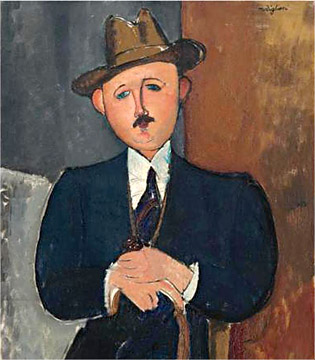
Modigliani's "Seated Man with a Cane" up for grabs

by Marc Masurovsky

[Editor's note: This blog piece originally appeared on November 15, 2011. It has been updated to reflect additional news and research regarding the "Seated Man with a Cane," by Amedeo Modigliani, in 2016, on June 9, 2018, and on 4 February 2024]
Seated Man with a Cane, Amédéo Modigliani
Source: Courthouse News Service
The first day of November 2011 began with a headline-grabbing story about a painting by Amédéo Modigliani, "Seated Man with a Cane." According to the prevailing news accounts in the Anglo-American press, a Frenchman of Jewish descent by the name of Oscar Stettiner had lived in Paris before the advent of the Second World War. Instead of waiting for the Wehrmacht to march into Paris, Stettiner did what a third of the Parisian populace did—he fled. Before going south, Stettiner parted with his property, including works of art, never to see them again.

The plaintiff in this case is Philippe Maestracci who was born in the Dordogne in 1944 where his grandfather, Oscar Stettiner, had sought refuge and remained throughout the Second World War in a small town called La Force.

The news reports indicate that, at some point in 1941, a man by the name of Marcel Philippon became the official overseer of Stettiner’s assets as a logical consequence of being of Jewish descent and being specifically targeted for that reason by German and French anti-Jewish ordinances and decrees.

On July 3, 1944, the Modigliani painting was offered up for sale at an auction in Paris.

In 1946, Oscar Stettiner initiated proceedings to recover his painting. He died in 1948.

More than sixty years later, the Modigliani painting was offered up for sale at Sotheby’s by its current owner, Helly Nahmad, which triggered the current claim by Oscar Stettiner's sole surviving heir, Philippe Maestracci.

The following text should be viewed as a historical consultation provided free of charge to the parties warring over the painting. If they get no benefit out of this, the fault is entirely theirs.

Before even entering into a critical analysis of the facts as they have been presented to the public, the news reports contradict one another, thereby making it very difficult to develop an accurate version of a now-familiar story of spoliation of Jewish cultural assets, recycling on the wartime art market, and postwar attempts at recovering the stolen cultural property.

Most news reports, which repeat Courthouse News Service and the British Mail, indicate that “the Nazis appointed Marcel Philippon a temporary administrator to sell Stettiner’s property…” ArtInfo, on the other hand, gets it all wrong by indicating that the Nazis placed the Modigliani painting “in the care of” Marcel Philippon in 1939, which is a bit nonsensical since the Germans entered Paris in mid-June 1940.

The complaint itself does not shed additional light on what went wrong during the war. However, it does make several historical errors which are not helpful. It alleges that “the Nazis adopted a practice and a policy of despoiling Jewish families of property located in the Occupied Zone by forced sales.” It would have been more intelligent to indicate that the Nazi authorities, referred to as the German Military Administration (Militärbefehlshaber für Frankreich) shared the burden of enacting and enforcing anti-Jewish decrees with the collaborationist regime of Marshal Philippe Pétain, whose government was based in Vichy. It was Vichy that enacted the most sweeping anti-Jewish laws, not the Germans. Those laws established a sequence of economic restrictions aimed at ostracizing and impoverishing the Jews living in France at the time of the German invasion. The turnkey moment was the establishment of the “Commissariat Général aux Questions Juives” (The General Commissariat for Jewish Affairs or “CGQJ”) in April 1941 whose main purpose was the wholesale transfer of property from Jewish ownership to Aryan hands in consultation with and sometimes in opposition to German dicta.

Le Commissariat général aux question juive, place des Petits-Peres, l´ancenne banque Léopold Louis-Dreyfus
Source: Wikipedia via Bundesarchiv
Where does Marcel Philippon fit into this strategy? According to the complaint, “the Nazis would appointe [sic] a Temporary Administrator (“Commissaire Gérant”) to marshal and sell Jewish property and to turn the proceeds over to the Third Reich.” This is really where matters get very sticky.

Before the establishment of the CGQJ, the German authorities began to appoint overseers to manage companies and businesses owned by Jews. The individuals appointed in this capacity were known as commissaires gérants. The title should be interpreted literally: their function was to manage businesses whose owners had fled, hence the word “Gérant” or “manager.” The ultimate fate of these businesses became entangled in arduous negotiations between the German occupation authorities and the newly-minted CGQJ since the Vichy authorities had laid claim to any assets owned by Jews on French soil, especially if they were French nationals.

The Administrateur Provisoire is an invention of the Vichy government. Loosely translated as interim overseers, their function was to manage confiscated Jewish assets for the purpose of either liquidating them or aryanizing them. In the case of Oscar Stettiner, the complaint raises a number of questions which need to be researched thoroughly:
  1. Stettiner -- assuming that we are talking about the same one--allegedly owned a gallery which had been founded by his family in the second half of the nineteenth century. If his gallery was still active in the fall of 1939, it would have been placed under the care of a “commissaire gérant”, assuming that the Germans had gotten to it first. Had they not, the Vichy government would have seized the opportunity and appointed its own overseer, hence the competitive nature of control of Jewish assets between the Germans and the French.
     
  2. Marcel Philippon, as an interim overseer, had to abide by the instructions of the CGQJ and/or the Germans, depending on who actually appointed him. If he was in charge of both Stettiner’s personal and corporate assets, a determination would have to be made about how best to handle the seized property. It could be a mix of transfer of ownership to Aryan hands and outright liquidation through auctions or sealed bid offers. If there is a paper trail, it would be in the records of the CGQJ, archivally known as AJ38, the acronym given to this notorious collection by the French National Archives.
     
  3. the sale of the Modigliani painting three years after its placement under the management of Philippon is of concern, because it is difficult to understand, although it is not inconceivable, how and why Philippon would have waited for so long to sell the Modigliani, knowing that the wartime Paris market was thriving and that Modiglianis were easy to sell at a fair price due to their desirability both in contemporaneous French and foreign art circles. For reasons of due diligence, both parties should consult the d’Atri records at the Archives of American Art which contain the notes of Mr. D’Atri who was busy assembling a catalogue raisonné of Modigliani’s works but failed to complete it. However, his notes and ledgers are enlightening since he presumably inventoried every oil painting produced by the master until his untimely death.
     
  4. the postwar claim gives me heartburn. Indeed, there is no indication that Mr. Stettiner filed an official restitution claim with the French government. The records of the Commission de récupération artistique (CRA) make no mention of Oscar Stettiner or of his gallery. The records of the Office des Biens et Intérêts Privés (OBIP) make no mention of either Oscar, Maud, or Jacques Stettiner. However, in this particular instance, the current inventories are incomplete. Both parties in this litigation owe it to themselves to contact the Archives of the Ministry of Foreign Affairs at La Courneuve (Ministère des Affaires Etrangères et Européennes or MAEE) and request any compensation or restitution claims filed under the various names of the victims as presented in the complaint. If Oscar Stettiner decided to “go it alone” and seek personal justice outside the sphere of State-sponsored claims through judicial proceedings, the Paris courts and especially the Tribunal de la Seine and the Tribunal de Première Instance might be the proper jurisdictions where a docket might have survived.
     
  5. forced sales in Vichy France: The French government has never admitted to the existence of so-called “forced sales”, assigning that moniker to Nazi ill-doings. Liquidation sales of Jewish-owned property did occur on a weekly basis throughout occupied France, mostly in the Paris region, but the mechanisms used to recycle Jewish-owned property were far more complex than meets the eye, especially when cultural assets were involved. This matter needs to be seriously examined in light of the extensive historical documentation surrounding the wartime Paris art market and the recycling of confiscated Jewish property.
Parting thoughts:

The search for justice through claims for restitution of cultural assets forcibly removed from the hands of owners of Jewish descent requires that those who represent the aggrieved parties should pay close attention to history as it unfolded and reflect that history in their argumentation. Without such scrupulous and diligent attention to the historical truth, history is rewritten and the damage is done in the courts and in the minds of those who must hear these cases and make an informed decision about the validity of the claim brought before them.

That is not to say that the Stettiner issue is invalid. Far from that, but the historical investigative work must be brought to a forceful conclusion in order to allow all parties involved in this and similar conflicts to reach an outcome that is anchored in historical truth and ethical conduct.

Otherwise, much like “Groundhog Day”, we keep on repeating history over and over again.

Is it too much to ask that the parties involved in the dispute over the Modigliani painting come together and ascertain the facts as they occurred in the name of history, justice, and the truth? No more, no less. It would be reprehensible for Helly Nahmad to proceed with the sale of the painting because there is a taint on it and that taint must be washed off.


2016 update:

The Toronto-based Mondex Corp. now represents Mr. Maestracci, the closest kin to Oscar Stettiner in its attempt to recover the "Seated Man with a Cane", an oil painting by Modigliani.

The "Seated Man with a Cane" by Amedeo Modigliani has been located in the Geneva Freeport where Swiss authorities ordered its seizure.  The shell company under which it was registered is in fact owned by the Nahmad family which means that, by several steps removed, Nahmad is the current possessor. Or so the Swiss prosecutors believe together with US investigators.

The challenge now is to see whether Mr. Maestracci and Mondex can prevail and assert their claim over the Modigliani painting.  Its history remains murky.

Meanwhile....

The provenance of the "Seated Man with a Cane" raises questions, which beg for more meticulous and forensic research:

Repeated inspections and examinations of the records of Alfredo d'Atri, an art dealer and collector based in Paris, France, who was an expert on Modigliani's life and works, failed to produce any tangible information on "Seated Man with a Cane."  The only reference to the painting was a photograph of the painting when it was loaned by a Mr. Stettiner to the 1930 Venice Biennale. D'atri's ledger of paintings by Modigliani does not include any information on this work nor does it mention it.

In other words, there is a 14-year gap between the only public display of the "Seated Man with a Cane" and the purported sale of the painting in wartime Paris on July 3, 1944. It needs to be "filled."


"Seated Man with a Cane"

Page from the Venice Biennale catalogue, 1930


Note: the black and white photograph of the "Seated Man with a Cane" and the page from the 1930 Venice Biennale catalogue where the painting was exhibited come from the Archives of American Art, in Washington, DC.

Update from June 9, 2018

On April 18, 2018, New York State Judge Eileen Bransten denied Nahmad's motion to dismiss the case against him for the Modigliani painting. On June 5, 2018, Helly Nahmad, current possessor of the "Seated Man with a Cane," by Amadeo Modigliani, filed a request for judgment with the New York State Supreme Court to dismiss Mr. Maestracci's complaint against Nahmad, and to award monetary damages to Nahmad in the event of a ruling favorable to Maestracci equal to the value of the painting at time of purchase plus interest.

Source: Verified answer and counterclaim re "George W. Gowen as Limited Ancillary Administrator of the Estate of Oscar Stettiner, against Helly Nahmad Gallery, Inc., Helly Nahmad, (New York) individually, David Nahmad, and International Art Center, SA." NYSCEF Doc. No. 1819.

Update from February 4, 2024

13 years have passed, come and gone, since we first heard of the "Seated Man with a Cane" by Amadeo Modigliani. As of today, Mr. Nahmad remains the happy current possessor of a painting which has been labeled as "looted." You would think that in its many boasts Mondex Corp. would have seen fit to release part of the historical evidence making it clear to Mr. Nahmad that it would be best for him to surrender the painting to Mr. Maestracci, the purported heir of Mr. Stettiner, alleged victim of this crime of spoliation at the hands of the Vichy government and the German occupation force.

In 2020, the Art Newspaper published an update on the case putting forth new evidence from the French archives showing that the painting was clearly looted. A note on a document signaling the painting as stolen and being sought in America. Is that it? 

I'd gladly offer a bottle of champagne (I get to choose the brand) to anyone willing to come forth with the damning and incontrovertible evidence against Mr. Nahmad. I doubt that the offer would bear fruit because, at this stage, no one is convinced that there is a case to be made and that Mondex has convinced a distant relative of Mr. Stettiner to sign on to a restitution claim for a painting worth today upwards of 20 million dollars. Another high-stakes game played by the new bad boys and girls of the restitution industry. At the end, claimants suffer, the restitution process gets trivialized and maligned by the very people who should take heed of how serious we are to do justice and fix--even symbolically--the crime of cultural plunder.

At this point, it would be foolish to take bets on a losing case.


15 July 2011

The Wildenstein reality check

by Marc Masurovsky
[This article was updated on May 25, 2018.]


Guy Wildenstein found himself in a sticky situation pertaining to various matters involving art, money, and power.  In 2017, Wildenstein was cleared of tax fraud, but in March 2018, the French government, on appeal, requested four years of prison, with two suspended, and a punitive payment of 250 million euros.  The Wildensteins have asked that the charges be dropped. Why should all of this matter?

Aside from the fact that the Wildenstein name alone is synonymous with everything that is gigantic and disproportionate in the way that art is traded in today’s world, so it has been for the past six or so decades.

The Wildenstein family can only be matched in its zest for influence with the eponymous “robber barons” of US industry. With equal doses of verve, recklessness, swashbuckling ways and bravado, with not so subtle shades of arrogance, the Wildenstein dynasty has imposed itself upon the global art market as one of its kingmakers, with traditional spheres of influence centered in Western Europe and North America.

Why the hullabaloo? For many, it is more like a sporting game to go after the powerful and mighty of any industry, and especially nowadays those in the art industry which provide much grist for the mill. Yes, industry, as opposed to taste. Or taste in the pursuit of profit. No matter.

Georges Wildenstein was the true scion of the family, the man who made Daniel, his late son, and Daniel thence made his sons, Guy and Alec (he died in 2008), in the dynastic family mold, for better or for worse.  The flagship of his business was in Paris with branches in London, New York, and even Buenos Aires. Georges knew everyone there was to know, much like his archrival, Paul Rosenberg. Although keenly interested in 19th and 20th century artists, he definitely expressed a marked preference for the 18th century and its creators, stylists, and decorators. In fact, that’s where he excelled. Old Masters? Of course. Medieval pieces? Why not?

The Wildenstein clientele is powerful, both in private as well as in State circles. Georges was well introduced among curators and directors of museums across Europe and the Americas; a well-heeled man with his frivolities, paranoid moments, and phobias.

Georges fled to the south of France before the German Army entered Paris in June 1940, leaving his Parisian business in the managerial care of Roger Dequoy, who had run his London office.

Georges ended up in New York via Lisbon, a preferred route for most exiles at that time who crossed the Atlantic either by Pan Am clipper or by boat, depending on means and resources.

The Wildenstein interests in Paris were quickly subjected to the gluttony of the Nazis’ culture vultures. Competing German plundering units raided at least five sites owned or controlled by Georges Wildenstein, including two bank vaults, his gallery in Paris, and three residences with two in the French countryside.  The gallery’s stock, Georges’ privately-owned inventory in half-a-dozen locations across France, as well as a handful of bank vaults, fell into the hands of the Nazis by the second half of 1941. His library attracted many interested buyers including a close friend of René de Chambrun who intrigued with the pro-Nazi industrial group in Vichy France, aspiring for the new France to be the Aryan vassal of the New Germany. The Gazette des Beaux-Arts, which Wildenstein had run for decades, together with the rest of his assets, were subjected to Aryanization proceedings under the aegis of the Commissariat Général aux Questions Juives (CGQJ). Certain German interests represented by Karl Haberstock, a senior Nazi cultural agent operating in occupied territories, sought to derail Vichy’s absorption of Wildenstein’s assets in order to channel them under Nazi control. Regardless, Georges was a bona fide victim of Nazi aggression and cultural plunder.

The plot thickens... and this is where Hector Feliciano, author of “The Lost Museum”, got himself in a legal hornet’s nest with Georges Wildenstein’s heirs. Although the Wildenstein suit against Feliciano was eventually dismissed, it nearly ruined Mr. Feliciano.  Haberstock and Wildenstein were old friends and business partners. Together, they had acquired and sold paintings for at least a decade prior to 1940. Feliciano implied that Georges and Karl had struck a deal whereby Georges’ cultural assets would fall under Nazi protection and he could continue to do business as he liked in German-occupied France under the stewardship of Karl Haberstock, using Dequoy as a go-between. A hefty charge which requires flawless historical documentation. Incidentally, the Foreign Funds Control Division of the US Treasury Department under Henry Morgenthau suspected as much and monitored Georges Wildenstein's cable traffic throughout 1941.

Dequoy’s wartime management of the Wildenstein House in German-occupied Paris proved to be a financial bonanza for him as he had engineered the Aryanization of the gallery, which Vichy and the Germans had suspected of being a sham to cloak Georges Wildenstein’s assets. Nevertheless, Dequoy survived the war unscathed and a rich man. Wildenstein continued to rely on his managerial experience with the firm in the postwar years.

Wildenstein’s wartime cultural losses are well-documented, most notably in the publicly accessible and fully searchable ERR database where more than 500 objects owned by Georges Wildenstein are listed as having been looted by the Nazis. Many works are still missing. There are also concerns that looted objects belonging to other victims of Nazi plunder might have been erroneously transferred to Georges Wildenstein by French restitution authorities after the war. If that is true, his case would be no different than those of many other victims of Nazi plunder since these flawed returns contaminated many postwar restitutions, a perverse way for postwar European governments of applying the law of in-kind restitution: if it looks like your object, why don’t you take it anyway?

Only a detailed and comparative forensic analysis of postwar restitution files can resolve these knotty questions. They have direct relevance to the controversy over the so-called Kann manuscripts—stunning medieval books which were looted from Alphonse Kann’s house in Saint-Germain-en-Laye between summer 1940 and spring of 1941. A number of them were still missing in 1945. At least one had fallen, according to the Kann heirs, into the hands of Georges Wildenstein who, truth be told, had lost similar manuscripts as well. A lengthy legal battle ensued in an American court which pitted the Kann heirs against the Wildenstein interests. Despite the fact that an art historian close to the Wildensteins could not certify that Wildenstein had ever owned the claimed manuscripts, the Kanns lost on technical grounds, not on historical substance.  From a forensic and historical standpoint, the case remains open for renewed investigation.  However, it is unlikely that it will be reopened, despite the fact that the historical evidence mitigated in favor of the Kann family.