Showing posts with label Vienna. Show all posts

16 June 2014

Provenance research—now and later (First installment)

This “think-aloud” is neither the first nor the last on a topic that has become, despite its innocuous phrasing, far more contentious than it ought to be.

For now, it is best to throw out some questions for which answers are not necessarily forthcoming.

Why all the fuss about provenance research?

Up until the mid-to late 1990s, provenance research remained within the province of trained art historians working in cultural institutions where art objects are cared for and displayed for the benefit of the public. The research aims to enhance the understanding of the object—its author, its physical attributes, the period in which it was produced, the reasons for its existence, and how it evolved over time and space.

This kind of research is an academic/intellectual exercise that helps ascertain the authenticity of an object and its place in the history of art, writ large.

It is not a requirement incumbent upon its practitioner. Provenance research is one of many duties that “come with the job.” If it does not get done, no one gets fired. More often than not, the information that is collected about the object does not enter the “public record” insofar as it is communicated to the general public. If it is communicated, that is left up to the discretion of the institution where the research is conducted.

Then, the 1990s came and went, and, all of a sudden, “provenance research” became something else entirely.

If I had been working in a museum in the wake of the scandal surrounding the misuse of Swiss bank accounts owned by persons of Jewish descent who may or may not have perished during the Holocaust, I would have been rather oblivious to any debate about loot in general. Once the debate about the mishandling of “Jewish bank accounts” (I hate that expression!) transferred into the (mis)handling of art objects nestled in the permanent collections of countless museums both in North America and Europe, provenance research entered the spotlight front and center.

If I had been working in a museum at the time that the “Portrait of Wally” by Egon Schiele was seized at the Museum of Modern Art of New York in early January 1998, I probably would have wondered: what is that all about? And I would have naturally sided with the then owners of the painting, the Leopold Foundation of Vienna, and the exhibitors, the Museum of Modern Art, wondering what Robert Morgenthau, then district attorney of Manhattan, had had for coffee on the day that he decided to order the New York Police Department to seize the painting.

I would have done so because my training would have precluded me from even wondering if I should even worry about whether or not the institution that I served had actual title to the objects under my care and examination. Why should I have worried about title since I simply assumed that my institution was the rightful owner?

I write these words simply because it is the right thing to do: acknowledge that the beast that has become “provenance research” has been transformed from an innocuous art-historical practice into a tendentious, litigation-laced, means to an end: does the research into the origins of an object lead to the maintenance of that object in the collection that I help steward or does it lead to the de-accessioning of the object because of some historical wrong that broke the chain of ownership of the object, thus changing its status to “restitutable”?

05 July 2011

Who Could Believe that It Was Happening, Even as It was Happening?

A commentary by Ori Z. Soltes, chair of the Holocaust Art Restitution Project (HARP)

Ori Z. Soltes
Source: The Great Courses
In the aftermath of the Holocaust, a peculiar sort of discussion emerged eventually that, in some corners, continues to this day. That discussion pertained to the idea that the victims of the Holocaust, primarily the Jews, went “like sheep to the slaughter,” instead of fighting back. Accusing the victim for being victimized has long been an instrument with which humans who were in a position to help the victim but did not, assuage their guilt for their own failure. Blaming those who were herded and branded and slaughtered like cattle for not responding to the program of Nazi deceptions until it was too late might assuage and has alleviated that guilt for many, as they sought a return to normal lives.

It is always easy to blame someone else, and in this case, the guilt has run particularly deep and wide—not just those Germans or Austrians or French who stood idly by or contributed actively to the slaughter, but the British and the Americans who famously refused to bomb the train tracks to the killing centers, and who kept their immigration quota doors closed tight or made the paths to Palestine all but impassable. For it was one thing to be fighting the Germans and their allies in World War II, and another altogether to be fighting the Nazis in the Holocaust.

The numbers of Jews who did fight back remained, for the most part, unheralded and forgotten until the last few decades. Inevitably, those who fought did so with very little in the way of armaments and with very little reliable support from—even, at times, finding themselves betrayed by—the various non-Jewish underground forces who were themselves fighting the Nazis. Conversely, the myriad times and places in which well-armed or at least militarily experienced forces failed to resist or, in captivity, to rise up against their captors has typically been ignored.

Moreover, as in any large lie there may be a smaller element of truth, it is true that many (perhaps most) Jews did not resist. A perfect storm combined the Nazi genius for willful deception—to simplify the process of extermination by encouraging their victims to believe that they were not on the verge of victimhood—together with the victims’ desire to believe, and therefore to be deceived, that this was a storm that, like so many others in Jewish history, would pass. Physical resistance, in any case, had not been the primary means for a fragmentary minority to survive over the centuries in the face of hostility from the majority population.

For German and Austrian Jews in particular, the sense of having arrived at a point of truly being part of that majority mainstream—socially, economically, culturally, even to some extent politically—militated against believing that what was happening was happening. In the discussion of this issue it has often been pointed out that the very fabric of the late nineteenth/early twentieth-century Austrian and German communities was so interwoven with Jewish threads that, had the Holocaust not followed, historians would be constantly waxing about the Golden Age for Jews in those countries in that era. The photograph of which Sigmund Freud—to name one Jewish luminary among many within the Viennese firmament—was proudest, showed him with his two sons, both of in Austro-Hungarian military uniform; they were among myriad Jews who served in the Hapsburg and Prussian armies between the end of the eighteenth century and the end of World War I.

On the other hand, the Golden Age was by no means free of anti-Semitism (in fact the very term was a coinage of that era, as the Prussian pamphleteer, Wilhelm Marr, was the first one to label the Jews “Semites” in 1878—but that’s another story for another day). But this is part of what made the Nazi era so inexplicable as it gradually unfurled its full fury against the Jews. Who could imagine that such a definitive exterminationist intention would be directed toward a population so integrated into that world?

Marc Masurovsky and I uncovered one of the most extraordinary proofs of this a few years back as we were systematically studying the property census forms that every family with even an oblique Jewish component or connection was required to fill out for the Nazis after Austria fell before—or rather, embraced—the Anschluss. Our interest was in the cultural and similar property that the Nazis confiscated based on these on-demand listings of everything from silverware, desk lamps and jewelry to paintings, drawings and sculpture.

But along the way, we noted three other, unexpected features. One was the prevalent tone assumed by a good number of those who filled out the forms: little jocular side notes, as if submitting a report to a long-time superior with whom one has a warm, friendly relationship—as opposed to filling out what would amount to one’s death warrant. A second was the fact that a number of these forms were filled out and sent in from places as far away as Ankara and even New York City. This might have been out of fear for family members still in Austria, but may well have been out of a Teutonic sense of duty: one is required by the authorities to fill out a form as a Jew, then as a Jew more Viennese than the Viennese, one fills out the form—because regardless of where one lives one remains emphatically a Viennese.

Most intriguing is the third feature: virtually every form indicated the possession of real estate—from the partial ownership of an apartment to that of multiple apartment buildings and factories. The fact is that one does not invest in real estate if one has the slightest inkling of needing to leave a place quickly—it is too difficult to liquidate with alacrity. All of these Jews who bought real estate to live in, work in or employ others in, had to have been powerfully certain that they were in Vienna (after more than eight hundred years) to stay. When the Anschluss arrived and, as often happened, their neighbors turned against them, they could neither understand nor believe what was happening; it would not have occurred to them to “fight back.” That once-golden world disappeared before their eyes, never to be restored.

Ori Z. Soltes

26 June 2011

The Leopold Museum: where North and South meet

On 3 May 2011, the Dorotheum auction house in Vienna inaugurated its new section on “Tribal Art” by organizing a sale of over 100 high-quality items of African origin acquired over the decades by the late Dr. Rudolf Leopold. The Dr. Leopold who prolonged for decades the agony of the Bondi family by refusing to restitute to them their “Portrait of Walli” which had been misappropriated after the Anschluss of March 1938 by a Nazi art dealer, Friedrich Welz.

Dr. Kwame Opoku-Bonsu
Source: Kwame Nkrumah University of Science and Technology
This same Dr. Leopold turned out to be an enthusiast of African art. Who would have known? Even the “Modern Ghana” author, Dr. Kwame Opoku, expresses his surprise, a surprise also shared by the Dorotheum.

Dr. Opuku wonders why there is a total absence of information on past ownership and sources for the African pieces sold by the Dorotheum, a situation that afflicts nearly all African artifacts available in developed nations. Surprise, surprise…

In short, the opaque and dubious practices of the Leopold Museum in acquiring 19th and 20th century works of art extended as well to African artifacts. Hence, North meets South at the Leopold Museum as the plight of African cultures to recover their prized possessions intersects with that of claimants seeking the return of their works of art looted during the Nazi era and currently owned by institutions such as the Leopold Museum.

20 June 2011

The Leopold Museum strategy regarding Nazi art claims

The Leopold Museum in Vienna has just settled another looted art case with the family of a former Czech citizen from Brno, Moriz Eisler.

Several points stand out in the way in which the story was reported by Catherine Hickley for Bloomerg News.
  1. the Leopold Museum presumes that the works in its collection were acquired in good faith. That stance alone is extraordinary in view of the checkered history of its late founder, Dr. Rudolpf Leopold, who amassed a collection of works by Schiele that had once belonged to Jewish families. And he, like anyone else, was well aware of what had happened to those families.

    Good faith usually means that the acquirer of the work of art did not ask questions and did not really worry about the origin of the art object that he or she was purchasing.  In most cases, good faith rested on willful ignorance, writ large, ignorance of history, ignorance of the past, ignorance of one's environment, ignorance of the fact that twelve years of Nazi rule, a Holocaust, and a global war, occurred which might have disrupted the normal chains of ownership and cost the lives of the owners of the works being acquired "in good faith."

    As the 1960s saying goes, "ignorance is bliss."

  2. Since Dr. Leopold’s death last year, his son, Diethard Leopold, pledged to settle all outstanding claims against the Leopold Museum pertaining to looted art from the Holocaust era. Although he is making good on his pledge, settling is not restituting. Moreover, the strategy of settlement is predicated on his argument that the Museum holds art acquired in good faith. Had it not been purchased in good faith, the legal strategy might be a bit different or, at least, more exacting on the Museum. There is nothing new in waving money at claimants, especially when the alternative, seeking restitution, can become very costly due to the refusal of cultural institutions like the Leopold Museum to even consider restitution as a plausible means of "doing the right thing." Look at how long it took to settle the “Walli’ case.
If the Leopold family’s settlement strategy is a harbinger of things to come, few works of art will be restituted to their rightful owners.

The question of the day is:

Does the offer of a financial settlement carry within it the denial of restitution?


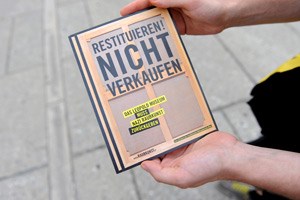
"Protestaktion vor dem Leopold Museum: 'Restituieren!'",  22 Jun 2011
Source: Der Standard
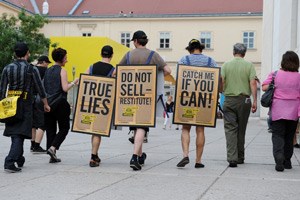
"Protestaktion vor dem Leopold Museum: 'Restituieren!'", 22 Jun 2011
Source: Der Standard
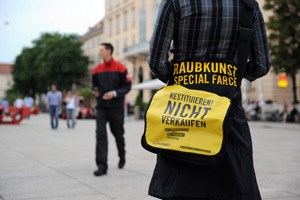
"Protestaktion vor dem Leopold Museum: 'Restituieren!'", 22 Jun 2011
Source: Der Standard
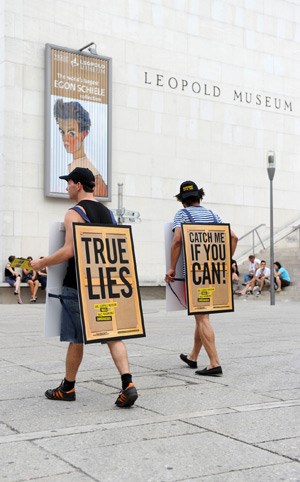
"Protestaktion vor dem Leopold Museum: 'Restitueren!'", 22 Jun 2011
Source: Der Standard

09 April 2011

ERR database—Frederic Unger collection (U)

by Marc Masurovsky

I went over the items seized by the ERR from Frederic Unger, an Austrian citizen from Vienna who had left his home town in the wake of the Anschluss in late 1938 and headed to Paris, France. He had shipped his liftvans to a storage facility on the outskirts of the French capital and from there had emigrated to the United States. The liftvans never crossed the Atlantic Ocean. They remained in Paris, held hostage by the war effort. Eventually, the German Army rolled into France like in a wad of butter and by mid-June 1940, half of France was occupied as was all of Belgium and Holland.

The ERR seized the liftvans and removed their contents.

The contents of the liftvans arrived at the Jeu de Paume at some point in 1942 and some--not all--were inventoried in October 1942.

The ERR staff at the Jeu de Paume dutifully typed up a set of 44 cards which describe mostly paintings and works on paper seized from Mr. Unger's crates.

As I perused through the items, I realized that there were gaps in the numerical sequence established by the ERR personnel. I checked the inventories against the cards and noted the gaps in the sequences.

There were 6 items that the ERR had not carded. Half of them were designated as 'vernichtet' or slated for destruction including a work that he or one of his kin had penned. Whether or not they were destroyed, I know not.

Many of Mr. Unger's items were eventually shipped to a castle in the former Czechoslovakia in a town called Nikolsburg or Mikulov for our Czech friends. The town of Nikolsburg had been annexed by the Nazis and incorporated into the Reich. The castle, as it should, stood on a hill overlooking the city. It was designated as a depot by the ERR leadership in Berlin to store many items stolen in France from Jews and others as well as items from Belgium. Trainloads of crates reached Nikolsburg from France and Belgium from the fall of 1943 to the spring of 1944. Mr. Unger's paintings and works on paper were shipped from Paris on November 15, 1943.

Out of that group, some Unger items found their way to a castle in Bavaria called Neuschwanstein which served as one of the ERR's oldest and most important depots for French Jewish confiscated collections. Neuschwanstein is the famous castle built by mad King Ludwig II of Bavaria.

I had to re-adjust the information on Frederic Unger's collection to note that about one-third of his items had not reached Neuschwanstein before American troops discovered a small number of crates marked 'Unger' or 'U' together with thousands of other looted objects. They were all eventually shipped through Munich to Paris to be returned to their rightful owners. The present location of the missing items remains unknown. As a result, the database shows them as not having been restituted.

The final exercise for Mr. Unger's property will involve cross-checking his restitution records with information in the database so as to indicate precisely which items were returned to him and on what date. The most complex aspect of this task will involve those items that were sent to the Jeu de Paume by the ERR but were neither carded nor inventoried. All we have are crate numbers and descriptions but we don't know for certain whether they in fact transited through the Jeu de Paume Museum, the main triage and selection facility for looted art in downtown Paris between October 1940 and August 1944.

For more details, go to http://www.errproject.org/jeudepaume.