Showing posts with label Lincoln Kirstein. Show all posts

10 June 2014

The Real Monuments Men—and Women

by Elizabeth Karlsgodt, Associate Professor of History, University of Denver
Elizabeth Karlsgodt
Source: University of Denver,
Arts Humanities & Social Sciences


George Clooney’s latest film, The Monuments Men, offers audiences an action-packed adventure set in Europe during the final days of World War II. The film is based on the true story of American and European art experts who became officers in the Monuments, Fine Arts and Archives (MFAA) section of Allied forces and recovered several million cultural objects from castles and salt mines that had become Nazi art repositories. It is a feel-good saga about American heroes who outsmart Hitler, the ultimate villain. The actual history of the Monuments Men is riveting in its own right, but without the happy Hollywood ending.

Franklin Roosevelt charged the MFAA officers with protecting European cultural heritage from the ravages of war. They initially focused on preserving churches, palaces and other historic buildings but ended up recovering the art found in Nazi caches as the Allies moved into Reich territory. The repositories held objects evacuated from museums in the Third Reich and stolen from German-occupied territories across the continent, such as Belgium’s famed Ghent altarpiece and the Bruges Madonna by Michelangelo. Most tragically, the Nazis had plundered much of the loot from Jewish art collectors across Europe, while agents working for Hitler, Göring and other Party leaders had bought thousands of pieces relinquished by Jews under duress.

Madonna, by Michelangelo 
In Clooney and Heslov’s version of events, the Monuments Men race against time as the Third Reich is crumbling, trying to find art repositories before the Nazis destroy the hidden treasures. The Nazis, the story goes, would rather obliterate masterpieces than let them fall into Allied—especially Soviet—hands. The Germans are implementing Hitler’s Nero Decree of March 19, 1945, which ordered the demolition of infrastructure that could be useful to the Allies—railways, bridges, factories. In the film, the Germans include works of art as potential enemy assets and systematically burn paintings in the Heilbronn salt mine as the Monuments Men race through Germany to stop them.

In reality, Minister of Armaments Albert Speer largely thwarted implementation of the Nero Decree and the Germans did not carry out an eleventh-hour demolition of looted art. In Berlin and Paris, they had burned thousands of paintings they considered “degenerate”—Cubist, Surrealist, and Expressionist works they considered harmful to the Aryan mind and spirit—but they did not methodically destroy art they valued. On the contrary, Hitler aimed to preserve all the art the Nazis had accumulated, using it to glorify himself and the Third Reich.

Why would Hitler, the man who had wrought such destruction across an entire continent, preserve art? He was building the world’s greatest museum in his childhood hometown of Linz, Austria. His planned display of the continent’s masterpieces would symbolize his military power, much as Napoleon had done with the Louvre collection before him. Hitler’s last will and testament written the day before his suicide states that all works of art in his possession should go to the Linz museum: “It is my most sincere wish that this bequest be duly executed.” His drive to preserve fine art, however, was directly connected to the Nazi destruction of people who had owned it. Seizing and profiting from Jewish assets, including artworks, was central to the Nazi Final Solution.

It is true that Hitler ended up endangering the seized works of art by issuing the Nero Decree and feeding a climate of fear and uncertainty among German leaders as Allied forces advanced into Reich territory. In Austria, the fanatical Gauleiter August Eigruber intended to carry out Hitler’s orders and placed explosives inside the Alt Aussee salt mine, repository for 6500 works of art, including the Belgian treasures and works from Vienna museums. In early May 1945, Austrian mine officials received authorization from SS officer Ernst Kaltenbrunner to seal the mine and protect the art inside. Two MFAA members in the Third U.S. Army, Pfc. Lincoln Kirstein and Captain Robert Posey, arrived at the mine on May 16, 1945, a week after V-E Day, and oversaw work by Austrian miners to dig through the rubble and regain access to the mine, locating the cultural treasures.

In the film, we see the Monuments Men organized into a platoon. They survive boot camp in England together, land on the Normandy beaches, and develop a sense of camaraderie in their hunt for looted art. But such a platoon never existed. Instead, the military command scattered cultural officers across Allied armies and they most often worked alone or with one partner, meeting occasionally to share information and avoid duplicating efforts.

The challenge of working in isolation is illustrated by the work of Lieutenant James Rorimer, future director of the Metropolitan Museum of Art in New York and the inspiration for Matt Damon’s character, James Granger. A curator at the Cloisters Museum in civilian life, Rorimer landed with French troops at Utah Beach on August 3, 1944, two months after D-Day. He immediately began surveying the damage to churches and other historic buildings nearby, documenting in painstaking detail the destruction inflicted by German and Allied bombing.

While maintaining contact with superior officers, Rorimer mostly worked alone in Normandy, without a vehicle or assistant. Determined to inspect damage at the grandiose medieval abbey of Mont Saint Michel, he hitched rides on Allied military vehicles and with French civilians. When those vehicles veered from his destination, he walked. Alone. One Air Corps MP Captain suspected he was a German spy, incredulous that a U.S. officer would travel in Normandy without his own transportation. Rorimer and his MFAA colleagues used cunning and imagination to make up for the dearth in personnel, equipment and preservation supplies. Fogg Museum preservationist George Stout, the inspiration for Clooney’s character, managed to secure a beat up German Army Volkswagen without a roof, and New York architect Bancel LaFarge, after weeks of hitchhiking and walking, procured a small British car to navigate country roads.

The terminology “Monuments Men” itself elides a rich part of this history: the role played by remarkable women. One was Rose Valland, a French museum official who inspired the Claire Simone character in the film, played by Cate Blanchett. In the film, Simone shows Granger the extent of Nazi looting by taking him to Paris warehouses filled with everyday objects plundered from Jewish homes, much as Valland did with Rorimer in December 1944. Romantic tension between the film characters is pure Hollywood invention, but in real life the two were a powerful team, as Rorimer used Valland’s records of Nazi art looting to track down the treasures of France stashed in Neuschwanstein castle and other repositories. Valland later became a Captain in the French Army and from 1945 to 1953 worked in Germany to help return the collected art to countries of origin. A recipient of the Resistance Medal, the French Legion of Honor, and the U.S. Presidential Medal of Freedom, she remains one of the most decorated women in French history.
Rose Valland at the Jeu de Paume


Edsel’s non-profit foundation includes Valland and several other women on its list of more than three hundred “Monuments Men” from thirteen countries. Among them was Captain Edith Standen, a Canadian-born art expert who became a U.S. citizen in 1942, joined the Women’s Army Corps, and in June 1945 became director of the Wiesbaden central collecting point. Ardelia Hall was a cultural officer at the U.S. State Department from 1946 to 1962 and worked tirelessly to promote restitution of looted art to rightful—mostly Jewish—owners.

The Monuments Men should be seen as an entertaining entry to a far more complicated history embedded in the Holocaust. The recent international controversy surrounding the revelation of Cornelius Gurlitt’s art hoard in Munich shows how difficult the work of restitution remains. In the chaotic postwar years, restitution was defined in national terms, to countries of origin that would determine rightful owners, despite the fundamentally international nature of the art market. Over the past seventy years, works seized from Jewish collections or sold under duress during the Nazi era have been resold across territories with varying statutes of limitation for illicit trade, even within the United States. For this reason, the central mission of many Monuments Men and women, restitution to rightful owners, is not yet accomplished.

09 June 2014

Belated open letter to the "New Republic"

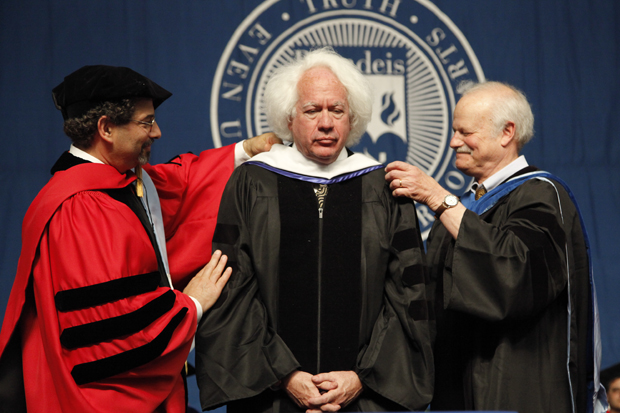
Leon Wieseltier, Literary Editor of The New Republic, Source: Brandeis University
by Marc J. Masurovsky

Why did it take so long for the "New Republic" to write about cultural plunder and restitution of looted art? Is it really because of the incongruous convergence of the so-called “Gurlitt Affair” and the global release of that “trashy and supercilious film”—the Monuments Men? Or put differently, why the silence for so many decades despite the fact that “restitution [is] as much as the next child of the dispossessed”? There are probably no easy answers to those questions and perhaps they are best left alone. Still...

“The obsession with restitution” is an obsession with justice, as exemplified by restitution of lost cultural assets, those items, those objects, those artifacts, regardless of value or museum worthiness, those parts of ourselves that serve as our extensions and our means of expressing non-verbally our deepest sentiments, longings, loves, and aspirations.

It is not just about Fragonard, Bellini, Tintoretto, van Dyck, Rembrandt, Leonardo and countless other “masters”. It is not just about the finest silver and the finest gold and the finest stones set in the finest settings. It is not about those rarest of rarest of books and incunabulae, or textiles carefully woven with the most precious fabrics for that most precious person. Actually, we are talking about something that makes you and I and our friends, our children, our relatives, and those around us whom we do not know, it is what makes us human, it is about culture. And culture is what Hitler and his henchmen and collaborators across Europe sought to uproot wherever it was deemed to be “Jewish” and “degenerate”, in order to substitute something clean, tasteful, that was Judenrein.

A crime against humanity.

In order to proceed with the uprooting of culture and the mass of objects encapsulated under that moniker, Hitler’s henchmen and collaborators across Europe committed an act of genocide. That makes Hildebrand Gurlitt, Cornelius Gurlitt’s father, an accessory to genocide, together with all other art dealers, collectors, museum officials and curators, art historians, auctioneers, and appraisers who found opportunity in State-sanctioned mass displacement of property that accompanied the slaughter of millions.

The dispossessed lost their homes, their property, their sense of self, the beauty around them was extinguished and they were only left to wonder why such horrors had befallen them.

There exists a significant emotional and spiritual linkage between people of all ages and backgrounds and ethnicities and creeds and the objects that surround them, that populate their lives. It could be a candelabra, it could be an incense burner, it could also be a small drawing by Edgar Degas, or a satirical piece by Georg Grosz or even a surrealistic painting by Felix Nussbaum, or a ditty scrawled on a napkin. It doesn’t matter what it is; it is the meaning that it embodies which is precious to us all. The crime consists in rending that object from our bosom, as if part of our soul had been ripped to shreds, and for what? For being Jewish, for being “different”? for being “unacceptable”? “undesirable”?

We certainly do not place objects above people. We place objects in the constellation of people, much like satellites circling planets. And when the satellite leaves its orbit, all hell breaks loose and we are released into the wilderness of space, aimless.

Fighting for restitution does not weaken our loss, it acts as a vital reminder of the world that was consumed in flames and gas, not completely, but almost. Obtaining restitution is but a small step to establish the cardinal principle that justice does exist and that with resolve and perseverance and belief in ourselves and in our kin and in higher principles, even if the outcome is hopeless much like it was for those young fighters in the Warsaw Ghetto, my personal heroes, we can assert the value of justice and reaffirm our right to exist while honoring the loss of those who came before us and cannot be with us due to a crime against humanity.

For myself, I am the single child of two artists, two artists who sought out the famed “School of Paris” and bought a one-way boat ticket from New York to experience it all in the City of Lights, poor as could be, rich as could be. Miserable but filled with the soul and spirit of what they embraced and lived—art and culture. Breathing it, in and out, every day, as pure as the driven snow, which drove them into the ground, because, as you know, the art market is unforgiving, cruel, and indifferent to human plight. By the way, Lincoln Kirstein and his ilk are part and parcel of that market, that cultured elite which enjoys driving artists into the ground in the name of Kultur. I make no apologies for being so fiendish and cynical but that is the cold reality that artists must endure. By extension, the “Monuments Men” would not have given the time of day to most artists incinerated in the Nazi apocalypse. Sad but true.

Where are we now? Most people think that the excitement today is about money. It always has been. People are what they are. A cheap headline always includes money. Journalists do not write about a restituted collection if the word “million” is not included in the header. That state of affairs comes from ignorance and intellectual opportunism, the flip side of “pornographic journalism.” It is no different today than it was in the 1930s and 1940s and 1950s. Yes, it is true that high-priced restitutions are good for the art market. There is a certain twisted logic in the way that the press, comforted by today’s elites, creates a perverse and distorted linkage between the restitution of looted art and the staggering values derived from those objects that have been returned to rightful owners. As if the only objects that were stolen by the Nazis were of museum quality and affordable only to the 1 per cent. Let's not forget that the 99 per cent are ignored by the press and whose clamor for justice is never heeded? Why then claimants to give up and simply “remember"?

Once again, it is not just about Gustav Klimt or Egon Schiele. It is about those thousands of artistic minds and creative spirits from dozens of nations who produced all kinds of works, in all sorts of media, as extensions of their spirit. It is up to us to appreciate them or ignore them, but their sum constitutes our cultural and artistic patrimony, like it or not. As to your quip about rescuing a piece by Damien Hirst, he occupies a space in our culture, even if we do agree here that his work might not be worth saving. But, if I did not save Hirst, why should anyone save my parents’ works? Who am I to judge what is worth saving and what is worth abandoning to a hellfire? Such flawed reasoning puts us square in the lap of the Monuments Men whose mission was to rescue the “cultural treasures” of Western civilization, worshipped in countless museum studies programs, institutes of art, and revered temples of culture, at the expense of the lesser-known, the lower tiers of cultural and artistic output. Cost-benefit analysis correlates with the rarefied air of high-priced recoveries and restitution of stolen art.