Showing posts with label France. Show all posts

15 September 2023

A brief introduction to smuggling looted assets into Spain

bt Marc Masurovsky
France and the demarcation line (1940-1942)

During the German occupation of Western Europe (1940-1945), one of the major activities of the occupying forces and their local collaborators was plunder, looting, outright theft of Jewish-owned property, regardless of its form and shape, from residential and commercial property deeds to industrial know-how (patents, licenses, royalty agreements and trademarks), to financial instruments (stocks, bonds, shares) to artistic, cultural and religious objects. Let’s not forget those highly fungible precious stones and metals.

Regardless of the motivations for these wanton acts of thievery perpetrated on an industrial scale against their victims, the idea of monetizing this stolen property was high up on the looters’ priority list. An infrastructural web of connections was carefully woven, often aided by local and national police officials, fueled by pre-war business and political relationships, to allow for these transactions to take place for the benefit of the Reich and its collaborators. Oftentimes, this plundered moveable property was ferried across borders into neighboring countries that acted either as end points or transit centers for this property to move even further. Think Western Hemisphere, the Americas-North, Central, and South, and especially the islands lying between the Gulf of Mexico and the northern edge of South America.

In the case of thefts committed in the Netherlands, Belgium, and France, looters looked to the south to sell off or “dump” their loot. Precious stones looted from Dutch and Belgian Jews were very easily transported and promised lucrative payoffs. An exception: many works of art looted traveled to Germany and other “Germanophile” markets to be incorporated into museum collections or sold at auction. Otherwise, paintings and other works of art were taken through Belgium and France into Spain, Switzerland or Italy. The main way station for this movement was Paris, which behaved as an international turnstile based on connections between dealers, collectors, art world officials, intelligence agents and the like. These works would find their way to Swiss cities and banks or make their way further south across the Pyrenees [Pyrénées] mountains into northern Spain.

The literature on the role of Switzerland as an endpoint for looted art is ample. From the earliest cases of Nazi thefts of Jewish assets, looted goods were sent to Switzerland from Germany (gold, jewelry, cash, securities, etc.). After the Anschluss in Austria in March 1938, a similar movement was observed from Austria into Switzerland. Likewise, Switzerland has served as a haven for Italian Fascists to deposit their ill-gotten assets in Swiss banks and estates. The passage of the Bank Secrecy Act in the mid-1930s secured complete confidentiality for foreign depositors transferring assets to Swiss institutions. 

By contrast, Spain and Portugal, but mostly Spain, have been largely ignored as loci of such activity. We’ve heard of Axis war criminals, collaborators of all stripes and shades, making their way into Axis-friendly Spain governed by the iron fist of "Generalisimo" (General) Francisco Franco and his Falange. These fugitives sought protection and shelter from prosecution and the wrath of the victorious Allied forces and national Resistance movements desirous to get their hands on these criminals and bring them to justice. 

What did these people carry with them? Little is known aside from well-documented cases like Alois Miedl, Goering’s personal banker and art agent in the Netherlands who almost single-handedly aryanized the famed Goudstikker collection. Lesser-known players have been largely ignored by the historical field. They turned out to be far more effective than Miedl to ferry looted goods into Spain. Still, it might be eventually worth taking a closer look at the Miedl case because he tapped into multiple networks of criminal gangs to ensure his flight to safety. In other words, even someone as important as Miedl was forced to rely on underworld figures and torturers to get across the Franco-Spanish border with his Dutch loot.

In the last years of the Second World War, southwestern France—an area bounded to the north by Bordeaux, and to the East by Montpellier and to the South by the Pyrenees, had been teeming with French fascists, criminal elements who were making their way to Spain. Nazi security agents, Italian and Spanish fascists worked side by side with Nazis and French fascists. In the midst of this beehive of terror and persecution, Allied agents together with Resistance elements did their best to provide some solace to refugees and victims seeking to make their way to Spain and to evade the dragnets established by local collaborators. They set up, at great risk, clandestine chains through which refugees and anti-Nazi militants could flee to relative safety. It was better to spend time in a refugee camp inside Spain than a jail cell run by Gestapo and Milice agents “up north.”
Southwestern France

In setting up these chains, it was critical to know which village, which hill, which crossroads were safe for travel away from prying eyes. Was the mayor in cahoots with the enemy? How about the local police? The priest? The judicial authorities? The baker? Not knowing was the bane of the victims and their protectors—resistance fighters and Allied agents. As you can imagine, many clandestine operatives were unmasked and arrested. Their resilience and persistence eventually saved many lives. How did one get across a porous border where no one could be trusted? As you can imagine, the odds favored the perpetrators by a long shot.

Smuggling goods and people across the border was a profitable way of life on both sides of the Pyrenees. Entire hamlets supplemented their meager resources with these clandestine acts. As long as there was an exchange of money, locals were at your service, as long as the risk could be mitigated. Knowing this, it was not very difficult for fleeing war criminals, underworld figures, intelligence agents, and economic collaborators to make full use of the “friendly” atmosphere that reigned all along the French and Spanish sides of the Pyrenees, viz., the Basque and Catalan regions, Navarre and Aragon, separated by a mountain chain. One still had to be careful with whom one did business and in whom one put one’s trust because he/she could turn on a dime, or a franc, or a peseta, and your luck would end there. As a general rule, you were in far more trouble if you were caught on the north side of the border than on the south side. Lastly, the political reliability of the individuals running these smuggling chains ensured the temporary safety of their clients, long enough to get them to a secure area.

To be continued….

Updated on 13 November 2024
Reviewed and edited by Maria Ruigomez Eraso

22 November 2019

Diplomatic highs and lows in Paris

by Marc Masurovsky

Ambassador Stuart Eizenstat, special envoy on Holocaust affairs for the US Department of State, was one of the most prominent speakers at the 20th anniversary colloquium of the CIVS in Paris on November 15, 2019.

The main point person since the Clinton era on matters pertaining to Holocaust-era claims, Mr. Eizenstat delivered an unusual speech regarding looted art, restitution, France’s treatment of looted art in State collections, and his own legacy.

From year to year, the Eizenstat narrative on looted art and restitution has morphed and been rewritten, not for stylistic reasons but perhaps because Mr. Eizenstat has had a decades-long love/hate relationship with the whole idea of restituting art objects to plundered victims of the Nazis. And he simply does not know how to address it. After all, you cannot package art the way you bundle insurance policies, gold bars and coins, bank accounts and so forth, something that he excels at, which has yielded billions of dollars worth of settlements for Jewish victims and their families. For that reason alone, Mr. Eizenstat's legacy as a reliable and devoted advocate and champion of Holocaust victims' rights is uncontested and admirable.

Here are some of his many statements which were oftentimes punctuated by occasional spurts of ire:

-“France is going from being a laggard to being a leader” on questions of art restitution. That elicited some giggles including from Mr. Eizenstat who appeared pleased by his joke which was not really a joke.

-The CIVS conference symbolized “our last opportunity”. Let’s recall that the Prague Conference on Holocaust-era Assets in June 2009 was also “our last opportunity.”

He reminded us of his infinite capacity to repeat “fake news” about cultural losses during WWII. Unverified, the numbers put forth by Eizenstat are the same ones he has repeated since 1998.
According to him, 600000 paintings were looted during WWII, of which 100000 are still missing. In 1997, Philip Saunders of Trace database had made this unfounded assertion.  (Mr. Eizenstat went on record with those numbers in 2006). The Polish government alone claims that half a million cultural objects were removed from its territory during WWII. Which irresponsible historian or advocacy group came up with these fictitious numbers? Not even the Monuments Men could be bothered to audit the cultural losses of each nation victim of Nazi aggression. The more accurate estimates situate cultural losses in the millions.

Speaking of the Monuments Men, Mr. Eizenstat delivered a paean in their honor, citing their bravery and courage (smoking pipes and sporting tweeds) in Munich and Wiesbaden, while recovering 5 million works of art! No kidding! He forgot to mention that this figure mostly accounts for books, decorative objects and State-owned art. Not much room left for Jews, is there? Moreover, 5 million might be just a tad exaggerated. But who’s counting? You get the idea. Lots of looted stuff was repatriated to countries of origin.

Mr. Eizenstat was on a roll. He posited that it was impossible to identify owners at the end of the war. If so, how did so many objects get returned? The heirless asset problem must be staggering.

Let us now enter fantasy land. In December 1997, Mr. Eizenstat came up with the brilliant idea for a conference on looted art or so he says. That’s really strange because he was firmly opposed to the inclusion of looted art in any international convening dealing with assets during the Holocaust. It was the seizure of the two Schiele paintings at the Museum of Modern Art in January 1998 that provoked the inclusion of looted art in what became the Washington Conference on Holocaust-era Assets.

Speaking of the 1998 conference, Mr. Eizenstat, since November 2018, has changed his tone regarding the 11 Washington Principles that he penned which were supposed to frame an international strategy to identify looted art in public collections (not private) and suggest ways for victims to settle their grievances with current possessors.

Well, as it turns out, these non-binding Principles were mostly based on a set of guidelines developed by American museums earlier in 1998 when faced with mounting criticism over their indifference to the presence of stolen objects in their collections. A funny way of helping claimants by seeking inspiration from the very institutions that are firmly opposed to any form of restitution.

Mr. Eizenstat went on to honor the Association of Art Museum Directors (AAMD) for setting up a task force to address the question of looted art in their collections. To that end, the AAMD issued a set of guidelines in June 1998 which served as the benchmark for the Washington Principles, of which Mr. Eizenstat is the uncontested author.

Mr. Eizenstat proffered adoring words for Philippe de Montebello. The flamboyant former director of the Metropolitan Museum of Art was a fierce opponent of restitution but a very savvy museum official who understood the value of pre-emptive strikes on issues of looted art and artifacts. To wit, he promoted the drawing up of guidelines for American museums to follow when confronted with objects in their collections that might be of dubious provenance and negotiated creative settlements with the Italian government over the presence of looted antiquities in the Met’s collections.

Mr. Eizenstat was particularly combative in upholding his legacy and defending his record against critics who have blasted him for “doing nothing” and uttering mere “words.”

Seizing the opportunity in a fiery tone, he shared a long list of recommendations and critiques in Uzi-like fashion. It was hard to keep up. Some of the more notable ones follow:

1/ he denounced the impossibility of de-accessioning restitutable objects from French museums as “a French problem.”

2/ He went on to skewer Dutch museums for having reneged on their commitment to the Washington Principles by equating the cohesiveness of their collections with the interests of Holocaust claimants—the notorious “balance of interest” doctrine approved by Dutch museums in 2016? Verify.

3/ he denounced the German Limbach commission and its 15 cases in 15 years.

4/ Once again, he congratulated the Metropolitan Museum and the Boston Museum of Fine Arts for showing the way on how to handle looted objects in their collections.

5/ Quoting the AAMD and the AAM, he observed that the NEPIP portal was worthless and “outmoded”, in other words, unusable.

6/ He criticized US museums for being so aggressive towards claimants by resorting to technical legal defenses in order to dismiss their claims.

7/ He applauded the HEAR Act as the antidote to summary judgments petitioned by museum lawyers against claimants, whether meritorious or not.

8/ He thinks highly of the JUST Act which requires countries to publish annual reports on the state of restitution in their midst.

9/ he took partial credit for launching “provenance research as a new profession.” As if it was not performed prior to 1998.

10/ He congratulated France for acting as a coordinator between the five standing restitution committees.

Then, Mr. Eizenstat pulled out his foggy crystal ball and peered inside it, noting:

1/ Forced sales and flight sales (fluchtgut) are to be included as part of the Washington Principles (the former are mentioned explicitly in the Terezin Declaration and the latter are suggested implicitly therein);

2/ provenance research is expensive and requires resources.

3/ Public museums should publish on the Internet a detailed provenance for all of their objects.

4/ research should be conducted in all museums—private and public.

5/ De-accession laws need to be changed in order to accommodate restitution of looted objects.

6/ The Washington Principles apply to private collections

7/ Every country should designate a point of reference for claimants

8/ there should be no time limits on claims.

9/ he denounced the European Union as being “behind the curve.”

10/ with regards to so-called heirless assets, Eizenstat reiterated the need for “just and fair solutions” which amount to selling off these unclaimed assets after giving research one more try. Meanwhile, the institutions holding such objects should educate their public about how they ended up in their collections. As an aside, Eizenstat lauded the Austrian solution to the heirless assets question, embodied in the National Fund run by Hannah Lessing. In short, if Austrian federal museums identify objects in their midst for which there are no identifiable owners, they are transferred to the National Fund which follows up with its own research and posts the objects on its website. After a period of time has elapsed, the Fund sets aside those objects for sale, the proceeds of which are disbursed amongst needy families of survivors. Ms. Lessing begged to differ during the question and answer period.

That was enough for one day.

18 October 2017

Different shades of recovery

by Marc Masurovsky

The process of recovery of looted cultural, artistic and religious objects is daunting for several reasons:

If action is not taken right away to recover a looted object, it becomes exponentially difficult to identify its current location. In the case of losses during the Third Reich, “recovery” was an absurd notion since the perpetrators of the thefts controlled the reins of political, legal, and economic power. Hence, the process of tracing the object could only occur after a regime change and with rules in place that would facilitate such searches. Moreover, if the works confiscated or plundered by the Nazi regime ended up in neighboring countries, what rights did the claimants have to recover such works, since Nazi Germany was a recognized nation in the community of nations, for better or for worse? What rights do they have now? Since most of the domestic losses suffered by Jews living in Germany were State-sponsored, there was no mechanism in place in other nations to deem the actions of the Nazi state illegal and the confiscated property subject to restitution. Therefore, if you lost your property in 1934 and if you survived all of the subsequent events provoked by the Nazis’ fury against the Jews and others, you would have to wait for at least 12 years to assert a claim of restitution.

If your missing object is located in the hands of a new owner, regardless of how that person or institution acquired the victims’ property, the laws governing property rights and title to “legally acquired” property prevent the plundered owner from obtaining restitution of his/her looted property without going through a complex tangle of legal and political maneuvers. In the absence of explicit mechanisms put in place by the national governments of nations where such looted objects have ended up, it is extremely difficult, if not impossible, to recover them. This state of affairs endures to this day and has been a continual source of frustration for victims of plunder with minimal accommodations made by governments and courts to facilitate the process of recovery.

If the looted object is declared part of the cultural patrimony of the nation from where it ended up, the recovery process involves a direct negotiation with that nation’s government, a very laborious discussion which usually ends in utter failure. What is the word of a dispossessed Jewish owner against that of an official who upholds the notion of cultural patrimony and inalienability of art objects located in State collections, whether those objects were looted during genocidal acts? Culpable countries hiding behind such imperialistic arguments are: France, Germany, Belgium, the Netherlands, Spain, Italy, to cite the worst, Eastern European nations, all of the nations that once formed the Soviet Union.

When source nations seek the return of their looted patrimony which usually consists of antiquities illegally extracted from archaeological sites or illegally removed from religious and other sacred edifices, the wait can last for an eternity; it can also be circumscribed to anywhere from a year to several decades if the aggrieved nation is willing to compromise, accept trade offs like offer commercial advantages to the withholding nation, or agree to symbolic returns with a promise never to come back and ask for anymore as in the case of South Korea and the shabby treatment it received from France over a set of priceless manuscripts.

Aggrieved source nations include but are not limited to Greece, Turkey, Italy, South Korea, China, Egypt, Nigeria, Mali.

In other words, we have not made much progress in the past several decades. As provenance continues to become optional in art market transactions and most nations do not encourage their cultural institutions to be more forthcoming in publicizing the history of the objects that are part of their “patrimony,” nothing short of a cultural revolution will sway them to change course and become, god forbid, ethical.


25 October 2016

The domino effect


by Marc Masurovsky

In its most basic form, the domino effect is an uncontrollable chain reaction, an irreversible sequence of events brought about by one well-placed flick against a tile, which tumbles the neighboring tile, and then another tile, and then another tile, in a long line of domino tiles until the entire deck is down. Some of these “domino effects” make for fun, easy-to-produce effects. Many of us have tried them at least once to everyone’s delight.

Now apply the same idea to countries. The last time the domino effect was seriously invoked, it was in the form of a threat. American politicians and senior military officers used it to justify a hardline approach in Indochina against the “communist threat.” If one country “went” communist, the rest would fall. Here, the domino was South Vietnam. The other tiles were Laos and Cambodia, and then, who knows? Thailand? India? The “domino effect” was an integral component of the Cold War.
The domino theory in Southeast Asia

Let’s now turn our attention to the museum world. In order for the domino effect to work in the museum world, one needs a critical mass of cultural institutions predisposed to lean in one direction or another. In our case, the domino unit is “restitution”, the “return” of looted cultural assets to rightful owners, be they individuals, communities, tribes or source nations. For there to be a domino effect in the museum world, there needs to be a restitution, a repatriation which “tips the scales” in a way that paves the way for similar returns by other institutions and provokes a generalized onrush of claims that will ultimately provoke more returns, more repatriations, instability in the management of collections, loss of equilibrium in negotiations of loans with source nations, impending chaos, the end of the world as we know it.

Believe it or not, museum leaders and nations whose cultural institutions harbor looted cultural property have invoked the “domino effect” either to prevent restitutions or to isolate restitutions as unique cases which cannot be repeated, fearing that, if such restrictions are not imposed in a settlement, more claims will be filed and a generalized disgorgement of looted objects would ensue in favor of the aggrieved nations. As you know, that simply cannot happen.
The Wrestler from Koh Ker

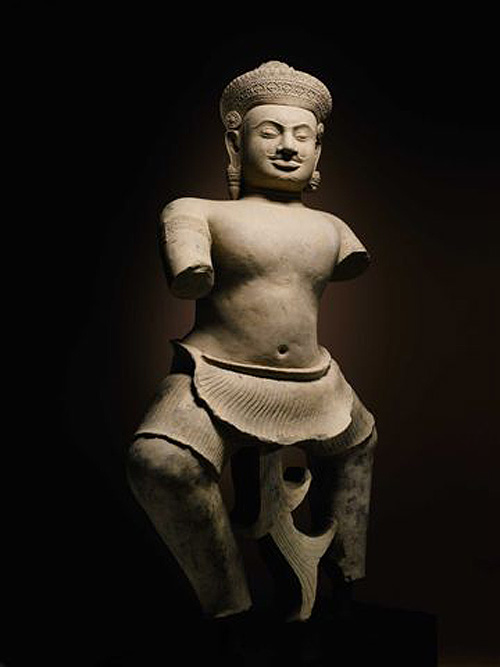
The repatriation of the Koh Ker statues to Cambodia, it is argued, triggered a minor “domino effect” or a “breaking of the dam.” After Cambodia had won its case against Sotheby’s in December 2013, the matter could have been isolated to that one return. But there were many more statues located in different cultural institutions throughout the United States. The Metropolitan Museum of Art followed suit and agreed to return its two statues, followed by a return from Christie’s and the Norton Simon Museum in Pasadena, CA.  So did the Cleveland Museum of Art.

It is presumed that many more statues are located in European collections. Hence, the domino effect remained confined to the United States.

In the case of the Parthenon marbles, Michael Repps infers that the obstinacy of the British Museum to hold on to the marbles claimed by Greece constitutes a guarantee that, like Tom Thumb removing his digits from a hole in the proverbial dam thus causing the inevitable flood of the low lands, an unconditional surrender to Greece propelling the return of the marbles to their new home at the Acropolis Museum in Athens would trigger an irreversible chain of events, a domino effect, leading to uncontrolled disgorgement of cultural objects and their repatriation to aggrieved source. The counter argument is offered in a master’s law thesis entitled “What’s yours is mine—Indeterminacy in cultural property restitution debate” which was submitted to the University of Helsinki in 2014, by Pauno Soirila. In it, Soirila argues that the “domino effect’” threat is a non-argument since each restitution case is viewed as a unique case and should not cause such a massive disgorgement as threatened by some in the museum world and cultural officials in recipient nations. 
Parthenon Marbles on view at the British Museum, London
An unusual twist to the repatriation/domino effect dyad refers to the hypothetical “devolution” of Wales and Scotland which might provoke a deluge of repatriation requests against “English” museums that would gut them of significant numbers of objects. Hence, in a twist of irony, the threat of falling dominos may not come from those “nationalist” source nations which selfishly demand their looted property back, but rather from insurgent regionalist movements plaguing the halls of power in London. How fitting!

So, what’s all the hullaballoo about with all of these dominos falling and the world of museums as we know it collapsing around us because of incessant claims for return of looted cultural property to source nations and tribal communities?

In true fashion, France embodies the worst of the anti-restitution movement, whereby objects, as a rule, do not leave State-controlled museums under any circumstances. Once in, there is no conceivable exit. The principle of inviolability reigns over the management of cultural objects in French museums, regardless of provenance and origin.

In the case of the Oekyujanggak Royal Manuscripts which South Korea claimed, the French government rejected the Korean repatriation claim. Granted, the case was complicated. The French navy had stolen these sacred royal documents in 1866 presumably in retaliation for the deaths of nine Catholic priests. [This bears strange similarities to the punitive confiscation of bronzes in Benin  in 1897 as a retaliatory act by British colonial troops].

These manuscripts were rediscovered in 1975 at the “Bibliothèque nationale” in Paris. 
Sample pages from the Oekyujanggak Manuscripts

The idea of recovering these manuscripts first was discussed in 1991 by scholars at Seoul National University. South Korea filed a formal request for restitution in 1993. The claim quickly became entangled in larger trade issues between South Korea and France involving high-speed train contracts. [A similar entanglement occurred in the United States which linked high-speed train contracts between France and the United States to pending Holocaust-era claims against French railroads.] The discussion between the two nations evolved into a possible exchange through loans of artifacts of equal worth between the two nations.

As Professor Keun-Gwan Lee of Seoul National University rightfully asked during the ICECP conference held in Gyeongju on October 18-20, 2016, which law should be applied: the 1866 law or the 2011 law?

Regardless of what law applied, France invoked the “domino theory” and felt that an unconditional return of the royal manuscripts without any “contrepartie” from South Korea might provoke a generalized gutting of colonial-era plunder from French institutions.

In Korea, opposition built up and voiced against a proposed exchange of similar documents with Fraance, because, the argument went, any exchange or loan would be tantamount to a recognition of the plunderer’s right to good title, enabling nations like France to loot another nation’s treasures and get away with it.

In February 2011, an agreement was signed between France and South Korea outlining the terms under which the royal manuscripts could return to the Korean people. It wasn’t so much a return as a long-term loan renewable every five years. Hence, title remained with the French government while South Korea obtained the equivalent of “custodial rights” over their stolen royal manuscripts.

Furthermore, the French government insisted in Article 4 of the 2011 agreement that:

“The loan of the Uigwe manuscripts by France to Korea is a transaction characterized by its uniqueness, which cannot be replicated under any circumstance and cannot be viewed as setting a precedent…”

In other words, France would never repeat this folly again.

The so-called “domino effect” of repatriation and restitution of looted cultural assets is a convenient, albeit cynical, scarecrow invented by nations with long histories of cultural plunder to atone for and museum boards worldwide which fear the impending, unproven, gutting of their collections by aggrieved source nations should they surrender prized items. It’s unfortunate, however, that source nations should succumb to these idiotic arguments. We can only surmise that larger considerations—trade, politics, geopolitics—have more to do with the compromise settlements that put an end to these restitution claims than simple fears of a scarecrow wafting in the wind in some abandoned corn field.

A scarecrow

10 May 2015

The day after…


by Marc Masurovsky
 
We just commemorated the 70th anniversary of the end of the Second World War, at least that portion of the war being fought on the European continent. It took another three months of heavy fighting, two atomic bombs, and an invasion of Japan to bring the Empire of the Rising Sun to the table and sign an unconditional surrender in mid-August of the same year.

Let’s try and imagine what it must have been like to wake up the day after the surrender of the Reich and to think about all that had occurred since Hitler took power in January 1933.

With 60 million people dead, including six million Jews, men, women and children, five million others who perished in prisons and camps, a third of the male population of the Soviet Union destroyed, one third of Europe’s infrastructure in ruins. Basically a traumatized world. Not a pleasant morning on which to view a sunrise.

Let’s focus on the thefts and displacements of objects. With every act of physical aggression comes a theft especially during military conflicts, civil disorder, and wholesale extermination of one group by another. In this case, the backdrop of a war on culture decreed by National Socialism everywhere Nazis set foot provoked a systematic and systemic displacement of objects from homes, businesses, and public places.

Take a camera with a very wide angle lens and click. The snapshot you record should tell you where objects were located on May 10, 1945.

 In short, it was an utter mess. Displacement meant movement. Objects were removed from their original home and taken somewhere else, never to return again. Liberators, whether military or militia or resistance units, found “things” everywhere they went---barns, attics, basements, gyms, cellars, abandoned apartments and villas and farmhouses, barracks, everywhere someone with a gun showed up, there were objects strewn about or carefully stacked, no matter.


There was no system in place on May 10, 1945 to properly dispose of “found” objects. It was all improvised which led to massive abuses, naturally, like theft.

In most places, objects did not travel very far. They remained within the immediate geographic area and ended up mostly in other people’s homes, which means that those objects were never recovered unless someone denounced you after the war ended, neighbors stealing from their neighbors, communities cannibalizing themselves.

Those objects which traveled far were those taken either by people fleeing one area and getting as far away as possible from the scene of the crime, or by paramilitary or military units, resistance groups on the prowl. In that case, objects could travel long distances, ten, one hundred, even one thousand kilometers or more.

So, on May 10, 1945, you must imagine that most objects that were removed illegally from people’s homes by neighbors, strangers, policemen, thugs, agents, soldiers, officers, either stayed on your street, or moved to another neighborhood, or another city, or another country, ultimately another continent.

On May 10, 1945, Europe was a mess, like an attic through which a tornado had passed and objects blown out and falling wherever.

That is why “things” taken from Western Europe went as far as Kiev, Ukraine.

Soviet counteroffensive, 1943-44

That is why “things” taken out of the Soviet Union went as far as Germany and Austria.

That is why “things” taken out of Norway went “south.”
Norway


“Things” taken out of France went north, east, south, and west.
Northern France
   And so forth and so on.
Axis-occupied Europe
The problem of restitution on May 10, 1945, was a staggering mess with a crime scene engulfing 15 European countries.

Now, let’s finally get to the point.

How many objects were removed?

No number can adequately reflect the reality of the thefts.

But, governments and armies are in the business of releasing information which is supposed to be accepted as “official”, therefore not up for discussion.

When the French government says that 40,000 objects were removed from its territory, it’s because it recovered 40,000 objects from Germany, Austria and other places. Half of those objects presumably went through the Jeu de Paume in downtown Paris. That makes it easier to count. 

On December 1, 1998, American pundits announced that there were 125,000 works of art still missing which needed to be identified, recovered and returned to their rightful owners. No one bothered to ask: How did you come up with that figure?

Then, as recently as this year, another figure was proposed: 600,000 objects were still missing. And yet again, no one bothered to ask where that figure came from and what documents were used to tabulate a figure which had grown more than five-fold in less than two decades.

At the end of the movie, “Woman in Gold” a text appears indicating that there are 100,000 works of art still missing. Already people who have seen the film are quoting that figure as if it is manna from heaven. But here again, where did the filmmakers obtain that figure? Does it apply only to Austria or to Europe as a whole? That figure mysteriously coincides with one put forth by the London-based Art Loss Register (ALR) as the total number of all objects in its registry of stolen objects, including contemporary commercial thefts.

The short answer is: no one knows because no one has bothered to know. Simple. If you don’t bother to know how many objects were stolen, you don’t really have to focus on restitution issues. The missing objects are gone with the wind, just like in the wake of a storm. Poof! Disappeared. It would be simpler to consider WWII and the Holocaust as a natural disaster. It does not work that way. These were nightmares created by human beings against other human beings, a man-made disaster which implies accountability.

If you do come up with a number like 100,000 or 125,000, you might have something in mind. Could it be that those 100,000 works of art are worth something? Could it be that the numbers game is all about value? And not necessarily about individual losses? That the only way to interest someone in restitution is to place a monetary value on an object?

Maybe, for some people, the “restitution game” is just a global treasure hunt where we forget about the “why”, the ”where” and the “how” of the thefts committed in the context of genocide. People hunt for treasures from the Holocaust the same way they look for metal on beaches and dive for gold laying about on the ocean floor. With a little effort, you too can get rich. Or so you think.

Except that we have no idea how to define a “treasure” and, for the most part, we don’t really know what we are looking for, except for objects listed on online databases.

The only way to understand the reality of the thefts that took place across Europe is to collect all relevant information about what disappeared, sift through the evidence, sort it, and catalogue it. This exercise began but was never finished in the years that followed May 9, 1945, perhaps because it took too much time and the chances of finding anything were deemed to be close to zero. So why bother? Instead of recording everything that was lost, the focus was placed on registering losses of “culturally significant” items. No one really defined “culturally significant” except to suggest that the loss of the cultural item meant a loss for the nation. In other words, someone had to decide whether your objects had any “cultural” meaning as determined by the government of your country. That “someone” was usually an art historian, a museum curator or director, or an official in a government ministry. This is where the recording of cultural losses crossed over into cultural policy and esthetics.

If you were unfortunate to have owned objects deemed “insignificant”, chances are that your government was not going to assist you in locating them.

insignificant?

If, on the other hand, there was something “significant” about your collection, the government did take an interest and registered your claim.
significant?
Treasure?
unworthy?

It is difficult to pinpoint the difference between significant and insignificant. If we use French archival records as a point of reference, those containing information about cultural losses as an example, we can begin to understand the difference.

The members of the Art Restitution Commission, Commission de récupération artistique (CRA), were mostly museum curators and art historians. They devised, perhaps through trial and error, a ranking system using different colored pencils and a lettering system from A to H. Each letter stood for a type of object. Many lists of losses submitted by victims were hardly annotated, meaning that there was little chance that the objects that they contained would ever be registered as “worthy” or “significant.” [This question will be explored in greater detail in future articles on plundered art. Stay tuned…]

As an example, the “Répertoire des biens spoliés”, a central registry that the French government published in 1947, can be viewed as a central catalogue of “culturally significant” objects listed as still missing by that date. Similar lists were published in other countries using different formulas and presentation schemes. But the end result was the same: these official lists tended to summarize, encapsulate the universe of what was missing as “significant” and what was being sought by the governments of the nations which had suffered under the Nazi boot.

It’s time to understand, better late than never, that art restitution, the idea of cultural loss, was quickly subverted even before the ink had dried on the act of surrender of the Third Reich. It was not about what you lost but whether what you lost was important enough for the government to take heed of your loss. The principle of restitution was transformed into an arbitrary State-sponsored diktat which implicitly carried a judgment about the quality of your losses and how the government perceived your ownership of cultural assets.

A far cry from being the victim of an act of cultural plunder and genocide.

That explains in part why restitution efforts fell far short of their potential, because they quickly had very little to do with you as an individual victim. The idea of ‘recovery’ was intertwined with the interest of the nation, of the State. When the State decided: enough was enough, it meant that it was no longer interested in promoting location, identification and recovery of objects, even those that were deemed “significant.” It was easier to mourn them as a nation’s loss than to make the effort to “find” them.

The irony of this exercise is that many “mourned” objects ended up sitting in the museums of the nations that “stopped looking for them.” Hypocrisy? Double speak? Or sheer deceit?

So, we are back to where we started: a staggering mess. The only way to solve it is through citizens’ initiatives, publicizing the losses, identifying where lost objects are located especially if they sit in State collections and demanding their return.

It is up to each and everyone of us to document these crimes and to tell their stories, not necessarily for the sake of restitution but to teach a public lesson about the crime of cultural plunder, to restore the word “significant” to its proper context and to assert that an individual’s cultural tastes and losses are not subject to government whims and elitist conceptions of “Kultur.”


07 March 2015

Rwanda: Art in a post-genocide society

by Marc Masurovsky

By all accounts, there is no reason why artistic activity should have even found a haven in a society where half of the minority Tutsi population was hacked, stabbed, impaled, shot, sexually assaulted, enslaved, raped and otherwise martyred by Hutu extremists more than 20 years ago.

Rwanda is a nation whose post-genocide population is afflicted by collective post-traumatic stress disorder (PTSD) of the worst kind, something that is not cured by heavy doses of synthetic drugs which would serve as mere palliatives. As one cynical researcher observed who is very familiar with Rwanda, if you suffer from PTSD, Rwanda will make you feel like you are normal.

View of Kigali
If anything, the process of creating a work of art, an object of art, either two dimensional or three-dimensional, might be viewed more as a therapeutic exercise aimed at exorcising the demons of a genocidal enterprise anchored in neighborhood kinship ties.

And yet…Rwanda has emerged from its own version of hell on earth to become a society desperate to thrive and to show its best side to itself and the world.


Detail, Ivuka Arts Center, Kigali
One example of that miraculous turnabout are the artistic outputs produced largely by self-taught painters and sculptors. As some of these artists have indicated, at the very beginning of this creative process, there was no artistic activity to speak of in Rwanda. Nothing. Nada. But at the onset of the 21st century, several arts centers like Ivuka and then Inema emerged in Kigali from the aftershock of the genocide. They operated as havens of expression, free expression for those who desired it. Mostly, the children came, those who lost everything, their parents, their siblings, their friends, their relatives, their neighbors. With no one to turn to, some of these children found solace in the idea of daubing paint on a canvas and allowing their scarred minds to free up some of the light buried deep inside, that shimmer which contained their innocence and their identity as independent beings striving for a place in the world, a cruel one at that, who once played and imagined.
Ivuka Arts Studio, Kigali
Detail from a child's painting, Inema Art Center, Kigali
Group painting at Inema Art Center, Kigali
Bit by bit, canvas after canvas, these children have grown up feeling a bit less shackled to their past and looking forward to learn, discover and think about a future free of machetes, spears, and other sordid implements of torture, defacement, and death. Their palette has shifted from dark browns, greens and grey, to more vibrant colors, sometimes expressionist without knowing what that means.


Detail, Ivuka Arts Center, Kigali

Many of today's artists in Rwanda's capital, Kigali, the locus of Rwanda's art scene, have tapped their inner beings for inspiration and have not sought inspiration outside the borders of their nation.

Let's not forget the surviving Tutsi women of Rwanda who were enslaved sometimes for weeks on end, abused, tortured, raped, violated, and who somehow were able to make it out of the abyss in which they had been cast simply for being Tutsi (a number of Hutu women suffered equally because of their kinship ties to Tutsis).

Their recovery has been nothing short of unbelievable. But one has to credit a massive collective effort engineered by the leadership of post-1994 Rwanda to bring about stability and self-respect in all the communities that make up this small country surrounded by self-interested nations which have only profited from the turmoil exacerbated by the former colonial powers that controlled at one time or another Rwanda, namely Germany, Belgium, and France.

The surviving Tutsi women and their daughters are deeply scarred, in such a way that one can wonder if they can fully function. But Rwanda’s miracle is to have produced an environment in which they can find themselves again despite the pain of having to know that their torturers live not too far from them.

As we celebrate International Women’s Day on March 8, let’s pay a special tribute to the women of Rwanda, to their resilience, to their internal beauty of mind and spirit, for having had the courage and strength to help keep alive and tightly woven the fabric of Rwandan civil society.

29 January 2014

Ce que j'aurais voulu dire aujourd'hui mais n'en ai pas la force

Plaque Rose VALLAND
Source: MNR
Le crime contre l’humanité est imprescriptible. Le pillage qui l’accompagne est également imprescriptible. Et c’est peut-être pour cela que les gouvernements de tous les pays concernés directement ou indirectement par la deuxième guerre mondiale et la Shoah ont vite fait de passer des lois visant à exonérer un maximum de personnes, de parties tierces. Une épuration en bonne et due forme du marché de l’art a ainsi été évitée de justesse, au grand dam des victimes. Au fond, ces lois sont immorales et constituent un outrage à la société civile. La realpolitik de l’après-1945 exigeait que les crimes d’hier soient ensevelis et oubliés au nom de l’unité de la nation. Comment peut-on unifier une nation sur les cadavres de ses propres victimes ? Là, vous avez demandé l’impossible, en demandant à la victime d’accepter son tortionnaire, le brigand qui l’a dépouillé de ses biens et l’opportuniste qui a fait fortune en les recyclant. Comme on dit en anglais, « nothing personal. It’s only business. » Dans quel monde vivons-nous donc, un monde qui encourage ces compromis, ce déni du passé, quitte à l’effacer, le réécrire pour produire une version plus douce de l’Histoire. Une version douce du génocide, une version douce du pillage et de la spoliation. Nous vous spolions avec tous nos remerciements, merci d’avance. Veuillez donc vous adresser au bureau un tel si vous avez des questions concernant le prélèvement de vos biens, occasionnés par votre malencontreux statut de juif.

Désolé, c’est la loi. On ne peut rien y faire.

Par contre, vos tableaux, votre mobilier, vos objets d’art sont d’une singulière qualitè qui intéressera sans aucun doute l’administration de nos musées. En cela, vous aidez à enrichir le patrimoine culturel de l’Etat. Soyez-en fiers, relevez donc la tête. Vous n’êtes pas une victime. Ces biens appartiennent à l’Etat dont nous sommes les garants.

Ce discours, quoiqu’hypothétique, reflète un aspect de la réalité historique : l’Etat s’arroge le droit de ne rien rendre au propriétaire lésé, surtout si l’objet spolié en lui-même plaît aux représentants culturels de l’Etat, ceux qui font les choix pour les collections.

Mais cela ne nous empêche pas de dire la vérité et d’exposer au grand jour la réalité des crimes commis contre ceux qui ne sont pas ici pour articuler leurs griefs.

C’est vrai que l’homme est cruel, que nous pouvons être cruels les uns envers les autres. L’Etat se rend cruel envers les spoliés en faisant montre d’indifférence et même d’hostilité à leur égard, et pourquoi ? parce qu’ils ont l’audace de réclamer leur bien qui languit dans ses réserves, ou pire encore, qui décore les murs de ses salles d’exposition ?

C’est de cela qu’il s’agit ici, le reste n’est qu’une farce. Pourquoi sommes-nous ici en train de débattre ce qui aurait dū être fait il y a des décennies ? pourquoi ces MNR ? la question aurait dû être réglée dans les années cinquante. Si vous les aviez tous vendus, il s’agirait d’une autre discussion. Mais non, ils vous plaisaient trop, ces tableaux, ces dessins, ces aquarelles, ces charmantes tasses, ces ivoires, ces pendants de luxe. Il fallait absolument que l’Etat les « protège » si possible ad perpetuitam. Espérons que personne ne vienne les réclamer, sinon on risque de les perdre. Donc, nous sommes ici parce que nos ancêtres en 1945 ont succombé au vice de l’avarice ? l’idée de posséder ce qui ne vous appartient pas vous donne tant de plaisir, tant de pouvoir ? En ce sens, la France ne fait pas un cas d’exception car tous les pays ont le même comportement, surtout ceux-là où l’Etat joue un rôle culturel important comme gérant et propriétaire d’œuvres et d’objets d’art et de biens culturels pour la Nation. Aux Etats-Unis, ce sont les musées privés qui jouent le rôle de Dieu comme garants et propriétaires de la Culture avec un K.

Je suis ici pour voir si vous êtes courageux. Si vous avez le courage de tourner la page et d’adopter un comportement plus éthique concernant la destinée des objets qui ne vous appartiennent pas mais qui demeurent toujours dans vos collections, et ce depuis plus de 70 ans. Avez-vous le for intérieur pour mettre fin à ce qui constitue en fait un deuxième larcin ? Vous savez bien que nous sommes sur cette terre pour un bref moment, et qu’à notre mort, il incombera à la génération suivante de vous poser les mêmes questions et de vous rappeler que vous êtes complice d’un crime contre l’humanité lorsque vous vous obstinez à ne pas restituer les objets qui sont dans vos sous-sols, vos entrepots, vos salles d’exposition, vos bureaux, vos chateaux et demeures, et qui ne vous appartiennent pas. Justice sera rendue lorsque vous accomplirez cette mission. Entretemps, mes enfants et mes petits-enfants viendront vous rappeler gentiment de vos responsabilités.

31 July 2011

Restitution vs. replacement-in-kind: a French approach to cultural plunder

When the Allied powers became gradually aware of the extent of the cultural looting being perpetrated by the Nazis and their local henchmen across continental Europe, they formulated a number of principles which, on face value, were high-minded and honorable.

In the Allies’ view, all items stolen or forcibly removed from the possession of civilians in Nazi-occupied territories should be restituted to the rightful owners upon cessation of hostilities. In other words, once peace returned to the European continent, those who had been stripped of their belongings because of who they were and what they were could obtain the return of those objects, as long as they could be located and identified as theirs. Through an elaborate and ill-organized system of claims, the Allies processed hundreds of thousands of requests for restitution of cultural and other assets.

The simplicity of Allied intentions to return stolen objects to their rightful owners quickly ran afoul of customary international law whereby the rights of nations supersede those of individuals. In terms of property recoveries and returns, Allied diplomats swiftly veered off course and established the preeminent principle of repatriation—the return of looted objects to the country from which it had been forcibly removed. Once repatriation had taken place, the recipient country was held responsible for restituting those returned objects to their rightful owners.

The French postwar authorities responsible for cultural restitution publicly and vociferously stated what many of their formerly occupied neighbors—Belgium and Holland in particular—kept to themselves: that their cultural losses were so extensive that they were entitled to replace those items looted from their territory with items that resembled or were close in value and theme to those which they had lost to the Nazi invader. More specifically, the French government included replacement in kind in its panoply of measures designed to repair the harm done to the French “patrimoine” or “cultural legacy.”  Allied protestations were duly noted (The US and Great Britain opposed replacement policies which were implemented by France and the Soviet Union).

How did this translate into practice?

French missions would set out for the US occupation zones of Germany and Austria armed with lists of objects looted by Nazi officials between 1940 and 1944. The easiest place to find those objects was at the many collecting points established by US authorities to centralize the collection, identification, and disposal of items located across their respective zones of occupation which they suspected of being looted cultural property. Many items were identified as having been acquired in France during the war and therefore could be turned over to the French authorities for return to France.

A careful study of cultural objects assembled under the rubric of “Musées Nationaux Récupération” or MNR allows us to reach certain conclusions.
  1. the American government allowed French recovery missions to repatriate any art object found on German or Austrian soil for which the French laid a claim on the presumption that the item had come from France.  As an example, a search on the word "probablement" (probably) in the "Musées Nationaux Récupération" database yields 222 items which may not be of French origin, but were handed over to France and incorporated into various city and national museums.
     
  2. Many of those items claimed by the French government had been acquired from merchants, dealers, and galleries in German-occupied France. Whether or not the transaction involved an object looted from a Jewish owner or not was immaterial. The fact is that the object had been acquired in France during the war and brought back to Germany or Austria by its new owners.
     
  3. Based on the aforementioned, any transaction involving art objects which had occurred in occupied France entitled postwar French authorities to claim those objects as property of the French State regardless of the nature of the transaction.

Photographies prises au Jeu de Paume sous l'Occupation
Source: Site Rose-Valland -- MNR
Who wins?

Clearly, the seller won because he or she was paid fair market value and more for objects sold under Nazi rule.

Clearly, the French government won because it obtained for free items traded during the occupation on the so-called “legitimate” art market, the market against which neither Vichy nor the German occupation authorities dared intervene because it was so lucrative and bountiful for all parties.

In sum, replacement in kind benefited postwar France by replenishing and embellishing its State collections. The French recovery missions, staffed by Museum curators and art specialists, acted as selection committees for vetting future accessions to their collections.

Were the sellers collaborating with the Germans by selling freely and openly to them? If so, were they punished with heavy fines and even jail terms or loss of voting rights? Aside from fines levied against a handful of the most notorious art market dealers, everyone did fine and continued to trade “sans inquiétude”—without any worry whatsoever.

Since most objects in the MNR category were acquired on the “open market” in France during the German occupation, chances are that they had nothing to do with an act of persecution motivated by racial, political, or other motives. For that reason alone, these objects should be removed from the MNR category because it is hypocritical to equate them with objects in that list that truly were plundered from Jewish victims who remain unidentified.

Interestingly enough, real estate that had been owned by Jews and expropriated from them during the Vichy years, to a large extent, was never restituted after the war, even if it was clear as crystal that the property had been subject to an act of plunder through expropriation and forced sale. The same holds for true for factories, stores, banks, investment firms, and other forms of assets, which continue to be claimed today, albeit with highly inconsistent results.

Time to stop picking on France. This story of failed restitution applies universally to all European countries.