Showing posts with label Ardelia Hall. Show all posts

01 November 2025

Rose Valland mania

by Marc Masurovsky

Many books have been published about Rose Valland, the unsung French heroine of WWII in her quest to recover and protect France’s cultural heritage. One might ask if her idea of cultural heritage also included works produced on French territory by Jewish artists who elected to live and work in France before ending up in the crematoria and gas chambers of the Final Solution. The answer to that question lies in the copious notes she left behind.

Regardless of how she felt (the subject of another text), it might be instructive to give you a quick overview of the many volumes and visual productions that have created a "persona" for Rose Valland as a creature of the French museum world who rose above the fray to do the unimaginable in times of war—put her life on the line to document the plunder of art collections during the Nazi occupation of France (1940-1944). She was passionately devoted to a certain idea of the cultural heritage of her nation, ready to defend it at any cost, even if it meant sacrificing her own life. Truly admirable.

Here is a brief recap of monographs published in French and English since 1961 when the “Front de l’Art (Art Front)”, Rose Valland’s account of her wartime defense of French cultural heritage appeared in its original French edition at Editions Plon. There followed two updated French editions of the “Art Front” in 1997 and 2014. The first English-language edition of the “Art Front” came out in 2024.

Books

1961 
Le front de l’art, défense des collections françaises, 1939-1945 Rose Valland, Plon, 262 pages

1997 
 Le front de l’art, défense des collections françaises, 1939-1945 Rose Valland, RMN 262 pages

2008 
 Rose Valland : Résistante pour l’art, Frédéric Destremeau

2009 
Rose Valland, Capitaine Beaux Arts, Tome 1 Claire Bouilhac, Catel, Emmaneul Polack

2014 
 Le front de l’art, défense des collections françaises, 1939-1945 Rose Valland, RMN (update of the 1997 edition), 403 pages

2016 
Le livre de Rose, Emmanuelle Favier (Editions les Pérégrines)

2024 
 L’espionne à l’œuvre, Jennifer Lesieur

2024 
The Art Front : The Defense of French Collections, 1939-1945, Rose Valland

Rose Valland’s notebooks are translated and annotated in an English-language version, courtesy of the Monuments Men and Women Foundation. 

2025 
The Train, John Frankenheimer

2014
 “The Monuments Men” starring George Clooney, Matt Damon, Cate Blanchett (in the role of Rose Valland).

2015 
Rose Valland, l’espionne aux tableaux (the Art Spy) by Brigitte Chevet. Aired on May 4, 2015, as an episode of La case de l’oncle Doc

Rose Valland mania spread to the French educational sector.

Schools and institutes named after Rose Valland

Collège Rose Valland, Saint-Etienne-de-Saint-Geoirs

Ecole élémentaire publique Rose Valland, Le Mans

Ecole Rose Valland

Institutes

Even a research institute bears her name in Berlin, Germany.

Rose Valland Institut, Berlin

Parting thoughts

We cannot cry over spilled milk. Strong-willed women (Evelyn Tucker, cultural advisor to the US zone of occupation in Austria, and Ardelia Hall, cultural officer in the US Department of State (1944-1961), Rose Valland, cultural officer in charge of recoveries of French cultural treasures) fought an uphill battle to implement Allied restitution policies so as to provide some measure of justice to the victims of National Socialism. 

Life is what it is. Words are one thing. Deeds are quite another.  Something that these three outstanding women found out and fought through in order to assert a policy that was quickly reneged by the very people who shaped them. Alea jacta est.

We haven't forgotten them and we honor them. Role models. We need them now more than ever.

Sources

Photo courtesy of "The Collector."


20 July 2023

The Auerbach Case: Part Three-The Auerbach plan

by Marc Masurovsky

At a March 1949 meeting at the State Department with Ardelia Hall, Dr. Auerbach laid out his ambitious plan to compensate Holocaust survivors with the proceeds of a sale in the United States of 6000-8000 works of art still stored at the MCCP, including works set aside for Goering and Hitler. The sale of these paintings, in his estimate, could top 200 million dollars. The sales should take place incrementally so as not to “dump” the works on the art market. The Bavarian ministries of education and finance were on board with his plan. Jewish organizations active in Bavaria were on board with the project. He indicated that Bavaria was willing to set aside 20% of the proceeds of the sales to compensate residents outside their borders. The remainder would be assigned to residents inside Bavaria. Auerbach hinted that “private groups in the United States were anxious to invest in industrial projects in Bavaria”, a mini-Marshall Plan recycling the proceeds of unclaimed Jewish assets into the Bavarian economy. Ardelia Hall told Auerbach that his project required an official position emanating from Washington as well as the US military occupation government in Germany. Heinz Berggruen and Georges Wildenstein were some of the dealers interested in negotiating such arrangements.

On 23 May 1949, Auerbach visited the MCCP in his role as Bavarian minister in charge of a commission comprised of Jewish organizations, including one from the US. The purpose of the commission was to draw up a list of unclaimed art objects at the CCP of proven Jewish origin which are not likely to be claimed by formerly plundered nations.” 800 paintings had already been identified and transferred to the Wiesbaden CCP for further disposition. On 28 October 1949 Rose Valland received word from her deputy, Mr. Doubinsky, that Auerbach had requested a list of all unidentifiable works of art handed over to the Minister President of Bavaria during the summer of 1949. “He wanted to obtain approval to sell them for the benefit of the Jews.”

In January 1951, Auerbach became a member of the Central Council of Jews in Germany. After five years of hectic leadership, Auerbach’s unconventional methods and personal ambitions finally caught up with him. In March 1951, the Bavarian minister of Justice, Joseph Muller, former liaison between the Vatican and domestic resistance during the Nazi years, launched a formal inquest against Philipp Auerbach with the tacit support of the US High Commissioner, John J McCloy. One month later, Auerbach was accused of financial misconduct and forgery in regard to reparations payments. His supporters insisted that he never personally benefited from the alleged fraud, and that he gave all the money to the victims. Some billed the campaign against Auerbach as a “monstrous defamation” campaign. It is widely believed by present-day historians that antisemitism contributed to Auerbach’s demise. After his arrest, a trial ensued starting in April 1952 which lasted five months.

On August 14, 1952, Auerbach was found guilty of a host of crimes ranging from fraud and embezzlement, using false university credentials, “irregularities in office, bribe-taking in connection with funds allotted to Jewish victims, to passive corruption. A court of five judges, three of whom were ex-Nazis, sentenced Auerbach to two and a half years in prison. Although Auerbach accepted the verdict, he denounced the trial and compared it to what happens in the “Russian area.” His supporters filed an appeal in vain. John J. McCloy, the US High commissioner for Germany, rejected it outright. At 2 :30am on August 16, 1952, Auerbach swallowed a massive amount of sleeping pills and died at the age of 45. Four years later Dr. Philipp Auerbach was posthumously cleared of all charges.

Looking backwards, historians have argued that Philipp Auerbach’s trial and suicide had a chilling effect on public German Jewish life from the 1950s on. According to historian Dan Diner, many retreated into the private sphere.

                                                                                                                   to be continued...

29 November 2022

What happened to Raphael's "Portrait of a Young Man"?

by Marc Masurovsky

Portrait of a Young Man


What happened to Raphael Santi's “Portrait of a Young Man” which belongs to the world-renown collection of the Cracow-based Czartoryski princely family? The now-iconic painting remains the poster child for WWII plundered “treasures.” Its handlers pulled off a world-class vanishing act in the early days of May 1945 as US troops were closing in on the South Bavarian compound of Hans Frank, by then former governor-general of German-occupied Poland--the last known location of the Raphael.

In the coming weeks, the plunderedart blog will devote a series of informative pieces on various aspects of the disappearance of the Raphael painting and the global search for it.

We will highlight:

-two individuals who were “that close” to the painting up to the days before its disappearance—Eduard Kneisel and Wilhelm Ernst von Palézieux;

-Hans Frank who was governor-general of German-occupied Poland;
Hans Frank awaiting trial

-the US army units that raided Hans Frank’s compound at Neustadt am Schliersee in early May 1945;

-Ardelia Hall, who served as “Fine Arts and Monuments Adviser to the Office of International 
stopped searching for the Raphael;

-Geoges Wildenstein, owner of the internationally-known Wildenstein & Co., Inc.;


Georges Wildenstein

-the Czartoryski family, rightful owner of the Raphael;

-the leadership of the Metropolitan Museum of Art, NY, including former "Monuments Men"--James J. Rorimer, Theodore Rousseau and James Plaut.

And we will pick apart the sequence of events leading to the disappearance of the painting and the post-1945 search for it.

It is a story for the ages. It attests to how easy it is for an imposing work of art like the “Portrait of A Young Man” to  be there one instant and gone the next.  It has remained out of sight since May 4, 1945, the estimated date of its disappearance.

Sources and photo credits:

Ardelia Hall
http://illicitculturalproperty.com/victoria-reed-on-monuments-woman-ardelia-hall/

Georges Wildenstein
https://www.wildenstein.com/history/

Hans Frank
https://encyclopedia.ushmm.org/content/en/article/hans-frank
https://collections.ushmm.org/search/catalog/irn1005017

Monuments Men and Women Foundation
https://www.monumentsmenandwomenfnd.org/hall-ardelia-r


Reviewed and edited by Saida S. Hasanagic

11 January 2012

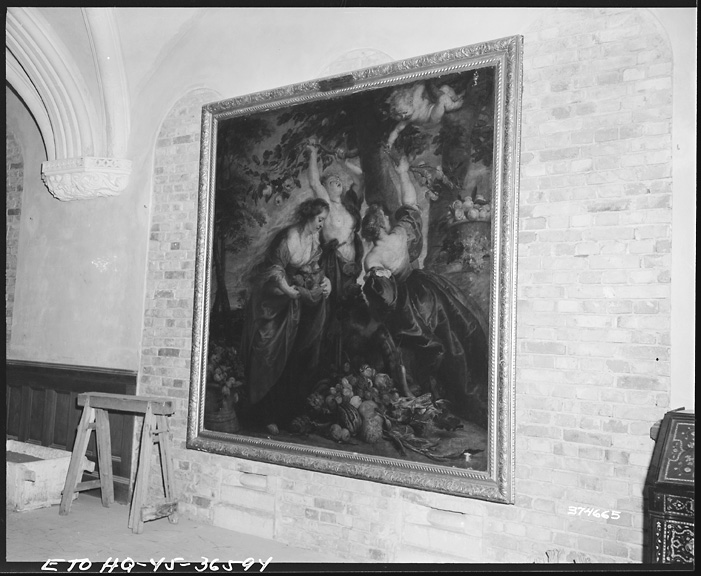
The “three graces” of art restitution

"The Graces of the Gardens of the Hesperides", Rubens, taken by the ERR
Source: Holocaust-Era Assets Portal, NARA, RG 111-SC-374665
Although they were not paragons of beauty by any Classical standard, Ardelia Hall, Evelyn Tucker, and Rose Valland, constitute a trinity of hard-nosed women who flew the standard of art restitution in the post-1945 era as high and as steadily as they possibly could with the bare means put at their disposal to do justice in their own special way.

Indeed, each one of them behaved in a unique way, faced with specific sets of challenges that on occasion may have seemed insurmountable to them. And yet, they persevered. Although Ardelia Hall and Evelyn Tucker left their respective duties with very mixed feelings, Rose Valland, in relative terms, fared far better and benefited from additional institutional support for her mission to recover items belonging to France and to individuals living in France at the time of the German occupation and the Vichy years. In true French style, Rose Valland was awarded some of the highest honors commensurate with engaging in feats of Resistance during the German occupation.

On the other hand, Ardelia Hall and Evelyn Tucker, the former at the US Department of State, the latter in the US zone of occupation in Austria, were given short shrift throughout their tenure in the US government and were forced to turn into one-woman armies with skeletal staff support in an all-male world. I emphasize this gender issue because it stands out as self-evident. The worlds of international diplomacy and Allied military occupation and civil administration were populated by men, while women, for the most part, served in auxiliary functions. Even the various Allied art recovery commissions established by France (Vaucher), Great Britain (Macmillan), and the United States (Roberts) were all-male casts of museum directors, art historians, curators, and civil servants.

While Ardelia Hall and Rose Valland were creatures of the prewar museum world, Evelyn Tucker was not. Ardelia Hall was a specialist in ancient China and began her museum career in Boston at the Museum of Fine Arts before moving on to the Metropolitan Museum in New York, from which she was tapped to serve in a small office of cultural affairs at the US Department of State in 1944. Rose Valland worked in a curatorial capacity in prewar Paris, and was referred to by a senior curator in France, as a “little mouse”[la petite souris du Louvre] at the Louvre, before she was thrust into the weird world of the Einsatzstab Reichsleiter Rosenberg (ERR) at the Jeu de Paume.  Her tenacity earned her many postwar stars as an unwitting observer of institutional plunder for four long years. Following the Liberation of France, she served at Baden-Baden in the French zone of occupation of Germany where she coordinated restitution operations on behalf of the French government.

In some strange way, based on a comparative reading of the correspondence between Ardelia Hall, Evelyn Tucker and Rose Valland, Ardelia appeared to be the one on whom they both relied for strength, inspiration, and support, especially Evelyn whose continual run-ins with the US military administration in Vienna and Salzburg and confrontations with the leadership of the Munich Central Collecting Point (MCCP) made her tasks all the more arduous. This might explain why Evelyn Tucker became increasingly an advocate of Austrian interests, sometimes setting her at odds even with official US restitution policy.

More will appear in these pages about Ardelia, Evelyn, and Rose. Suffice it to say, for now, that without their extraordinary displays of bravura and stubbornness, we would not be blessed today with hundreds of thousands of pages of invaluable information regarding thefts, investigations, and recoveries of countless cultural items purloined by the Nazis in Europe. In a corny way, I feel compelled to doff my invisible hat and say to them: thank you for sticking by your guns and handing over to us and future generations a priceless legacy of historical information documenting one of the most complex events of the last century.

Les trois muses. Fragment de décoration de la maison de Titus Dentatius Panthera à Pompéi, (54-68 ap.J.C.)
Source: Radio France Internationale (RFI) via Musée national d'archéologie de Naples

02 June 2011

Memorable quotes from US restitution officials, 1943-1955

Francis Henry Taylor
Source: Archives of American Art, Smithsonian Institution
“Public institutions disposing of trust funds could not very well connive in the liquidation of the artistic patrimony of Europe and act as public receivers of stolen goods.” 
Francis Henry Taylor, director of the Metropolitan Museum of Art, New York, in a New York Times op-ed piece September 19, 1943

“…. People with looted objects in their possession are subject to federal law governing the transportation of stolen property over state lines.”
—July 23, 1946/Lieutenant Karasik, State Department official, regarding importation of art from occupied areas by US personnel

S. Lane Faison
Source: Williams Archives and Special Collections
“…[the] most barefaced type of looting and …everyone who took part in [these exchanges] must forfeit not only what he received (because that was stolen goods) but also what he gave (because he had knowledge of what he was receiving).”
—June 1, 1951/Lane Faison, Property Division, High Commission of Germany (HICOG), Munich Central Collecting Point, commenting on the exchanges conducted by Hermann Goering and the ERR to trade stolen Impressionists for more acceptable cultural assets.

“The restitution of looted art is an obligation of this Government under international law."
—May 19, 1955/Ardelia Hall, Arts and Monuments Advisor, US Department of State

09 April 2011

Historical backdrop of postwar restitution politics

The following is an excerpt from a November 18, 1998, presentation on looted art given at Clark University, Worcester, Massachusetts. A bit dated and dusty but still relevant...

There is ample precedent in recent history for the United States government to engage in a policy of restitution of looted works of art. It is rooted in wartime experiences and rejection of the Nazis' genocidal program and policy of wholesale plunder. At its heart stand the principles enacted in Article 3 of the Hague Convention of 1907 which condemned wartime plunder of cultural property from public and private collections in times of war and made the governments of those responsible for the thefts liable for compensation. In the throes of the Second World War, the beleaguered Allied powers denounced through the so-called London Declaration of January 1943 all acts of dispossession in occupied territories by the German occupation forces and their local acolytes. In February 1944, American Treasury Secretary Henry Morgenthau, flanked by representatives from a dozen nations, warned the Nazis not to steal gold from occupied countries and promised full retribution at war's end. The statement was a not so veiled warning aimed at the complacent neutrals only too eager to benefit from Axis transactions in fungible assets stolen from occupied Europe. In the summer of 1944, at Bretton Woods, where economists and government planners from around the world met to lay the foundations of the post-war international financial system, a Resolution passed known as Resolution VI which condemned all transfers of plunder from the Third Reich to neutral nations and warned the neutrals--Sweden, Switzerland, Spain, Portugal, and Turkey--that they would be held liable for harboring such ill-gotten wealth, including stolen cultural property. At Chapultepec, Mexico, similar pronouncements were made in March 1945 to sensitize Latin American nations that hoarding of illicit wealth was anathema to the Allied nations and would be viewed as an attempt to aid and abet the Nazis in the post-war era. The Potsdam declaration of August 1945 confirmed the Allies' pledge to ferret out loot in neutral countries, whereby the Soviet Union ceded all such assets found in Western and Central Europe to the Americans, the British, and the French. The Soviets' jurisdiction extended east of the Oder River, wherein all looted works of art were looked upon as in-kind payments and absorbed into State collections, a predicament which reverberates ever more intensely today.

At the onset of the International Military Tribunal in Nuremberg in 1946, the Allies enshrined as a crime against humanity all racially, politically, and religiously, motivated acts of spoliation and dispossession aimed at civilian populations. Therefore, the act of plunder was placed on par with the commission of atrocities and not subject to any legal prescription in the post-war era. However, the governments of recently liberated countries of Western and Central Europe faced the politically unsavory task of ferreting out collaborators, and punishing them, while trying to compensate their own citizens for wartime losses. The short-lived and grossly inadequate purges of wrongdoers in the private sector failed to cleanse the ranks of the art world of the men and women who fueled the bustling, Nazi-sponsored art trade of the occupation years. Kinship ties, business and political relations between those who plundered Jewish collections, those who benefited from the plunder, and those officials who achieved a remarkable transition from collaboration to post-war reconstruction governments because they played the resistance card at the opportune moment, made any effective overhaul of the art market an impossible goal to attain. To deal with the question of restitution, post-war governments passed laws requiring claims to be filed within a 3-year period, and, by 1947-1948, most claimants were shut out of any attempt at recovery.

In the United States, museum directors and art dealers alike were exerting substantial pressure on the State Department to eliminate wartime measures aimed at preventing loot from entering the country illegally. Arguing that there had been few documented cases of actual loot being intercepted by Customs agents, museum officials and their allies in the private art market, worried about the consequences of these regulatory measures on the art trade, succeeded in persuading the State Department to lift all existing barriers that screened the flow of art into the United States. The real nut of the argument lay in the following rhetoric put forth by Lamont Moore, a government official who presumably worked at Customs: "Hundreds of works of art are coming in at present and they are increasing all the time. And is it proper to exert government control over a private industry? Is it right to put that much control over private business? ... to maintain such controls is bad business.,, The Germans have not transferred any hoards of art to foreign countries; the situation has been met; and the Treasury Directive is no longer necessary..." Obviously, this official echoed the back-to-business mantra of the art world and its conservative allies in the Federal bureaucracy.

The Treasury Department balked but conceded and on June 30, 1946, cancelled the relevant Directive #51072 that prevented works of art that had been confiscated from Nazi victims or illegally acquired by the Nazis from entering the United States. Restitution experts at State and Treasury who had lobbied against the lifting of these regulatory instruments, complained that the elimination of the directive contradicted America's international commitments to ferret out and restitute looted works of art. They also worried that the inflow of looted works into the United States would grow exponentially in the coming years, since the American market was the only one that had the resources and the infra-structure to absorb high-quality, museum-quality works from Europe. These same officials resorted to secret audits of importations of works of art and antiques by New York galleries like Wildenstein and Brummer, between 1946 and 1954, in order to smoke out suspicious shipments. There is no information on the outcome of these investigations, but they do cover several thousand objects. French cultural officials even warned their American counterparts in 1946 that the outflow of art from France to the United States had grown at an alarming rate since the fall of 1944. In a number of cases, Liberty military transport ships were used to smuggle paintings from France into the US. Although officials at State and Treasury pressed for a new set of directives aimed at thwarting the importation of loot into the United States, their efforts went largely unheeded in the changing climate of the post-war, where restitution gradually took a back row seat to geopolitical containment, European reconstruction, and business-as-usual.

In Europe, Allied officials in the occupation zones of Germany and Austria, already burdened with returning thousands of works to governments that placed competing claims on them, had to contend with American dealers and museum officials bidding for works with suspicious provenances on the black market or lobbying local government and military officials to relax export licensing laws and allow dealers to gain access to the thousands of works of art that had not been claimed by survivors or their families. Sadly enough, a number of notorious German art looters and Nazi purchasing agents like Bruno Lohse and Gustav Rochlitz who belonged in the defendants' dock at Nuremberg were shielded by the very museum directors and curators in charge of Allied restitution efforts who later on lobbied for a general relaxation of the international art trade. By the late 1940s, local laws in Germany and, to a lesser extent, in Austria, were liberalized to allow gallery owners and art dealers to resume trade with the outside world, and, especially with the United States.

Confronted by the realities of post-war business opportunities presented by thousands of high-quality works of art of dubious provenance available for sale at unbeatable prices, American restitution officials worked out a legal and political framework that would preserve the American government's commitment to the identification and restitution of stolen works of art to their rightful owners, A treaty was signed to that effect in July 1946, called the Tripartite Agreement. The co-signatories were the United States, Great Britain, and France. 14 nations endorsed the agreement, Its purpose was to uphold the principle of restitution as policy and for each government to ensure that looted works of art would not reach safe harbor on their shores and that every effort would be deployed to return these works to their legitimate owners. As part of its obligation under the Agreement, the State Department sent to 72 American museums, 57 New York galleries and 2 Boston-based galleries, and close to 40 colleges and universities, a series of consolidated lists of art losses compiled by various European governments. These lists served as the only bulwark of defense against looted works of art entering private and public collections in the United States. Whether or not they were ever consulted is subject to debate. In the words of Ardelia Hall, Arts and Monuments Adviser to State: 'The Tripartite Agreement is an outstanding contribution of our Government for the eventual recovery of objects lost in World War II and still missing. It is important that this policy be effectively carried out in the United States, as this country is, today, the chief market for valuable objects. Enormous sums of money might be involved ... this policy will contribute to the good name of our country, to the foreign policy of the Department, and win the gratitude of foreign nations, for cultural objects are always cherished." She went on to say the policy was "founded on international law and international agreements to which this Government is obligated.." But above all, she argued, it is based "upon the principle of respect for the inviolability of art and the integrity of cultural institutions, upheld by this country long before there were any formal obligations to require it." Alas! No one today comes close to Ardelia Hall's commitment to art restitution.

The American government also issued a directive aimed at restituting objects brought into the United States by returning servicemen. This directive, called SWNCC 322, barred servicemen from bringing back to the United States any items that had been illegally obtained in Europe, or, if acquired legitimately, had been plundered from Nazi victims. The War Department was charged with the investigation of these cases, in collaboration with State and other Federal agencies. Before putting itself out of existence in the spring of 1946, the American Commission for the Protection and Salvage of artistic and historic monuments in war areas--known as the Roberts Commission--staffed by luminaries of the museum world like Francis Taylor, director of the Metropolitan Museum of Art, had issued in support of SWNC 322 a strong reminder to museums, art and antique dealers and auction houses, with respect to looted works of art, that "It is, of course, obvious that no clear title can be passed on objects that have been looted from public or private collections abroad. We believe, therefore, that it is to the advantage of both public institutions and the trade... that any specific examples of looting of works of art or cultural materials be brought to light as soon as possible."

With the able assistance of Ardelia Hall, the Arts and Monuments Adviser at State, but actually, the pillar of art restitution in the post-war era, several hundred items were eventually found and returned to their rightful owners, including a Durer print taken to the US by a young Brooklyn College student named Raul Hilberg. Whether or not we are speaking of the eminent Holocaust historian, I do not know. But this peppy graduate student insisted that the work not return to Germany, but be placed in an Americn museum. The State Department threw the book at him and the Durer print was promptly returned to the depository from which Mr. Hilberg had removed it. 

The American commitment to art restitution lasted for as long as Ardelia Hall remained at the State Department. After her departure in the early 1960s, which was bemoaned by French restitution officials, and in particular her counterpart, Rose Valland, the American government essentially forgot about its post-war commitments towards potential art loss claimants as did most other nations. Without Ardelia Hall, government-sponsored art restitution in the United States came to a screeching halt, but the principles remained and live on to this day. Principles, that is. Not policies.

Meanwhile, the Allied military authorities and their several hundred Monuments and Fine Arts advisors were busy collecting close to 2 million looted works of art from Germany and Austria, sorting them and trying to match them with a prewar owner. The task was made all the easier by ascribing the main responsibility of restitution to the governments of the countries from which the items were forcibly removed or illegally acquired. By 1948, the American occupation authorities had decided to close down the bulk of its investigations, and by 1951, the main collecting points closed their doors and the residual works still in place were shipped to governments requesting them as part of their national treasure. By the mid-1950s, all avenues for claimants were effectively closed and the only hope of recovery lay in the cash settlements offered by the Federal Republic of Germany, which released the German government from any future claims filed by an individual for material losses.


02 March 2011

Ardelia Hall

Ardelia Ripley Hall


Ardelia Hall (1899-1979) is the quintessential personification of a one-woman campaign to track down looted art and restitute thousands of these missing works to their rightful owners.  Her art restitution mission lasted for 16 years, from 1946 to 1962,while she served as a cultural affairs officer at the US Department of State.  A trained art historian she specialized in ancient Chinese art and before the war worked at the Department of Asian Art at the Boston Museum of Fine Arts under whose auspices she participated in archaeological digs in China during the early 1930s.  After a brief stint at the Metropolitan Museum of Art in New York, Ardelia Hall entered the government as a cultural officer of the US Department of State.  In June 1946, she received the files of the recently-disbanded Roberts Commission, a wartime American organization that laid down the framework for American attempts to locate, recover, and return looted works of art in Europe and prevent their entry into the United States.  Overnight, she became the point person on art restitution in the US government.  Ardelia Hall managed to keep the issue of art restitution alive while most politicians and career government officials joined the increasingly fractious choruses of the Cold War.  In retrospect, Ardelia Hall stands out as one of the few champions of the rights of Holocaust victims to reclaim their lost possessions and perhaps their only voice within the US government.

Her quest for missing works of art led her to France, Germany, Austria, Italy, and back to the United States which, by the 1950s, had once again become a thriving art market, a welcoming safe haven for art works wrongfully removed from their rightful owners at the hands of the Nazis only to be sold to and incorporated into leading American private and public collections by unwitting and unscrupulous art merchants alike.

The story of this unsung heroine has never been told, it has only been hinted at in a series of books and documentaries pertaining to the looting of Europe’s cultural heritage between 1933-1945.  The story of Ardelia Hall resonates today in the wake of the depredations inflicted upon the cultural institutions of the Iraqi people.  Had she been alive today, her voice would have resonated throughout the halls of the US government in protest over such devastation.

Once anointed with her new mission, Ardelia Hall’s team of art restitution experts scoured the European countryside in search of lost collections, gathered them at collecting points and ensured their safe return to the countries whence they originated.  She also investigated on her own initiative dozens of leading art dealers in Europe and the United States whom she suspected of harboring stolen works of art for profit.  Her quest for justice also led her to forge working partnerships with the US Army and its legal arm, the Provost Marshal’s Office, to flush out works of art that had been illegally brought back to the United States by returning servicemen and officers.

Ardelia Hall worked hand in hand with two other art restitution specialists, Rose Valland, in France, and Evelyn Tucker in Austria.  Together, these three women took on the postwar governments of Western and Central Europe, the senior leadership of the Allied occupation military governments in Germany and Austria and the unrepentant representatives of the international art market.

Sources:
Photo of Ardelia Hall courtesy of https://stories.state.gov/ardelia-hall/