Showing posts with label MCCP. Show all posts

06 November 2025

"Portrait of Alfonso II d'Este and his secretary, Pistofilo," by Titian

Portrait of Alfonso II d'Este and his secretary, by Titian

by Marc Masurovsky


Josef Skvor was a Czech businessman born on 8 April 1888 in Chlistov (Czechoslovakia). On 10 January 1931, Skvor, who had an apartment in Paris on Boulevard Pereire, acquired a painting by Tiziano Vecello (Titian) under the title “Portrait of Alfonso I d’Este” from a Paris art dealer, Paul Jurschewitz. The painting had been in the collection of Marquis Franzoni until the latter sold it to a Mr. Bellini from whom Jurschewitz purchased it in 1930. At the outbreak of WWII in September 1939, Skvor was the director of Skoda Works in Prague. In 1940, he or his agents deposited the Titian in a safe #691 at a branch of the Crédit Lyonnais on Boulevard des Italiens in Paris. (In subsequent documents, the vault number is designated as #569 and #596). 

The German army began its occupation of France in June 1940 after roundly defeating the French army. In the months that followed, according to Skvor, German officials paid several visits to his bank ostensibly to view the contents of his safe since Czech citizens were considered to be enemies of the Reich. On 17 December 1940, Jurschewitz wrote to Skvor and his “authorized representative” Alexander Bagenoff to confirm the terms of the sale of the Titian which was finalized the following day, on 18 December 1940. According to Skvor, someone he called Mrs. Dittrich (Maria Almas-Dietrich of Munich) showed up at the Crédit Lyonnais in Paris flanked by two SS men and with a proxy which authorized a cash payment of 1,500,000 francs to Bagenoff, Skvor’s representative. The document in Almas-Dietrich’s hands bore the stamp of the Reichskanzlei in Berlin, whose boss was Martin Bormann, the “secretary” to Adolf Hitler. She then removed the painting. 

Maria Almas-Dietrich

Almas-Dietrich, a close friend of Adolf Hitler's, took the painting back to Munich where she lived and ran a thriving international art business. The painting was eventually transferred to Berchtesgaden, one of Hitler’s favorite residences. In 1945, Skvor petitioned the French Art Restitution Commission (CRA) for assistance in locating the painting. One year later, in November 1946, Almas-Dietrich delivered the receipt issued by the Reichskanzlei to the office of Capt. Edwin Rae, head of the MFA&A Section at OMG Bavaria in Munich. She denied that she had shown up at the Crédit Lyonnaiss with two SS men to seize the painting and that the transaction had been conducted “in orderly fashion.” She reiterated that the painting had already been offered numerous times on the art market before 1939. 

In December 1946, Hans Konrad Röthel (1909-1982), co-founder of the Zentralinstitut für Kunstgeschichte (ZIKG) in Munich and curator at the MCCP, echoed what Almas-Dietrich had told Capt. Rae regarding the Titian painting, namely that it had been available for sale on the market for quite some time. He also mentioned that Jurschewitz’s fiancée, Ms. Laesch, wondered if her husband-to-be may have had a financial interest in the Titian. Finally, he upheld the official American policy of repatriation of works back to their country of origin. In the Titian’s case, he felt that France should recover the painting, believing that it had been “legally sold… for 1.8 million francs (as opposed to 1.5 million francs, the oft-cited figure in this case.).

While the Americans supported the French claim on the painting, the Czech government stood by Jozef Skvor in his attempt to recover the Titian, arguing that he had been the victim of a “forced sale” to which he had not consented. His word against Maria Almas-Dietrich, a notorious Nazi art dealer, Dr. Hans Konrad Röthel of the ZIKG and the MCCP in Munich, Albert S. Henraux, president of the French Commission on Art Restitution (CRA), Elie Doubinsky, French representative to the MFA&A at the Munich Collecting Point and deputy to Rose Valland, chief restitution officer in the French Zone of Occupation. Paul Jurschewitz who had sold the Titian to Skvor and allegedly brokered the sale to Almas-Dietrich, was also the same individual who had advised the Germans on where to find famed art dealer Paul Rosenberg’s prized inventory after the latter had fled to New York. The postwar French authorities arrested Jurschewitz on suspicions of wartime trafficking in looted art.
MCCP card #8836 (front)
MCCP card #8836 (back)


The Titian painting sat at the Munich Central Collecting Point from 11 October 1945 to 21 January 1948. While awaiting its repatriation to France which Elie Doubinsky was pressing his American colleagues in Munich to hasten, pursuant to repatriation policies issued by the Four-Power Committee in Berlin, some MFA&A members were still under the impression in 1947 that the painting would eventually be returned to Czechoslovakia once the French and the Czechs had a chance to sit at a table and discuss the salient issues surrounding its ownership and the circumstances of its wartime sale. For their part, the French were unequivocal: since the painting was taken from France, it had to be returned to the country from which it was removed. Henraux insisted on the matter, betraying his excitement at the prospect of France acquiring a first-rate painting by a master such as Titian. Furthermore, their view was that the financial transaction of December 1940 canceled Skvor’s claims to ownership. The new MFA&A chief at OMG Bavaria, Richard Howard, backed the French position and reminded the Czechs of the Four-Power decision on repatriation.
Edwin Rae, MFA&A, and his staff


Amidst the brouhaha surrounding the legitimacy of the transaction between Maria Almas-Dietrich and Skvor’s representative, Mr. Alexander Bagenoff, neither the French nor the Americans gave any consideration to Skvor’s allegations that he had been subjected to a forced sale. Maria Almas-Dietrich who had “removed” from occupied France countless works of art for Hitler, Goering, Heinrich Hoffmann and herself, was more believable in their eyes than the purported Czech victim. There is no indication either as to the true nature of the relationship between Skvor and Bagenoff. Did the latter sell him out? Did the Germans pressure him? We will never know because he died during the war. Did Skvor actually collect the money as the French gratuitously asserted? No evidence suggests that he actually did.

Keep in mind also that the Cold War was in full swing while the fate of the Titian was under debate. From 1945 to 1948, relations between the US and Czechoslovakia deteriorated to a point of no-return due to Soviet aggression in that country which culminated in a hostile takeover of the country’s government in February 1948. The US had already frozen restitutions to “Soviet bloc” nations of Eastern Europe. These countries' claims for assets looted by the Germans and uncovered in the Western Zones of occupation in Germany and Austria were systematically rejected by the Western Powers. Could this state of affairs have influenced the MFA&A Section in its determination to deny the possibility of a restitution to Skvor which could only benefit America’s ally, France?

It's an odd story with colorations of early Cold War hysteria which benefited France’s museums desirous to enrich their cultural heritage at any cost. Sometimes, it’s not what you read that matters but what lies behind the curtain.

Technical specifications:

Author: Tiziano Vecello, known as Titian (1488/1490-1576)
Medium: Oil on canvas
Measurements: 102 x 116 cm
Titles given to the painting: Portrait of Alfonso d’Este; Portrait of Alfonso I d’Este; Double portrait of Alfonso I d’Este and his secretary; Portrait of Alfonso II d’Este and his secretary, Pistofilo

Sources:

Note from Paul Jurschewitz to Josef Skvor, 10 January 1932, RG 260 M1946 Roll 40 NARA.
Paul Jurschewitz to Skvor and Mr. Bagenoff, 17 December 1940, RG 260 M1949_Case C42 C6/36_Roll 11 NARA.
Skvor to the Director of the Commission de recuperation artistique, Paris, 5 November 1945. RG260 M1946 Roll 40 NARA
Josef Skvor undated application for the restitution of Czechoslovak Property # C6/2156 and 2157. [OMGUS number=C-42], RG260 M1949_Case C42 C6/36_Roll 11 NARA
Note from Edwin C. Rae, chief, MFA&A Section, Restitution Branch, OMG Bavaria, to Mr. Taper, OMGUS, Economics Division, Restitution Branch, 30 November 1946, RG 260 M1949_Case C42 C6/36_Roll 11 NARA.
Note from Dr. Hans Konrad Röthel to Samuel R. Rosenbaum regarding the “Portrait of Alfonso d’Este and his secretary”, 10 December 1946, RG260 M1949_Case C42 C6/36_Roll 11 NARA
Handwritten note, undated, Munich, Germany, ca. 1947 RG260 M1949_Case C42 C6/36_Roll 11 NARA
Richard Howard to OMGUS, 2 juin 1947, RG 260, M1946, Roll 40, NARA
Note from Richard Howard, Chief MFA&A Section, OMG Bavaria, to MFA& A Section, Restitution Branch, Economics Division, OMG Bavaria 20 June 1947, RG260 M1949_Case C42 C6/36_Roll 11 NARA
Captain Elie Doubinsky, French representative, MCCP, to Herbert Leonard, Chief MFA&A Section, Munich, 7 October 1947 RG 260 M1946 Roll 40 NARA.

Photos
Portrait of Alfonso II d'Este and his secretary, Pistofilo, courtesy of www.dhm.de
Edwin Rae with his staff courtesy of: https://www.artmagazin.hu/articles/archivum/1c6f0bb5a07c9f9ad66e8809213416c3
Maria Almas-Dietrich courtesy of https://agorha.inha.fr/detail/25


20 July 2023

The Auerbach Case: Part Two-Cabal of art dealers

by Marc Masurovsky
Rose Valland, c/o Ministère de la Culture

On 10 November 1949, Rose Valland, France’s point person on repatriation and restitution issues, wrote to Stefan Munsing, then Chief of the CCCP, to inform him on the activities of a recently naturalized American citizen of Jewish extraction living in Paris. His name was Heinz Berggruen. “He flaunts his privileged access to American museums. However, the US Embassy in Paris does not like him. Our suspicions about him grew when we compared his project with the one promoted by Auerbach and Wildenstein.” According to Valland, Berggruen was organizing a sale of paintings in Bavaria in which Georges Wildenstein held an interest. The works being sold had been consigned by Berlin dealers who knew that American clients would be congregating in Munich for that purpose. One of the dealers, a Mr. Buren, apparently consigned two French paintings, one by Corneille de Lyon and the other by Nattier. Valland notified Munsing that France reserved the right to assert its jurisdiction over those paintings and any others offered on the art market. She asked him to take the necessary measures to warn American museums not to deal with these “gangsters” whose behavior is unacceptable. 

Munsing’s investigations into Berggruen produced meager results. Berggruen was mostly dealing in rare books on his frequent visits to Bavaria. He also flaunted his contacts in high French circles as well as his familiarity with French customs who “never opened my bags.”

 
Theodore Heinrich

On 13 February 1951, Theodore Heinrich wrote to one of his former MFAA colleagues, Lane Faison. He warned him about his concerns regarding notables (Jewish and non-Jewish) of the art market who might be involved in postwar shady transactions. He was once the director of the Wiesbaden Central Collecting Point in the US zone of occupation in Germany, while serving with the Monuments Fine Arts and Archives (MFAA) administration. The MFAA had established the Munich Central Collecting Point (MCCP) in central Munich in May 1945 in order to process and dispose of cultural assets stolen from Nazi victims across Europe. In application of international law, their mission was to identify the place where these assets had been stolen and return them to those countries from which they would then be restituted to the rightful owners. At least in theory… Heinrich suspected that something ominous was brewing in the postwar art market with respect to the fate of “undistributed holdings at MCCP.”

The cast of characters included:

Karl Haberstock

- Karl Haberstock, Nazi art historian and art dealer who carried out the plans of Nazi dignitaries to acquire thousands of works of art for Hitler’s Linzmuseum project and, in so doing, partook in the spoliation of Jewish collections across Western and Central Europe.

Georges Wildenstein
- Georges Wildenstein, a legendary art dealer based in Paris, London and New York who was in a business partnership with Karl Haberstock before and—some allege-during WWII. His relationship with Haberstock apparently survived the war years.
                                                                                                                                                            
- Heinz Berggruen, a German Jewish refugee who settled in San Francisco in the 1930s, returned to Europe with the US Army and established what became one of the most famous art businesses of the postwar era, starting in liberated Paris.

Heinz Berggruen

- Dr. Philip Auerbach, a Bavarian official who worked closely with Jewish organizations on the question of unclaimed Jewish cultural assets located in the US zone of Occupation of Germany where he worked.

- Grace Morley, a native of Berkeley (CA) and a UNESCO official who headed its Museums division (innocent bystander)
Grace Morley


It is unclear when and how Theodore Heinrich discovered the “sub-rosa” relationship between Karl Haberstock and Georges Wildenstein. He nevertheless accused Berggruen (Paris), of acting as a go-between between Wildenstein (New York), and Haberstock (Bavaria).

Lane Faison (director of the Munich CCP) was aware of the fact that « many dealers had come to Munich in fall and winter (1950-1) to meet with Auerbach and other officials about Goering’s assets. These dealers believed that some of the Goering treasure would be made available to the art market. Faison condemned this behavior saying that it was antithetical to the spirit of restitution. He made it known that the US would never tolerate such a strategy.

                                                                                                                                    to be continued...

20 November 2022

Anthony van Dyck and The Music Man

Portrait of Paulus Pontius,  Anthony van Dyck

by Marc Masurovsky


Adolphe Schloss spent the last thirty years of his life painstakingly assembling a collection of Old Master paintings—Dutch, Flemish, German, Italian, Spanish and French. When he died on New Year’s Eve of 1910-1911, Adolphe Schloss had collected more than 330 paintings. His widow and children took care of the collection until it was time to send it to safety at the approach of war in August 1939. Four years later, a commando of French and German agents stormed the site where the paintings were hidden at the Château de Chambon in Laguenne, Corrèze. They seized all the paintings and brought them to Paris for “processing.”

After they reached their destination on 10 August 1943, representatives of the Vichy government, senior officials from the Louvre, and German officials proceeded with the dismemberment of the confiscated collection. The Louvre snatched 49 paintings for its permanent collection while 262 paintings were sold manu militari to Hitler’s Linz Museum project, and 22 paintings served as a “finder’s fee” for the person who denounced the collection’s whereabouts, Jean-François Lefranc. The 262 paintings were shipped to Munich for storage at the Führerbau from which they were stolen between 29 April and 2 May 1945, under the very noses of American troops. One of those paintings was the Portrait of a gentleman-Paulus Pontius by Anthony van Dyck.

Before Adolphe Schloss acquired the work by 1896, Paulus Pontius had changed hands numerous times and travelled throughout Western Europe and the United Kingdom. Its earliest recorded owner was Cardinal Silvio Valenti Gonzaga (1690-1756), who held the painting until his death in 1756. Then it conveyed to Cardinal Luigi Valenti Gonzaga (1725-1808), Rome, until 1763 when an art dealer, Hendrick de Leth (1703-1766) acquired it. From there, the painting crossed the Channel and ended up at Peper Harow in Surrey, England with the Midleton Family (we think). It remained in Surrey until 1851 after which time it migrated to London into the hands of Wynn Ellis (1790-1875). By 1896, London-based P. & D. Colnaghi sold Paulus Pontius to Charles Sedelmeyer in Paris (cat. 1896, no. 11, ill.). Sedelmeyer was one of Adolphe Schloss’ main art advisors. Naturally, Schloss snapped up the van Dyck portrait that same year and it remained with him and the Schloss family until its confiscation in 1943.

Munich 1945

MCCP card #46622

The massive unprecedented and largely unsolved art theft at the Führerbau (29 April-2 May 1945) netted over 1100 paintings. While American troops were completing the liberation of Munich and ridding the embattled city of its most fanatical armed Nazi resisters, Munich citizens were busily robbing Hitler’s administrative office building in search of food, alcohol, and anything fungible with which to survive in war-torn Munich.

Like most of the plundered paintings removed from the Führerbau, Paulus Pontius went quickly underground. It took three years for Americans to catch wind of its possible location. Until then, its whereabouts had remained unknown to American and French investigators connected with the Munich Central Collecting Point (MCCP), a central processing station for all objects recovered by Allied troops in Bavaria and processed for repatriation to their countries of origin.

Wolfgang von Dallwitz

The efforts to locate the missing painting took an unusual turn in February 1948 when Wolfgang von Dallwitz, of Biedersteinstrasse 21 (Munich) told Edgar Breitenbach that he had seen the painting in mid-November 1947 at “the apartment of a friend in Munich” together with two other paintings from the Schloss collection (a painting by Ludolf Backhuyzen /Schloss 3, a painting by Abraham van Beijeren /Schloss 8). A Dr. Irwin Sieger had allegedly shipped them from a railroad depot in Göttingen. [Breitenbach to Leonard, “Information concerning stolen Schloss paintings,” 25 February 1948, www.fold3.com], a fact he denied vigorously when questioned by Breitenbach.

Irwin (or Erwin) Sieger

Allied investigators were unsure of Sieger’s identity since they had received conflicting reports about the activities of a man bearing that name actively engaged in concealing and dispersing art looted during WWII and stolen from the Führerbau. Under questioning, Dr. Erwin Sieger lived at Olgastrasse 98 in Munich who was known as an “unscrupulous businessman” and a self-described “art amateur”, pledged to assist US authorities with their investigations into the whereabouts of the Schloss paintings and others. [Breitenbach to Leonard, “Information concerning stolen Schloss paintings,” 25 February 1948, www.fold3.com].
Lt. Hugoboom

The music man

In early 1947, while serving as a MFAA officer in Munich, Lt. Ray W. [Wayne] Hugoboom received Portrait of Paulus Pontius as “turned-in loot from the Führerbau” which Hugoboom characterized as a “gift” from the Oberbürgermeister (Lord Mayor) of Munich. However, instead of returning it to the MCCP as he should have, Hugoboom asked Franz Söker in Neu-Gilching if he could restore the damaged painting. It took him about two weeks. 

Once ready, Hugoboom hung the painting in his office. He even mentioned to his former secretary, Miss Koslowski, that he had bought it on the black market in Munich and not to tell his superior officer, Captain Rae of the MFAA. Lt. Hugoboom had a black crate made with metal sidings in which to house the painting, ostensibly for shipment. When confronted by Edgar Breitenbach, Lt. Hugoboom contradicted Koslowski’s assertion in a letter dated 3 June 1948. He delivered a contrite apology about his errant ways in the handling of the van Dyck. [Ray W. Hugoboom, School of Music, Indiana Unversity, Bloomington, IN, to Edgar Breitenbach, MFAA, OMGBavaria, 3 June 1948; Breitenbach to Hugoboom, 26 May 1948, www.fold3.com].

The recovery

On 6 April 1948, Edgar Breitenbach recovered Anthony van Dyck’s Portrait of Paulus Pontius at the studio of Alfred Koch on Holbeinstrasse 5 (or 43), Munich. According to Breitenbach, the van Dyck painting was the third most important painting from the Schloss collection. As part of his investigation into the circumstances surrounding the van Dyck painting, Breitenbach summoned for questioning Franz Söker to the MCCP on 14 April 1948. [Herbert Leonard, OMGB, to Franz Söker, 14 April 1948, RG 260 M 1946 Reel 137 NARA. www.fold3.com].

Ray Wayne Hugoboom’s defense

After Lt. Hugoboom left Munich in mid-1947 and returned to the United States, he received a promotion to become Assistant Professor of Choral Practice at the School of Music at Indiana University, Bloomington, IN. Hugoboom retold his saga with the van Dyck and declared that “the painting was located in an alley rapped [sic] up in old papers, thoroughly soaked and quite badly damaged.” He largely corroborated his official story—restoration, hanging in his room “for a short time before leaving” and leaving the painting with Alfred Koch “momentarily.” He was so busy with plans for his departure that he forgot to “arrange for [the] return” of the painting to the MCCP. [Wayne Hugoboom to Edgar Breitenbach, 10 May 1948, RG 260 M 1946 Reel 137 NARA].

Breitenbach sets the record straight

In his reply to “dear Hugoboom,” Breitenbach informed him that his letter of 10 May 1948 had caused “considerable embarrassment” at the MFAA. His recounting of the facts did not tally with the MFAA’s investigation.

Firstly, the mayor of Munich did not show him the van Dyck painting and three other paintings. It is Alfred Koch who advised him on the selection. Koch remembered the other paintings very well: two Breughel-like landscapes and a Dutch interior with woman and child. Koch did recall your hesitancy in accepting the gift but that you decided to take it, nevertheless, hoping to donate it “at a later date to some museum.”

Secondly, the story of the gift from the Mayor’s office may have been a hoax. Did Hugoboom partake in it? Unsure. But Alfred Koch and an accomplice by the name of Gillman were certainly in on it. Breitenbach noted that an apology to the Oberbürgermeister was in order. Gillman was also involved as a bit player in the mishandling of another painting from the Schloss collection, Portrait of a Lady, by Bartholomeus van der Helst.

The MFAA ultimately laid the responsibility for the van Dyck affair at Hugoboom’s feet and suggested that the only way to fix it was for him to “make a clean breast” to the MFAA staff. [Edgar Breitenbach to Hugoboom, 26 May 1948, RG 260 M 1946 Reel 137 NARA].  On 3 June 1948, Hugoboom formally apologized to “Mr. Breitenbach.” [Wayne Hugoboom to Mr. Breitenbach, 3 June 1948, RG 260 M 1946 Reel 137 NARA].

Final destination

Portrait of Paulus Pontius, Israel Museum, Jerusalem
The van Dyck painting was repatriated to Paris on 3 June 1948 and restituted to the family of Adolphe Schloss on 6 July 1948. It was sold at Galerie Charpentier on 25 May 1949 (lot no. 17). Madeleine and Joseph R. Nash, an Australian couple living in Paris, acquired the painting. They died on 15 August 1977. Two years later, in keeping with their history of donations to the Israel Museum in Jerusalem, the painting was bequeathed anonymously to the Israel Museum.

Sources

RG 260 M 1947 Reel 137 NARA through www.fold3.com

ERR database
www.errproject.org

The Jewish Digital Cultural Recovery Project (JDCRP) Pilot Project
https://pilot-demo.jdcrp.org/

The Monuments Men and Women Foundation
https://www.monumentsmenandwomenfnd.org/hugoboom-lt-r-wayne

Reviewed and edited by Saida S. Hasanagic

15 February 2016

Research from the bedroom

by Marc Masurovsky

Prerequisites:

Internet connection within reach.
Sufficient battery time in your laptop to last at least 3 hours.
And some tea…or coffee.

Nowadays, if you want to launch into a research project involving the history of art objects, known as “provenance research,” you can get do so without having to get up, except to make yourself a cup of tea or for most of you out there, a cup of java.

Let’s get started….

I have to assume that you have not registered for any paying online database like the premium version of MutualArt, artnet, artprice, etc…which we will not discuss today.

You will only rely on freely accessible databases. No questions asked…Your focus will be on Nazi-era cultural losses. That means the start date is January 30, 1933, Hitler’s rise to power. Not September 1, 1939, not March 10, 1938, not the fall of 1935. January 30, 1933.

The databases that are mentioned in this article are by no means the only ones in existence. They are some of the more important tools at our disposal to engage in critical historical and forensic research into the history of art objects that crossed through the grinder of the Third Reich, the Holocaust and the Second World War, combined.
These databases are all works in progress due to the mountains of information that exist which must be reconciled before being entered and made available to the public at large.

The obvious places to consult are:

1/ the database of the Koordinierungsstelle Magdeburg, which is under the aegis of the German Ministry of Culture and which has been recently absorbed into a reorganized “German Lost Art Foundation. The objects listed in the database were, for the most part, “lost” within the borders of Germany between 1933 and 1945, either through forced sales or outright confiscations and aryanization measures. The information can be very sparse or rather well fleshed out. Whenever an object’s claimant has retained a lawyer, you will find the name of the law firm that represents the interests of that claimant on the bottom of the dataset that you are exploring. Sometimes, there are intriguing details that make you wonder whether the object has ever been restituted.

Clicks: four clicks away from retrieving individual datasets.

2/ The ERR/Jeu de Paume database (formal title: Database of Art Objects at the Jeu de Paume) documents cultural losses, mostly in German-occupied France, but also contains objects taken in Belgium and the Netherlands. The period covered by the database is 1940-1945. No need to search in this database for objects misappropriated in Germany or Austria. The database provides as much information about the object from time and place of confiscation to the postwar if at all possible, based on archival records in the US, France, and Germany. You can get the total number of datasets fairly quickly by clicking on “search” without filling out any field in the “advanced search” function of the ERR database. As of 15 February 2016, there are 28849 datasets representing about 30,000 objects.

Clicks: three clicks away from retrieving individual datasets.

3/ Object database of the European Commission for Looted Art (ECLA)

The datasets cover losses throughout Axis-controlled Europe. There are overlaps between this database, lostart.de and the ERR database. There are substantial data on Hungarian Jewish losses. The provenance information can be skimpy.

Clicks: three clicks away from retrieving individual datasets.

4/  “Entartete Kunst” database at the Free University of Berlin

This database focuses exclusively on works of art which were de-accessioned and confiscated in Nazi Germany for being “degenerate”, thematically objectionable or the artists producing these works being undesirable for a host of reasons defined by the Nazi authorities. The provenance information can be skimpy on many of the objects, but, as with all databases, it’s best to have the objects on display.
Clicks: three clicks away from retrieving individual datasets.

5/ Getty Provenance Index

This art historical database, emphasis on art historical, is hosted by the Getty Research Institute in Los Angeles, CA. It provides a different point of entry into the search for and identification of misappropriated objects throughout the duration of the Third Reich. Sales information from German catalogues can provide critical information to show one of the many paths borrowed by looted objects.
Clicks: four or five depending on how you enter into the Getty Research Institute.

This link gives you access to the Getty Provenance Index Databases.

5/ RKD website of the Rijksbureau v. Kunsthistorische Documentatie

Clearly one of my favorite websites, which specializes on Dutch artists. The search process takes you through artists, and their works. The information supplied on each work can provide a gold mine of information about the history of art objects. This website is invaluable.

Clicks: three if you start from the main site.

6/ Musées nationaux récupération database of unclaimed objects listed as being in French museums.

This is a hybrid website with an index of objects, known as MNR, and is hosted by the French Ministry of Culture. Searches can be deceptive and all-inclusive, meaning that you might collect information about objects that are not directly connected to your search. But, it’s a minor inconvenience. The historical information about each MNR object is quite detailed. One advantage with the MNR site is that you can correlate objects with dealers’ names, like Fabiani or Gurlitt. From that standpoint alone, the search can be instructive.  It's best to use the MNR database with the ERR database (above) and the MCCP database (below).

Clicks: at least two depending on how you start.

7/The Division for Looted Art of the Polish Ministry of Culture

This site provides you a digital version of objects by type which disappeared from Poland after the German Army overran its territory in September 1939. Losses are mostly from public collections but also include registered losses from some of Poland’s best known aristocratic families whose estates were thoroughly plundered.

8/ the Munich Central Collecting Point database is a digital representation of the index cards that the American personnel from the Monuments, Fine Arts and Archives (MFA&A) section of the US Occupation Military Government in Germany (OMGUS) compiled to document the entry and exit of looted objects that fell into the hands of American troops in the closing months of WWII.
From the main website of the German Historical Museum which hosts this database, it requires at least four clicks to gain access to the main page of the MCCP database. From there, you can maneuver by artist, type of work, title, and owner or thief, depending on what kind of information you have. You will need to use variant spellings because there are many misspellings in this database. However, it is an important tool for research because of the information contained on the cards which complements what you can find in other databases. Oftentimes, as in the case of paintings, markings from the backs of the paintings will be indicated on the MCCP index cards. Therefore, you will need to click on the cards themselves and read the information extracted from the backs because sometimes it has been badly transcribed in the database.

Well, that’s it for today.

These eight databases, when combined, will provide you with information about cultural losses in Germany, France, Belgium, the Netherlands, Poland,  as well as a smattering from Austria, Hungary, and Czechoslovakia.

By checking these sites, you are exercising multi-source due diligence. A detailed consultation of these online databases can sharpen your research strategy for an actual visit to a physical archive and/or an art historical library with documents that you have to consult, yes, the kind that you touch with your fingers and that are made out of paper or the microfilms and microfiche which hold photographic images of the documents that you need.

The database checking process is not lengthy, although it can be addictive. So beware.
The very existence of these databases makes it more difficult to argue that “you did not know” that an object in your care or that you wish to purchase or exhibit had a complicated history mired in theft and genocide where the victimized owner was never reunited with her property. That’s when all the trouble begins.


14 February 2015

Schleiertanz (Veil Dance) 1920, by Paul Klee


Schleiertanz, 1920, Paul Klee
by Marc Masurovsky 

Paul Klee produced the watercolor known as “Schleiertanz”, the Veil Dance, in 1920. It was exhibited in Munich at the Neue Kunst Hans Goltz until June 1920. Thereafter, Harry Fuld, Sr., a Jewish businessman from Frankfurt am Main, acquired the Klee watercolor and kept it in the family until his death in 1932. His eleven-year old son, Peter “Harry” Fuld, Jr., and his non-Jewish mother, Ida, inherited the Klee together with the rest of Harry’s considerable art collection, businesses and real property. Peter became a millionaire. However, Hitler’s ascent to power in late January 1933 changed all of that. Due to Nazi persecutions, Peter “Harry” Fuld, Jr. left for England shortly before the outbreak of WWII. Before his departure, the Klee was placed in storage with the shipping firm of Gustav Knauer in 1937 as well as other objects and property belonging to the Fuld family. In 1941, the Reich overrode Fuld’s ownership of items stored at Knauer’s and any real, financial and commercial property still owned by the Fulds in Germany since Harry—his father--was a Jew, Peter, although a “half-Jew”—his mother was not Jewish—was still treated as though he were Jewish. All Jews living in Germany who had “abandoned” their property to go into self-imposed exile, lost whatever assets they still held to the Reich, an act that the victorious Allied powers deemed illegal after their victory over the Third Reich in May 1945.

Some of the objects in the Fuld crates left with Knauer were placed in museums in Frankfurt, where Fuld’s family came from. It could be that all the crates packed by the Fuld family had been deposited with Knauer in Frankfurt instead of Berlin, which some researchers believe to be the case. At some point, perhaps in 1943 or 1944, the ERR, the Nazi plundering agency, designated “Schleiertanz” as a Neuwied item, an indication that it might have been stored at a customs warehouse in Neuwied which served as a central repository for items seized from Jews in Belgium and Holland.

Schloss Kogl
The absence of a “Neuwied number” for “Schleiertanz” makes it more likely that the Klee was sent to ERR headquarters at Bellevuestrasse in Berlin, a way station for confiscated "modern" works of art, from which it was transferred in a crate with other “Neuwied” items to the ERR depot of Kogl in Austria, a main recipient of loot from Western Europe, including items whose owners were “unknown”, like those marked Neuwied. It could be that the Klee was reclassified as a Neuwied item then. In 1945, the Americans found it in a crate stamped “Neuwied" and so designated it as well.
 
In 1940, the British authorities interned the young Peter Fuld as an “enemy alien” and shipped him to Canada where he remained until the end of WWII. He was released in 1941 and went to school at the University of Toronto where he sought both a Bachelor of Arts and a Bachelor in Law. He took Canadian citizenship in 1946 at the time of his graduation from the University of Toronto. Fuld had also fallen in love with Ivy Lawrence, a “woman of color” from Trinidad and a fellow student who was a year ahead of him.  Their unorthodox interracial romance shook things up on the Toronto campus. 
Ivy Lawrence and Peter "Harry" Fuld in Canada
Although the Nazis would have treated Peter a “mischling” or “halbjude,” still, in Canada, he had a difficult time fitting in anywhere not being born of a Jewish mother, being a native of Germany, and involved romantically with a woman from Trinidad. Ironic that he suffered similar discrimination thousands of miles away from Nazi Germany, free of racial persecution, but not free of discrimination.

In the spring of 1945, American troops liberated Schloss Kogl, one of the ERR’s depots in the Attergau in Austria, and carted off everything it contained including the Klee to the Munich Central Collecting Point (MCCP) in Munich, the administrative center of the US zone of occupation of Germany, where it arrived in 1946. Three years later, in 1949, the Jewish Restitution Successor Organization (JRSO) received Fuld’s Klee as heirless property from the American repatriation authorities in Munich as well as hundreds of other cultural and artistic items. Together with all other heirless properties it had gathered in the Allied occupation zones in Germany and Austria, the JRSO ceded these cultural assets to the Bezalel National Museum in the newly minted State of Israel. Bezalel preceded the Israel Museum in Jerusalem. “Schleiertanz” was transferred in 1950 and incorporated into the permanent collection of the Israel Museum until its restitution in September 2010.

After WWII ended, Fuld returned to England before eventually settling in Germany. He sought out his mother, Ida, with whom he had lost touch upon going into exile as a young man and initiated proceedings to obtain restitution of his family’s lost assets which the Nazis had misappropriated. Ivy joined him in London but , once found, his mother threatened to commit suicide should he ever marry Ivy. That threat caused the breakup between Peter Fuld and Ivy and resulted in tremendous emotional harm to Peter. He required regular care at the hands of a psychiatrist. After returning to Germany, Peter died of brain cancer in March 1962. At his death, Fuld had somehow complicated matters with his estate since he had left a will to which were attached four codicils which resulted in a number of legal proceedings challenging one or more of the codicils. Some had been drafted in England, others in Germany. The messiness of inheritance especially as it affects looted and misappropriated property, cultural, financial, and immovable, was fueled by his bitter mother and the psychiatrist who had cared for Peter through his erratic emotional upheavals.
According to an article that appeared in the magazine “Ebony”, the trial over Peter Fuld’s estate produced transcripts totaling 3 million words and kept Ivy in the witness box for days. 18 million dollars (1962 value) were at stake as well as his looted assets which he had labored to recover from Germany. One third of the “residuary estate” went to Fuld’s aging mother. Another part of the estate went to Ivy with a proviso that she use 10 per cent of it for educational betterment in the West Indies. The rest went to Gita Gisela Martin, his housekeeper.

The late German lawyer and restitution specialist, Dr. Jost von Trott zu Solz, garnered the historical evidence to prove that “Schleiertanz” had once rightfully belonged to the Fuld family which had lost it at the hands of the Nazis. In 2010, the Israel Museum’s leadership accepted the evidence and agreed to restitute the Klee to Gita Gisela Martin who donated it to the Magen David Adom UK, the Israeli equivalent to the Red Cross organization, to which she had donated other “holdings” from the Peter Fuld estate

In turn, Magen David sold the Klee in New York through Sotheby’s as Lot Nr. 342 on November 3, 2010. It garnered $326,500.

As usual, beware of mis-written provenances. The Sotheby’s provenance for “Schleiertanz” misinterprets the historical material regarding the Neuwied phase of the Klee’s travails and does not acknowledge the fact that the Israel Museum returned the Klee to the Fuld heir who then donated it to Magen David, the consignor! It’s all in the details.


12 February 2013

Three Impressionist paintings, three (or rather two) destinies

On March 1, 1941, the Paris art dealership of Durand-Ruel ships to its German client, Mr. Wolfgang Krüger, three high-priced paintings by noted French Impressionists:

1/ “Les Meules, le matin” by Claude Pissarro, painted in 1899
Les meules, le matin, Claude Pissarro
Source: Metropolitan Museum of Art


2/ “Promenade sous bois”, by Auguste Renoir, painted in 1910
Promenade, sous-bois, Auguste Renoir
Source: Culture France

3/ “Noyers, plaine de Veneux-Madon,” by Alfred Sisley.
Noyers, plaine de Veneux-Madon, Alfred Sisley
Source: Culture France
While in Paris during the German occupation of France, Mr. Krüger, a Berlin-based businessman and avid art collector, enjoyed his stays at the Hotel Saint-James & Albany. He paid 385,000 Francs for the three Impressionist works.

Fate would have it that the Pissarro painting ends up at the Metropolitan Museum of Art, courtesy of a bequest in the name of an American scion and philanthropist, Douglas Dillon. The odd thing about the provenance of the Pissarro is the name of the person who ostensibly owned it prior to Durand-Ruel, to whom that person had sold it in early 1941. Funny time to sell Impressionist works of art. But, let’s not think the worst of this work. The Met should be innocent until proven otherwise. The name of that previous owner is Braunthed, who lived in Neuilly sur Seine, a very wealthy suburb of Paris, home, in the 1930s, to some of the wealthiest members of the Jewish community and especially to German Jewish refugees who had settled there after Hitler had come to power in Germany.
Until someone can clear up who “Braunthed” is, the mystery remains as to the circumstances under which “Braunthed” sold the Pissarro painting to Durand-Ruel eight months after the Nazis began to plunder Jewish collections in the Paris region. Moreover, no one has asked Durand-Ruel why it made it a habit of selling wonderful works of art to German industrialists, bankers, and aristocrats, during World War II. Perhaps, their client relationship dated back to the roaring twenties. Still, that's no excuse, is it?

The two other works suffered a less glamorous fate, despite the fact that they were purchased from Durand-Ruel by the same individual, Wolfgang Krüger, at the same time. Allied troops "captured" or "liberated" the one by Renoir and the other by Sisley, after the fall of the Third Reich.  Before being repatriated to France as of "unknown origin," they allegedly went through the Munich Central Collecting Point (MCCP).  At least, the Renoir painting--Promenade, sous-bois-- did, according to the French Ministry of Culture.  If so, there is no trace of it in the MCCP database produced by the Deutsches Historisches Museum (DHM) under the supervision of Angelika Enderlein.  The so-called Munich number--7519--does not correspond to a painting by Renoir, but rather to a work by Panini.  Back to square one. 

 "Promenade, sous-bois" ended up at the Renoir House (Maison Renoir) in Cagnes-sur-Mer as MNR 207 where it keeps company to another ill-fated MNR painting by Renoir, “la Femme au puits”, also known as MNR 579, while the Sisley adorns the walls of a municipal museum in the birthplace of the "damned poet" Arthur Rimbaud, Charleville-MézièresWhy on earth did that small town receive the painting by Sisley? Political favor? Enriching local collections with stolen property? Who knows? In any event, the Sisley painting that once belonged to Mr. Krüger is now branded as MNR 209.

And so it goes.

Three paintings purchased from the same art dealership in Paris during Year Two (or Year 1.5, depending on how you count) of the Nazi occupation of France, ending up in two different nations, one ostensibly unfettered by the shackles of war while the two others remain in that purgatory called MNR. Why did the Pissarro not end up in the French Museum system as a MNR painting? According to the Metropolitan Museum's website, the first post-1945 owner of the Pissarro was Robert F. Woolworth, who then consigned the painting to the now-defunct Knoedler Gallery in New York.  Where did Mr. Woolworth obtain the Pissarro? From Mr. Wolfgang Krüger? or from yet someone else?

What made the Renoir and Sisley works fit that category despite the fact that they shared a common wartime fate? If anything, the Pissarro is far more suspect than the Renoir and the Sisley.

Mystery…

13 February 2012

Looted Renoir painting on the French Riviera

by Marc Masurovsky

SS Officer Hermann Brandl, also known as the head of the infamous black market organization in wartime Paris called “Otto” left France in a hurry shortly before the Liberation with at least one if not two truckloads full of loot. One item that he had stolen was a painting by Pierre-Auguste Renoir, entitled “La femme au puits”, also known by its German title as “Junge Frau am Brunnen.” Renoir had painted this modest work in the area around Cagnes-sur-Mer in 1886.

Junge Frau am Brunnen, Pierre-Auguste Renoir
Source: ERR Project via Bundesarchiv
Captain Doubinsky, Rose Valland’s deputy in the French Zone of Occupation, located the warehouse where Brandl had stored the goods he plundered in France in a small farming community called Kölblöd west of Passau, and had them transferred in early 1949 to the Munich Central Collecting Point for further identification. “La Femme au Puits” was one of a small group of paintings by Renoir among the many works stolen by Brandl from Nazi victims as well as dozens of decorative objects, furniture items, antiques, and works on paper. 

Ko 7, front
Source: MCCP Datenbank via Bundesarchiv
Ko 7, back
Source: MCCP Datenbank via Bundesarchiv
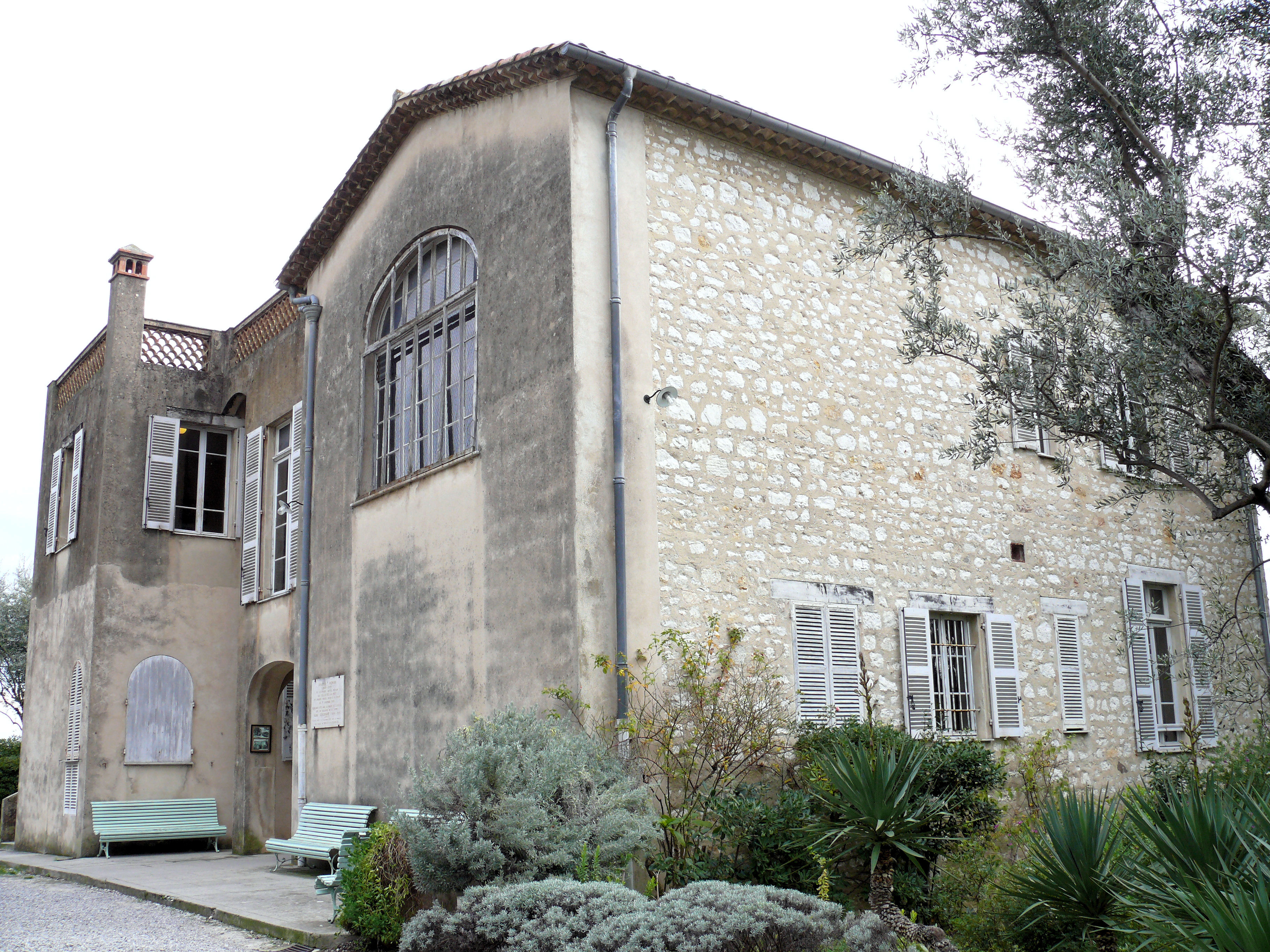
The Renoir painting was repatriated to France on June 3, 1949. Owner unknown, the painting was consigned to the French museum authorities for ultimate disposition. As had happened with so many other unclaimed looted works of art of museum quality, "La Femme au Puits" ended up in a Paris museum depot where it languished for decades before being transferred to the depot of the Musée d’Orsay, a museum in the heart of Paris inaugurated in December 1986 to house mostly 19th and 20th century works of art. In 1995, “La Femme au Puits” left the Orsay Depot and headed south to the sunny shores of the French Riviera where it is now at the Musée Renoir in Cagnes-sur-Mer. It is doubtful that the public will be made aware of the checkered history of this small painting which is waiting for its rightful owner to identify and claim it.

Musee Renoir, Cagnes-sur-Mer
Source: Wikipedia
Current research will focus on someone by the name of de la Chapelle who acquired this painting in April 1941 from the notorious Parisian art dealer, Raphael Gérard,