[Editor's note] Simon Goodman is the grandson of Friedrich Gutmann, a Dutch Jewish banker whose possessions were plundered during the German occupation of the Netherlands and who paid with his life at the hands of the Gestapo. One of the paintings that Gutmann lost was a pastel by Edgar Degas entitled "Landscape with Smokestacks", that ended up in the collection of an American billionaire, Daniel Searle, a trustee of the Art Institute of Chicago. The case became known as Goodman v. Searle and led to a bruising David against Goliath-style battle
between the Goodman heirs and an extremely wealthy man who refused to
return the pastel, on principle, arguing his good faith in the
acquisition of the looted work. The outcome was mixed as the case led to
a settlement. Twenty years later, Simon Goodman has penned “The
Orpheus Clock” which recounts his family’s history and the ordeals it
faced during the tumultuous 20th century and its endless quest for
justice to recover lost works and objects of art and, with them, a piece
of the family's plundered memory and spirit.
Landscape with Smokestacks, Edgar Degas
Mr.Goodman, when did you decide you wanted to write "The Orpheus Clock"? Was there a particular moment or event that triggered your need to tell the story?
I had the idea to write “The Orpheus Clock” almost 20 years ago. While researching two Degas paintings from my grandfather’s collection, I was angry to discover that he was not mentioned in any of the catalogues raisonné about that artist. I was shocked by how quickly my family had gone from fame and fortune to almost complete obscurity. It became my mission to make sure my family would not be forgotten. It was also my process for getting to know the family I never knew.
The Orpheus Clock
Why did you decide to use the Orpheus Clock as the title of the book? Would you say there is an underlying metaphorical relation between the ancient Greek myth and some of the events in the book?
The Orpheus Clock, I feel, symbolizes obviously the passage of time and in this case the reversal or return of my family’s fortunes. After decades of suffering the clock’s hand points towards happier times. Meanwhile the Orpheus legend symbolizes the will power to make great change. The Clock also represents my largely successful attempt to reunite the remaining dispersed fragments of my family, many of whom had never known each other before. Finally the restitution of this remarkable clock is also significant because it was my first direct restitution from Germany.
Most of us find it hard to even imagine what it would mean to be left with tens of boxes containing documents of the kind you were presented with. Do you ever wonder what would have happened if you and your brother hadn’t decided to go through them?
I don’t think there was ever any doubt that my brother and I would continue our father’s work once we understood the enormous extent of what had been taken from our family. That being said, I have often wondered how different my life (and many others) would have been had my father’s girl-friend decided not to pack up all his old papers – it would have been so easy for somebody to throw them all away assuming they were obsolete and worthless. Almost half of the book is dedicated to telling the story of your ancestors. When did you start tracing your family’s genealogy? Was it a parallel process to locating the art works or did you treat it as a separate process? Could you walk us through it?
Tracing my family’s genealogy and tracking our lost artworks went hand-in-hand. The works of art gave me an insight into the characters of those that had collected and cherished them. Also by following my grandfather and great-grandfather’s footsteps, as the amassed their collections, I gained invaluable insight into their habits and lifestyles. Growing up after the war with very little family, it was important to me to be able to establish my roots. Now that I have managed to document hundreds of relatives and ancestors I have discovered a huge family that I am justly proud of. The first part of the book does a brilliant job in painting a vivid picture of events at the turn of the century. There are parts in the book that make reference to what Eugen, Louise, Fritz and others might have felt or said in certain occasions. Were these excerpts derived from actual letters and/or written records or are they to be attributed to your attempt to give them a voice and bring them closer to the reader?
Fritz and Lili Gutmann
Virtually all our family records and letters disappeared during the war. Most of my recreation of the Gutmann family is based on what I was able to glean from my father’s notes and his sister’s recollections. A small amount of detail has also been preserved by the historical society of the Dresdner Bank. The rest I have extrapolated from snippets about the family that I found in old books and periodicals.
If you had to single out one of the moments in your mission to recover your family’s treasure as the most emotionally charged, which one would you pick? Why?
There have been many highly emotional events concerning the recovery of my family’s treasures.
"Sensuality," by Franz von Stuck
However one of the highlights of my saga is definitely when the Franz von Stuck “Sensuality” was taken down off the wall by the man who had had it for 40 years. He then helped me carry it to my car, where we put it carefully in the trunk. This was perhaps the closest I have got to a perfect restitution: no money changed hands and the legal work was kept to a minimum. After much conversation and deliberation the collector just decided to do the right thing. This was an intensely gratifying moment. The return of the Baldung-Grien comes fairly close behind, whereas all the other cases have involved considerable blood, sweat and tears.
In 1991, your father wrote a small memoir summarizing his attempts to recover the artworks and is quoted as saying “Only the lawyers made money”. Almost a quarter of a century later, is that an accurate statement?
My
experience with lawyers has been fairly similar to that of my father’s,
which is why I have trained myself to do my own research and then
approach the appropriate collector, museum or government directly. In
fact my approach as the representative of the family and the direct heir
has stood me in good stead. The possessor of the artwork is less likely
to engage expensive lawyers of their own; in contrast a fruitful
dialogue is often the result.
As you now know first hand from your experience, provenance research is an extensive, long and expensive process. What changes would you make to the‘mechanisms’ currently in place that would encourage more claimants to come forward and help correct the elitist approach that is often taken when deciding whether a claim is worth taking forward or not?
I think the reason provenance research has become such a rarified pursuit is largely due to the fact that over the centuries the recording of provenance history has been handled in a very cavalier manner. It has long suited the art business to hide behind these opaque practices. There is no great mystery to art provenance if the data is readily available. Obviously we would all benefit from a national database to which all accredited museums would contribute – galleries too ideally.
Every item has its own history, therefore every case should be treated as an independent search in its own right. But when the number of objects is in the hundreds, time is not on our side and it is impossible to deal with each object individually. Has a systematic approach to methodology come out as a result of your many years of researching many objects at once? Do you have any advice for new researchers who find it overwhelming to research multiple objects at the same time?
My approach to prioritizing my claims is fairly simple. At any given time at the top of the stack is the one I think is the most likely to succeed. The next priority involves the greatest number of pieces that are still in one specific place. Concerning research, I find it very helpful to stay focused on one specific school or medium i.e. Dutch 17th genre painters or Italian baroque bronzes. Collectors and galleries also operate within similar parameters. Invariably when looking for a particular Northern European Mannerist silver sculpture I find several mentions of others that were in my family’s collection.
As you state at the end of the book, your search is still ongoing. Could you share with the readers what your next quest is?
Several cases have been on the back burner while I finished my book. Coming to the fore now is a claim for eleven rare, and very beautiful, Italian hand-painted majolica dishes, which I found a couple of years ago in a Dutch museum. I also expect an imminent settlement for some Renaissance jewelry. Meanwhile I am negotiating with a Bavarian museum for the return of several antiques, mostly Meissen, including some of my grandmother’s coffee cups.
Sword of Damocles, Avelli
All photos, except the reproduction of "Landscape with Smokestacks" and the book cover were supplied by Simon Goodman.
Before there was any talk of restitution of looted art to families of individuals whose cultural assets had been stolen and misappropriated in Axis-controlled Europe between 1933 and 1945, provenance research did not even exist as a specialty, let alone as a concept worthy of address. When works or objects of art were suspected of having a less than savory past, it was incumbent upon civil servants in State-owned museums to look into the ownership history of these objects in search of that piece of information which might determine its plundered origin and, most importantly, ascertain who the rightful owner was and if that person or entity had recovered the suspected object.
Landscapes with Smokestacks, 1890, Edgar Degas Source: Art Now and Then
Ownership history, but not provenance research. Provenance was a pro forma addition to the description of an object, that never extended beyond the previous owner, if that. Should that person be of a certain rank or status or evoke historical resonance—Duke of Marlborough, Joseph Bonaparte, Count Lubomirsky, Edouard de Rothschild—it was worth mentioning and fleshing out.
Daniel Searle Source: Northwestern University
Ever since the controversial recovery in the mid-1990s of a pastel by Edgar Degas from the clutches of Daniel Searle, a billionaire who sat on the board of trustees of the Art Institute of Chicago which led to a bitter civil suit between the Goodman heirs—the spoliated party—and Daniel Searle, the then current owner--, provenance took on a completely different turn and meaning. All of a sudden, while historians had not yet caught up with the complexities associated with Nazi-ordered plunder and spoliation and their implications in the postwar world, lawyers, judges and government officials were forced to weigh in and assess the credibility of long-past historical data in an area where they probably knew something about Hitler, Mussolini, D-Day, and the bridges at Arnhem, but not much more. Let's not even mention curators and museum directors whose knowledge of the war and Nazi looting was reduced to movies, newsreels, and a handful of general books that they might have read on the subject.
Art Institute of Chicago Source: Wikipedia
Jest aside, provenance research for the defense meant that historical evidence had to support the rights of the current owner, or, to put it in blunt terms, historical evidence, much like forensic evidence at a criminal trial, would be presented insofar as it supported the case for the defense. Similarly, historical evidence was introduced to buttress the claims of the purported victims who sought the return of their property some sixty odd years after the crime.
Historical documents should never be made to serve either parties. Historical accuracy is all that is required and let the chips fall where they may. For instance, cases of duress or forced sales are the most contentious to date, because the evidence is complex and the stakes are high as the pieces under scrutiny are worth millions of dollars and museums are fighting tooth and nail to prevent them from being returned, while claimants are seeking to establish that a misappropriation occurred during the formative years of the Third Reich.
George Grosz Source: Wikipedia
In the lawsuit opposing the heirs of German satirist and Expressionist artist, Georg Grosz, to the Museum of Modern Art in New York, new lows have been reached in the presentation and argumentation of historical evidence central to the issues of the case—did Georg Grosz receive adequate compensation for works that his heirs claim were illegally sold at a time of increasing persecution in Nazi Germany?
The experts for the Museum of Modern Art needled the plaintiffs about how to interpret the relationship between Grosz and his dealer, while the plaintiffs’ expert asserted that Grosz had never been compensated for the works under question and that MOMA had obtained them knowing full well that Grosz might actually be the rightful owner but passed over critical aspects of the historical evidence.
Although a separate article is required to explore the depths of this significant case which was settled in favor of MOMA in 2010, the case was rife with accusations from the plaintiffs alleging withholding of key documents by MOMA and unethical behavior by its senior staff, while MOMA’s experts questioned the fact that Grosz had been plundered and suggested that he could go outside of Nazi Gemany to find a buyer for his works and that perhaps he had been compensated by his dealer, Flechtheim, who himself was spoliated by the Nazis.
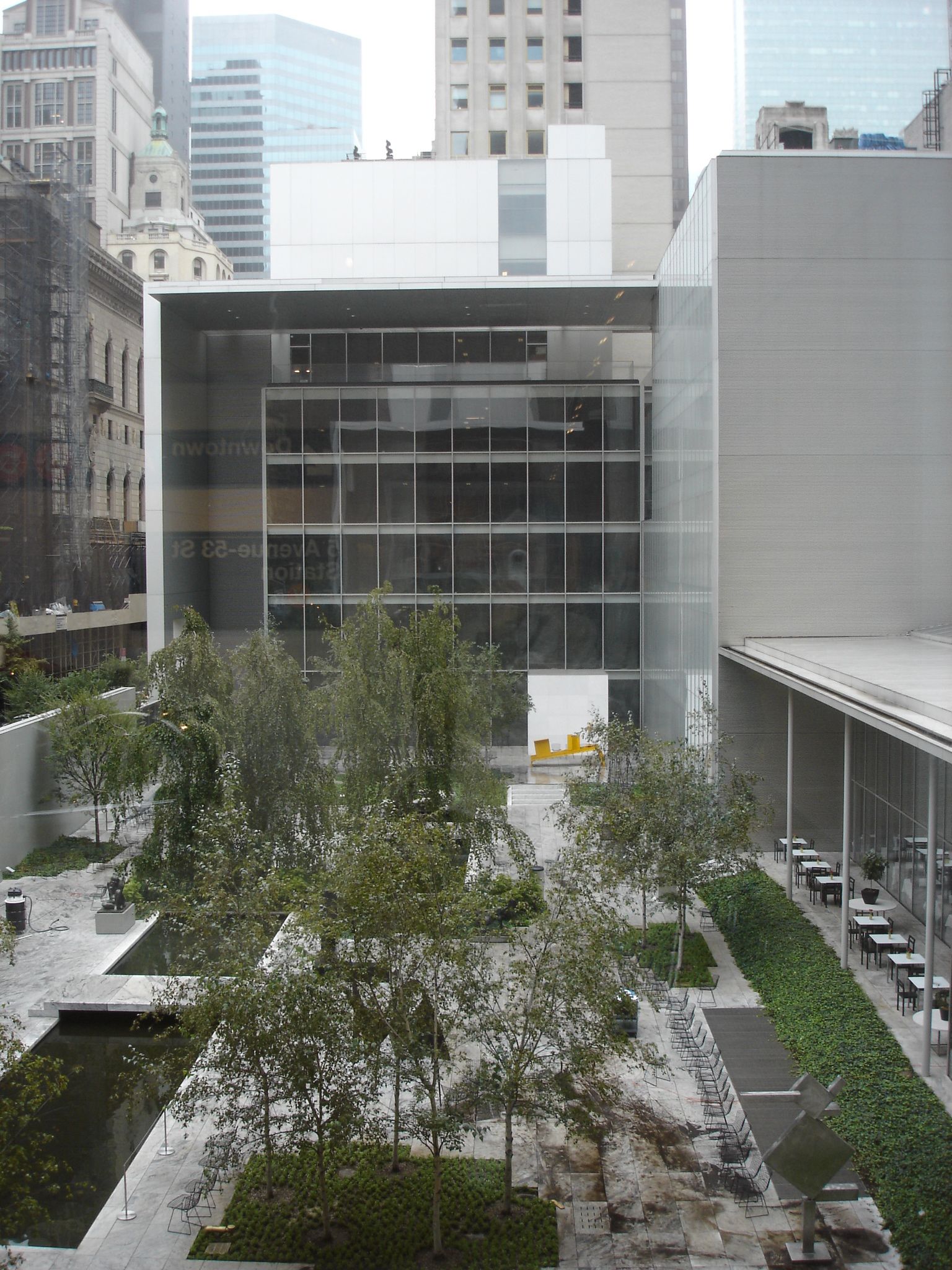
Museum of Modern Art (MoMA), New York Source: Wikipedia
As interest grows exponentially amongst university and college students in North America and Europe who contemplate a career as provenance research specialists and who wish to specialize in this complex field which is highly inter-disciplinary, there is a correlative ethical question that accompanies such specialization: will they be able to treat historical evidence in an objective manner within the framework of litigation opposing a so-called good faith purchaser (current owner) to a claimant purporting to be the rightful owner? Will provenance research become like any area of specialty where legal conflicts divide experts between pros and cons over the same body of evidence, fueling potential misuse of historical documentation, testimonials, to suit the restrictive context of a litigation?
It is critically important for academic institutions, publishers, and individuals alike to produce detailed and unimpeachable analyses of the dynamics, mechanics, and processes of plunder as they evolved in each country under Axis control, the interrelationship between the market and State-sponsored plunder, the role of art professionals in the abetting of State-sponsored plunder and looting in territories occupied by the Nazis, and the postwar evolution of the art market within the framework of a failed policy of cultural restitution.
Although I am not a lawyer, I am a trained historian on issues pertaining to the Holocaust, the Second World War, the mass plunder of all categories of assets by the Axis Powers and their allies in continental Europe and Asia, as well as the complex construction and enforcement of Allied restitution policies in the post-1945 world.
I also advocate for justice to Holocaust victims and their families in their efforts to receive either the rightful return of their stolen property or compensation for assets forcibly removed by Nazis and their agents.
With thirty years of focus on these and related issues, I feel well-equipped to address the concerns and points raised by this Prospectus.
My purpose is to respond point by point.
Regards,
Marc J. Masurovsky
Co-founder, Holocaust Art Restitution Project
cc: Ori Z. Soltes, Chairperson, Holocaust Art Restitution Project
Willi Korte, co-founder, Holocaust Art Restitution Project
1. Desirability and feasibility of a uniform act:
There has not been any desire expressed by claimants and other victims of the Holocaust for a uniform act governing issues of restitution of looted art. It is my understanding that those who are advocating for a uniform act are members of the US museum community and their representatives in the American Association of Museums (AAM) and the Association of Art Museum Directors (AAMD).
Although, in principle, such a uniform act might be viewed as feasible, its implementation would have untold negative consequences on those seeking the return of their cultural property, writ large, to include Holocaust-era losses, objects illegally removed from archaeological sites, as well as nations seeking to repatriate items which were illicitly removed from their territory and transferred to other countries. It would also destabilize current Federal and Congressional mandates governing the illicit traffic in stolen goods on US territory by producing what some have called an end-run around the National Stolen Property Act (NSPA).
2. Past art ownership disputes
Although it is always desirable not to go to court to obtain satisfaction and even some measure of justice for a historical wrong perpetrated decades ago in faraway lands, the idea that art ownership disputes used to be resolved out of court is not borne out by case law, by the history of the art world, and by the quest of theft victims for the return of their property. That might have been true in a bygone world where museum officials, art dealers, and art collectors discussed their problems over cognac and cigars. However, if you delved a bit deeper into the aggressive techniques used by art owners to settle scores even amongst themselves, they always invariably ended up in a courtroom.
3. Uncertainty and the Uniform Act
Uncertainty is a mathematical principle premised on the notion that there will always be a state of imperfection whereby results depend on the variables that are entered into an equation. For a geographer, the only certainty is a fixed point defined by longitude and latitude. When one injects the concept of scale into the location of a geographical point, uncertainty enters the picture. Therefore, uncertainty can be measured but it does not lead you to certainty. In terms of art restitution cases, even the concept of theft is subject to uncertainty. Was the object actually stolen? What constitutes theft during the Holocaust? During the Nazi era? Is a forced sale the same as theft? In the case involving the "Portrait of Wally" by Egon Schiele which pitted the heirs of Ruth Bondi Jarai against the Museum of Modern Art of New York, the New York State Court of Appeals was certain that Wally had been restituted because it had been ‘found’ by the US Army.
How would the Uniform Act establish certainty in a restitution case when all that is known is that the object disappeared from a home in Dusseldorf in March 1938 and resurfaced in a US museum in 1951? Likewise, how certain can you be that an object was not properly restituted after 1945 before its sale decades later? In the case over the restitution of a Degas pastel filed by the Goodman family against Daniel C. Searle, billionaire trustee of the Art Institute of Chicago (Goodman v. Searle), part of the battle hinged on the Goodman (then Gutmann) family’s intention to sell or to store the object in Paris, France, from which the Degas was stolen by elements of the Einsatzstab Reichsleiter Rosenberg (ERR). Despite the fact that the ERR removal constituted theft, the defense cast a doubt by intimating that the item was being offered for sale.
4. Stability into the national and international art markets
As of now, there is no indication that the art market is unstable and that it would be stabilized should there be a uniform act. The notion that standardized procedures on matters pertaining to art restitution in all 50 states would inject stability in the national and international art markets is ludicrous. The art market not only is impervious to the upswings and downswings of art restitution but it has succeeded in monetizing and increasing the value of restituted works of art, as demonstrated by the extraordinary prices commanded by Maria Altmann’s Klimt paintings, by the ‘Sunflowers’ of Egon Schiele, to name a few. The art market is more likely to be destabilized by the vagaries of speculation from key players, international fluctuations in currency rates, and fundamental disruptions in the supply of art brought about by mass conflicts, protectionist laws, and natural disasters.
5. Forum shopping
Oddly enough, forum shopping favors both sides of the art restitution debate and is a legal strategy that has always had its pluses and minuses. The elimination of such a strategy can only serve one constituency—the museum and art dealer community. Without an ability to ‘shop,’ claimants might be forced to rely on extremely unfriendly jurisdictions in their quest to obtain the return of their property. It is not clear that the so-called nonjudicial resolution of art ownership disputes would provide a level-playing field for claimants, in view of the complex nature of these historical cases.
6. Nonjudicial resolution of art ownership disputes
The emphasis given by this prospectus on this legal strategy is well-intentioned but misguided. As in a court of law, there are no guarantees that nonjudicial proceedings constitute a more favorable environment for claimants to obtain restitution of their stolen property. Museums, art collectors and dealers alike in the United States have been unusually stubborn in their belief that they are the rightful owners of the property being sought by claimants, as the good faith purchasers of those objects. Since the American legal system leans more favorably towards the good faith purchaser, the onus invariably is on the claimant to disprove the legitimacy of the current possessor’s title to the object sought for restitution.
Nonjudicial resolutions will deter restitution and encourage financial settlements. Again, in the case of the Portrait of Walli, the resolution of the case was viewed as a success, despite the fact that the painting was returned to the Leopold Foundation in Vienna, Austria, against a fee of 19 million dollars. The heirs of Ruth Bondi Jarai initially desired the restitution of the painting, not its return to the very people who had refused to restitute it to the family for over four decades. One can argue that a decade of protracted legal battles wore down the heirs and perhaps even the Leopolds into reaching a financial settlement. The settlement was also predicated on the insistence of the Leopolds not to return the painting. That is the cardinal principle at work here and in most art restitution cases filed in the United States: refusal by the current possessor to restitute. In civil proceedings, there is no legal mechanism that can compel the current possessor to restitute an item except on moral grounds, which is the predicate for all Holocaust-era restitution cases.
7. Inconsistencies among the States
The national art market in the United States is defined by two States—New York and California. What would be the consequence of resolving inconsistencies among the States through the adoption of uniform standards? How would such standardization affect art ownership disputes in those two States where there is a higher level of awareness on issues pertaining to art restitution, although not proven to have served claimants well in recent years? It is in New York, after all that, in 1998, months before the Washington Conference on Holocaust-era Assets, museums and art market groups such as the Art Loss Register led the charge to enact stringent statutory limits on restitution cases and press for the adoption of a single registry to fulfill due diligence requirements for those acquiring, selling, borrowing, lending, or donating cultural objects. The current strategy favored by the ULC to adopt a uniform standard might actually provide a belated victory to those entities by reducing, if not eliminating, most legal remedies that have given claimants greater flexibility in obtaining justice in the American legal system.
8. Ownership
a. “Theft does not convey title”— this sentence has been and continues to be the battle cry of those seeking art restitution. When uttered by an American brigadier general in the summer of 1945 in the face of the staggering breadth and scope of Nazi-ordered plunder across Europe, the phrase resonated more sharply as he tried to comprehend how plunder had become an integral component of a war of aggression against civilian populations because of their status, race, creed, ethnicity, political or religious beliefs. Unfortunately, that sentence does not mean much in the eyes of current possessors of art objects which have been repeatedly recycled in the postwar art markets. Current possessors have been shielded by a barrage of laws that provide them with the benefit of the doubt as to their possession of good title. All formerly occupied or annexed nations of Europe passed such laws so as to prevent a wholesale purge of the art market. The only transactions that could be scrutinized were those directly engaged in between seller and current possessor where the possessor was fully aware that the seller was persecuted owing to his or her religion and beliefs. Put another way, postwar governments gave a conditional pass to all wartime transactions regardless of how works and objects had been acquired, despite international pronouncements on plunder and accountability of those who abetted acts of looting through profit and recycling.
b. In the United States the Roberts Commission, staffed by eminent museum directors, art historians and experts, was put into place by the Roosevelt Administration to address the magnitude of cultural thefts in war-torn Europe and, in part, to assess the impact of those thefts on the US market. In July 1946, the Roberts Commission concluded, despite the total absence of reliable data, that there were too few stolen or illegally acquired objects entering the United States, to warrant the maintenance of wartime prohibitions or restrictions against such imports. The end result was that any mechanism to filter illicit imports of art objects disappeared and the only legal instrumentality left to Federal monitoring agencies was the National Stolen Property Act (NSPA). Needless to say, without any lists in hand or methods by which to identify these objects, there was no possible way that Customs or any other law enforcement agency could readily identify how one painting by Tiepolo could be ill-gotten as opposed to another painted by the same artist. In other words, the United States opened its doors wide open to all cultural imports without providing the needed resources to its monitoring agencies to filter illicit imports. The United States government’s initial commitments to restitute stolen objects to their rightful owners quickly faded as the Cold War heated up, while the art market grew exponentially over the coming decades. The occasional art theft cases rooted in wartime thefts garnered headlines on a periodic basis but did not influence museums and art dealers to change their ways.
Although it is true that “a thief cannot transfer title to another regardless of the other’s good faith,” the art world operates in a different manner by relentlessly upholding the rights of the current possessor against claimants’ assertions that the current possessor acquired title in bad faith. This problem brings up several points: transparency and due diligence.
c. Transparency: In an art world where transparency reigns supreme, there is full disclosure from all parties regarding the ownership history of the contested object being claimed for restitution. However, due to the unregulated nature of the art world, there is no obligation for any museum, art dealer, art collector, or any other individual or entity involved in the commerce of art to publish full provenances on objects in their possession or under their care. A brief survey of current auction catalogues, museum collections—private and public—art gallery inventories and other listings where art objects are featured, in the worst cases, the provenance is non-existent, in most cases it is minimal, and in a small minority, it provides more details which allow for the reader or potential buyer to be educated about the history of the object.
Since the act of producing a provenance is not regulated, there is no oversight mechanism in place to confirm or infirm the veracity of the content of that provenance. In other words, an element of blind trust goes hand in hand with the acquisition or trade of art objects. In short, there is more opacity than transparency in today’s art world, despite laudatory efforts on the part of leading auction houses like Christie’s and Sotheby’s and certain museums to be more forthcoming and systematic about the ownership histories of the pieces that they either sell or acquire or display. These efforts are especially noteworthy in specific markets—namely, New York, London, and Paris—and in larger so-called Tier One museums.
And yet, we are continually plagued by provenances which include a single transfer of ownership or several owners, despite the fact that the item in question is 200 or 300 years old. The practice of opacity continues unabated. Hence, transparency without regulation is a fantasy.
Before there is a legal debate over who should “be required to investigate the provenance of an item,” let us consider what due diligence entails. The act of due diligence is on par with the act of purchasing an automobile or acquiring a house: one must do one’s due diligence, by law, before acquiring good title to a car or a house. However, there is no full guarantee that one has good title because of various schemes used to cloak true ownership of assets. Those techniques evolved in the wake of the First World War and the Versailles Treaty and were fully brought to productive use during the Second World War in order to evade government restrictions on trade and transfers of ownership.
The act of purchasing an art object, writ large, to include antiquities requires a certain amount of research on the part of the person acquiring the object as a show of ‘due diligence.’ Part of the due diligence process involves obtaining as full a disclosure as possible from the current possessor regarding the history of the object. It is up to the potential buyer to decide whether or not to acquire the object if the seller cannot produce a fleshed-out provenance. More often than not, the absence of provenance does not deter a buyer from acquiring the object and thus title to that object. Once the transaction is sealed, the new possessor is assumed to have good title, unless otherwise proven wrong. The question is: by whom?
With billions of dollars at stake in a global market that is both covert and overt, the issue of due diligence shrinks in the presence of the goliath that is the marketplace of art. While much progress has been made in the trade about due diligence and provenance research for certain classes of objects that have been readily identified with Holocaust-era thefts—Old Masters, Impressionist works, Secession artists (Schiele and Klimt)—the same does not hold true for the vast majority of art objects, including, but not limited to, furniture, medieval two- and three-dimensional objects, works on paper, bronze objects (the origin of Rodin castings can be complicated to trace because private anonymous owners own the moulds. The same goes for engravings when private owners possess the original copper plates or stones in the case of lithographs or woods for woodcuts.) Short of regulation, there is no mechanism that can ensure even an iota of compliance and transparency on the part of current possessors, exhibitors, borrowers, lenders and donors of art objects to reveal the full provenance of the object.
Therefore, the long answer is that the due diligence duty befalls both seller and purchaser.
a. Accessibility of information on the Internet: The wealth of information on the Internet provides greater opportunity than ever before for individuals and organizations to obtain ownership information on a very limited category of objects. I wish to emphasize the word “limited”. The Internet may provide you with sufficient information on the ownership history of 1/10 of one per cent of those objects that are in the open market, whether on sale or on display. For some categories of objects, it is nigh impossible to obtain anything on the Internet. Therefore, due diligence begins with the Internet, but does not end there. One moves on quickly to a limited number of databases that are available for consultation. While most are proprietary or fee-based, a database like the “Database of Art Objects at the Jeu de Paume” contains fairly complete information on more than 20000 stolen objects which are fully-accessible and fully-searchable. But that number does not even scratch the surface of the total number of art objects in the market. Art-historical resources are difficult to consult if one does not live near well-endowed museum reference sections, art libraries, or institutions devoted to art research. Hence, due diligence takes on a very different meaning whether one lives in the Midwest, the New York area or in Oregon or even Alaska.
b. Value and due diligence: From 1944 to 1950, the so-called “Monuments Men” including a handful of women, consisting of curators, art historians, art experts, and museum directors, were detailed to the European Theater of Operations (ETO) and also the Far Eastern Theater of Operations to do what they knew best. They brought with them their baggage of taste and esthetics to war-ravaged continents and worked hard to facilitate the location, recovery, identification, repatriation, and restitution of untold numbers of looted objects. Because of time constraints, they invariably focused on the great names of classical art history and the most recognizable and expensive items with which they were familiar. Few were versed in the arcana of second-tier artists whose works were of high-quality but not sufficiently high to warrant inclusion in the collection of the Metropolitan Museum of Art or similar institutions in North America and Europe. Therefore, due to prejudice and time constraints, justice was denied to the overwhelming majority of victims of art thefts ever since the inception of Allied restitution policy. Those who happened to collect works by ‘minor’ Impressionists or artists whose appeal was regional—as in Central, Eastern, Western, Southern, or Northern European—saw their claims cast aside because of their ‘LESSER’ value than works by Bellotto, Cézanne, Pissarro, Leonardo Da Vinci, Ruysdael, and the list goes on and on and on.
Invariably, the art world argues time and time again that it is counterproductive and not cost-effective to do one’s due diligence on lesser valued items. And therein lies the rub. This debate about due diligence and transparency masks some of the inherent biases built into the restitution debate. Indeed, there is far less interest even for auction houses and gallery owners to waste their time on a work by Foujita of Paris, or Felix Nussbaum of Brussels, whose works are valued in the tens of thousands of dollars or perhaps low one hundred thousands, than they would on that cherished idol, Pablo Ruiz Picasso, or Marc Chagall. Even with those icons of the art world, there is discriminatory ‘due diligence’ depending on whether we are working with works on paper or oils or three-dimensional objects/sculptures.
Due diligence must apply to everyone and everything regardless of the market in which the objects are traded, with the notable exception of flea markets and garage sales.
10. Statutes of limitation
a. Commencement of statute: The theft occurs in 1941. The owners are gone. Some come back after the war. Their objects have disappeared. They don’t have an inventory but they do remember what they owned. They put together an inventory based on what they remember and file it with the proper authorities who handle restitutions. Nothing surfaces. These people are already middle-aged. They might have children. They keep this restitution issue to themselves. They die. Their children inherit the few possessions that they have as well as the inventory of what was once owned before the 1941 theft. We are now maybe in the 1960s or 1970s. Their children have their own families. Depending on their level of interest in the matter, they may make some inquiries. But they have day jobs and are not independently wealthy so as to afford full-time investigators. Meanwhile, their stolen possessions have gone through several owners. Perhaps, one or two or more may have been part of exhibits in different parts of the world. But they don’t know because they are not focused on the art world. Then one day, one of them walks into a museum and says: that looks like the painting that our parents talked about when we were kids. Question: does the statute begin at that moment?
Let’s say for now that the kids do not inquire further about this particular object. One of them eventually decides to look into it and makes an inquiry at the museum where the painting is displayed. Depending on how rude or cooperative the museum official is, there might be very little or no information for this potential claimant. If the object is on loan for the exhibit, the museum official would not be bound to say anything. Because the potential owner is ill-equipped to move the process forward, in more cases than none, he or she will stop inquiring at that moment. Hence, an opportunity is lost to promote the identification and possible return of a looted object. This story is repeated time and time again, for the following reasons: opacity of information denies the opportunity to families of despoiled owners to make informed decisions about whether to pursue a claim or not. With respect to due diligence, the onus of research is on the institution that harbors the piece for exhibition purposes as well as the current possessor. It should not be left to the victim to provide detailed information when such information may be non-existent or fragmentary at best. Therefore, instead of dismissing the question out of hand as groundless or unfounded, the institution must do its part, regardless of whether an individual walks in to an exhibit and believes that he/she has spotted an item that belonged to his/her family.
If we use the above example, let’s apply the different commencement dates:
i. The date the theft occurs or is discovered—in the above case, the statute would commence either in 1941 or in 1945.
ii. The date the whereabouts of the property is discovered—in the above case, it was not a confirmed discovery. But if we presume that it is the same object, it would have been in the 1980s or 1990s.
iii. The date the whereabouts of the property reasonably could have been discovered—this concept is heinous, to put it mildly, because it implies that every victim is an art historian, art connoisseur, art expert, and spends hours every day consulting art magazines, auction house catalogs, has access to a myriad of flyers, brochures, clippings, and illustrations about exhibits in collections around the world. How absurd an idea! The art market is all too happy to foist this ridiculous standard at claimants. It is irresponsible to expect a claimant to be so omniscient about the art world. There is not a single collector on this planet—I defy anyone to find one—who, with modest means at his/her disposal, spends a large chunk of his/her time keeping tabs on the global art market in all of its variations and infinite nuances.
iv. The date a demand for return of the property is refused- As a general rule, thefts associated with crimes of genocide or mass slaughter should have no statutory limits associated with the discovery of the objects. The issues surrounding cases of art restitution are complex enough that as much leeway as possible should be given to the parties involved to work out the question of ownership. That implies fleshing out the history of ownership of the object, which entails in most cases a significant amount of historical research oftentimes in several countries. A more dynamic public policy on the subject of restitution would provide resources to those who can ill afford years of research so as to bring about speedy resolutions of these art ownership disputes.
b. Laches and statutes of repose: Laches and statutes of repose should not be invoked in cases involving Holocaust-era thefts.
11. Burden of proof
In the US Zone of Occupation in Germany, a law was passed known as Military Law 59. The burden of proof was placed on the current possessor who had to demonstrate that he or she had not knowingly acquired an object having been associated with an act of persecution against groups targeted by the National Socialist government for persecution and extermination. Hence, the onus was placed on the current possessor to establish his/her good faith. The same should hold true today instead of having current possessors hiding behind shields of willful ignorance.
12. Remedies
Restitution where appropriate is the goal.
a. Damages are a compromise, especially when claimants have to work through expensive law firms and against institutions that refuse, on principle, to restitute. In this matter, American museums have a paltry record of restitution when compared to their European counterparts.
b. Compensatory awards to a bona fide purchaser do not occur frequently. In 1949, the US Department of State recommended successfully that a New York art dealer, Fine Arts and Associates, be compensated for the sale of a painting to the Detroit Institute of Arts which turned out to be have been stolen from a French Jewish owner and sold through the market by an agent of the Nazi Minister of Foreign Affairs, von Ribbentrop. When the item was restituted to the Jewish family, the New York art firm protested that it had been defrauded by Ribbentrop’s agent and demanded compensation. In the Seattle Art Museum case involving a painting by Henri Matisse which belonged to the heirs of Paul Rosenberg, the Paris art dealer, the Museum sued the New York art gallery, Knoedler’s, for compensation of its loss of the Matisse painting. The Museum argued that its donor, the Bloedel family, had been misled by Knoedler’s about the actual provenance of the painting at the time of its acquisition and therefore transferred the tainted title when they donated the painting to the Seattle Art Museum. The complexity of compensatory awards is tied to the inflated values of art objects on today’s art market. The concept nowadays is the equivalent of a slippery slope and should be treated as such. If there were greater transparency and stricter due diligence requirements, current possessors might be able to forestall these complications.
13.The Registry
It’s a nice idea and one that has been bandied about for years. The main problem behind a title registry is that it can provide good title to a current possessor of a stolen item and thereby, act as a ‘laundering’ mechanism for stolen property, The criteria that would have to be met in order to register a work or an object in that registry would have to reflect transparency and full disclosure of the past ownership history of the object being registered. In other words, the risks entailed by such a registry outweigh the benefits unless there is a thorough vetting process put in place. As discussed earlier, the Internet does not provide sufficient background information to justify giving an object a clean bill of health. Moreover, who would establish the criteria by which one could list an object in this title registry? Or would the title registry assume that everyone has ‘good title’?
14. Preemptive Federal Law
For now, Federal law provides the best instrument with which claimants can recover their property under the NSPA. Any attempt to gut or to weaken the NSPA would amount to a catastrophe for claimants who have very little or no protections at the state level. Hence, the ULC project should keep this in mind if it is interested in justice for all parties concerned. If a museum is the current possessor of stolen property, it has to return it to its rightful owner. That is where the Federal system has been and continues to be of tremendous assistance to claimants, regardless of their nationality, and the nature of the theft.



.jpg)