By Ori Z SoltesAmong the myriad angles from which one finds an expanding literature that considers the Nazi plunder of cultural property is that which places emphasis on some of the specifics of how a given Jewish family, or series of Jewish families, had hoped and believed that they were solidly embedded within the culture and community that ultimately discarded them as eternal foreigners when the SS knocked at the national door. The Austrians famously demonstrated this ugly truth in the immediate aftermath of the March 1938 Nazi Anschluss. So, too the Vichy government: “Free France”—except to the Jewish children and adults that the government and much (not all) of its population so easily (a better word would be “eagerly”) helped deport to Auschwitz and similar destinations. Such ease and eagerness can only have resonated from a history of gut-level Jew-hatred of long duration.
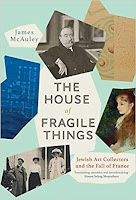
James McAuley’s deeply researched and elegantly written The House of Fragile Things plunges into the expansive efforts on the part of a key group of successful Jewish families in nineteenth-century France to shape their place within French cultural identity. These efforts played out against a backdrop of relentless antisemitism and the inability of key mouthpieces for France’s sense of self to accept Jews—any Jews, regardless of what they contributed to the national ethos—as truly French, in the century since the French Revolution and its declarations of acceptance.
McAuley explores families—the Rothschilds, Ephrussis, Reinachs, Camondos, Cahen d’Anvers, et al—and the extraordinary art and artefact collections that they amassed, the opulent homes that they created as settings for those collections, and their eventual deeding of such structures and their contents to their beloved France. On the other, he recounts the commentaries by renowned and vicious critics like the Goncourt brothers and above all Edouard Drumont—the “Pope of antisemitism”—capable only of expressing contempt for these individuals whose lavish and expansive dinner parties they frequently enjoyed.
McAuley’s text is not simply focused on dueling sensibilities. He provides an astute and perceptive analysis of each Jewish family and its key figures, and reflects on how we ultimately know so little about them beyond their possessions. His account resonates with an appreciation of the paradoxes defining their interweave into a multi-colored if flawed tapestry—and the psychological issues that motivated them, whether escapism (e.g., Moïse de Camondo), profound loss (the Reinach and Camondo deaths in military service during World War I), or gender (e.g., Béatrice Ephrussi de Rothschild); whether rooted in the collapse of relational certainties (the sense, for Moïse de Camondo, of losing control of familial, communal, and national situations around him); or in self-inflicted disasters that provided critics with fuel for their antisemitic screeds (the Reinachs and the Panama Canal scandal or the Ephrussis and the Alfassa Affair).
Above all, he delineates their struggle to present themselves as champions of France and the 1789 Revolution’s assertions regarding universalism—and thus of the unequivocal compatibility of being French and being Jewish—against the diverse failures of their beloved patrie to live up to those assertions. The narrative threads its way through the tapestry of fragile things to the culminating catastrophe for these and virtually every Jewish family within France and across Europe: the Holocaust.
There is double irony in the fact that in 1935, two of the major cultural donations to France—18th-century-styled villas filled with 18th-century objects, one left in his will by Moïse de Camondo and the other donated by his brother-in-law, Charles Cahen d’Anvers. First, because these gifts were immediately subject to ecstatic reviews,
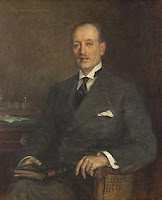 |
| Charles Cahen d'Anvers |
completely devoid of the antisemitic invective of the previous two generations regarding these very collections. Second, because in that very year, the Nuremberg Race Laws drafted by the Nazi authorities tightened the noose around the necks of Jews in Germany, and Nazism was not far from imposing itself on a largely cooperative France.Among the many quotable lines in McAuley’s volume, one (p. 227) stands out as a concise summary of one of the story’s endings: “By March 1944…. [t]he mansion that had once hosted glittering banquets in the fin-de-siècle, with guests like Marcel Proust and the King of Serbia, now imprisoned sixty Jews”—who would shortly be sent to Drancy and thence to Auschwitz. Nor is this the only terminus: the epilogue focuses on the moving portrait painted by Renoir in 1880, of Irène Cahen d’Anvers as a beautiful little girl with exuberant light-brown hair and a wistful look in her eye—stolen by the Nazis in 1941. (Renoir, by the way, had nothing but excoriating comments to make regarding the Jewish patrons who kept him afloat—including references to their cheapness, although he received far more for this and several other Jewish family portraits than for any works before or after from any other clients).
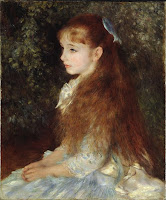 |
| Irène Cahen d'Anvers |
The painting had belonged to Irène’s daughter, Béatrice, whom Irène had abandoned when she divorced her husband, Charles, in 1902, (it was largely a mismatch, from the bride’s and groom’s ages to their personalities, but Charles never really recovered from the shock of the separation and its concomitants). Irène also abandoned her Judaism for Catholicism. The painting of Irène as a little girl was, sadly, the only tangible connection that Béatrice had to her mother as the years moved forward after the divorce. Béatrice perished at Auschwitz and Irène—who managed to survive the war hiding in Paris—was able to assert a claim and gain possession of the painting in 1946—but in 1949 sold it to Emil G. Bührle, the notorious Swiss collector whose wealth derived largely from selling armaments to the Nazis. One might suppose that Béatrice rolled in her grave.A dust-up emerged at the founding of HARP during an international conference held on September 4, 1997 in which the issue of how the National Gallery of Art (NGA) had allowed Bührle to be misrepresented as a virtual anti-Nazi crusader when the museum hosted his collection in a traveling exhibition in 1990. Bührle most notoriously acquired (during the war) four works plundered from another French Jewish collector, Paul Rosenberg, through Nazi connections. Rosenberg, who survived WWII, showed up at Buehrle’s doorstep to claim them—but that is another story for another day.
McAuley’s nuanced narrative leaves the reader with a range of villains from whom to choose in the century that encompasses the Holocaust and its aftermath, the handful of heroes mostly turned to ashes, like the unique world that they shaped—except for the lush array of objects and museums left to be enjoyed by the patrie. The Western world has suffered from remarkable bouts of amnesia—both willful and simply out of ignorance—(see the previous review by this writer in HARP’s “plundered art” blog), as the decades since the Holocaust spread out and we continue to repeat the sorts of actions that brought such grief to so many in so many different ways over 80 years ago. This book adds an important chapter to the Holocaust narrative and its culture-centered subset. It plays a noteworthy part in the effort to restitute memory—that most significant feature that makes humans human.
Photos courtesy of wikimedia.