by Marc Masurovsky
[Editor's note: This blog piece originally appeared on November 15, 2011. It has been updated to reflect additional news and research regarding the "Seated Man with a Cane," by Amedeo Modigliani, in 2016, on June 9, 2018, and on 4 February 2024]
 |
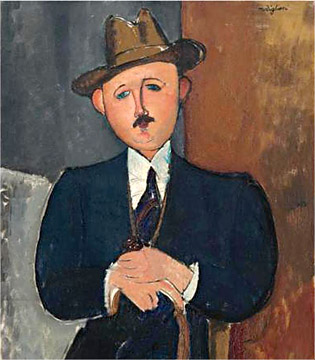
Seated Man with a Cane, Amédéo Modigliani
Source: Courthouse News Service |
The first day of November 2011 began with a headline-grabbing story about a painting by Amédéo Modigliani, "Seated Man with a Cane." According to the prevailing news accounts in the Anglo-American press, a Frenchman of Jewish descent by the name of Oscar Stettiner had lived in Paris before the advent of the Second World War. Instead of waiting for the Wehrmacht to march into Paris, Stettiner did what a third of the Parisian populace did—he fled. Before going south, Stettiner parted with his property, including works of art, never to see them again.
The plaintiff in this case is Philippe Maestracci who was born in the Dordogne in 1944 where his grandfather, Oscar Stettiner, had sought refuge and remained throughout the Second World War in a small town called La Force.
The news reports indicate that, at some point in 1941, a man by the name of Marcel Philippon became the official overseer of Stettiner’s assets as a logical consequence of being of Jewish descent and being specifically targeted for that reason by German and French anti-Jewish ordinances and decrees.
On July 3, 1944, the Modigliani painting was offered up for sale at an auction in Paris.
In 1946, Oscar Stettiner initiated proceedings to recover his painting. He died in 1948.
More than sixty years later, the Modigliani painting was offered up for sale at Sotheby’s by its current owner, Helly Nahmad, which triggered the current claim by Oscar Stettiner's sole surviving heir, Philippe Maestracci.
The following text should be viewed as a historical consultation provided free of charge to the parties warring over the painting. If they get no benefit out of this, the fault is entirely theirs.
Before even entering into a critical analysis of the facts as they have been presented to the public, the news reports contradict one another, thereby making it very difficult to develop an accurate version of a now-familiar story of spoliation of Jewish cultural assets, recycling on the wartime art market, and postwar attempts at recovering the stolen cultural property.
Most news reports, which repeat Courthouse News Service and the
British Mail, indicate that “the Nazis appointed Marcel Philippon a temporary administrator to sell Stettiner’s property…”
ArtInfo, on the other hand, gets it all wrong by indicating that the Nazis placed the Modigliani painting “in the care of” Marcel Philippon in 1939, which is a bit nonsensical since the Germans entered Paris in mid-June 1940.
The complaint itself does not shed additional light on what went wrong during the war. However, it does make several historical errors which are not helpful. It alleges that “the Nazis adopted a practice and a policy of despoiling Jewish families of property located in the Occupied Zone by forced sales.” It would have been more intelligent to indicate that the Nazi authorities, referred to as the German Military Administration (Militärbefehlshaber für Frankreich) shared the burden of enacting and enforcing anti-Jewish decrees with the collaborationist regime of Marshal Philippe Pétain, whose government was based in Vichy. It was Vichy that enacted the most sweeping anti-Jewish laws, not the Germans. Those laws established a sequence of economic restrictions aimed at ostracizing and impoverishing the Jews living in France at the time of the German invasion. The turnkey moment was the establishment of the “Commissariat Général aux Questions Juives” (The General Commissariat for Jewish Affairs or “CGQJ”) in April 1941 whose main purpose was the wholesale transfer of property from Jewish ownership to Aryan hands in consultation with and sometimes in opposition to German dicta.
 |
Le Commissariat général aux question juive, place des Petits-Peres, l´ancenne banque Léopold Louis-Dreyfus
Source: Wikipedia via Bundesarchiv |
Where does Marcel Philippon fit into this strategy? According to the complaint, “the Nazis would appointe [sic] a Temporary Administrator (“Commissaire Gérant”) to marshal and sell Jewish property and to turn the proceeds over to the Third Reich.” This is really where matters get very sticky.
Before the establishment of the CGQJ, the German authorities began to appoint overseers to manage companies and businesses owned by Jews. The individuals appointed in this capacity were known as commissaires gérants. The title should be interpreted literally: their function was to manage businesses whose owners had fled, hence the word “Gérant” or “manager.” The ultimate fate of these businesses became entangled in arduous negotiations between the German occupation authorities and the newly-minted CGQJ since the Vichy authorities had laid claim to any assets owned by Jews on French soil, especially if they were French nationals.
The Administrateur Provisoire is an invention of the Vichy government. Loosely translated as interim overseers, their function was to manage confiscated Jewish assets for the purpose of either liquidating them or aryanizing them. In the case of Oscar Stettiner, the complaint raises a number of questions which need to be researched thoroughly:
- Stettiner -- assuming that we are talking about the same one--allegedly owned a gallery which had been founded by his family in the second half of the nineteenth century. If his gallery was still active in the fall of 1939, it would have been placed under the care of a “commissaire gérant”, assuming that the Germans had gotten to it first. Had they not, the Vichy government would have seized the opportunity and appointed its own overseer, hence the competitive nature of control of Jewish assets between the Germans and the French.
- Marcel Philippon, as an interim overseer, had to abide by the instructions of the CGQJ and/or the Germans, depending on who actually appointed him. If he was in charge of both Stettiner’s personal and corporate assets, a determination would have to be made about how best to handle the seized property. It could be a mix of transfer of ownership to Aryan hands and outright liquidation through auctions or sealed bid offers. If there is a paper trail, it would be in the records of the CGQJ, archivally known as AJ38, the acronym given to this notorious collection by the French National Archives.
- the sale of the Modigliani painting three years after its placement under the management of Philippon is of concern, because it is difficult to understand, although it is not inconceivable, how and why Philippon would have waited for so long to sell the Modigliani, knowing that the wartime Paris market was thriving and that Modiglianis were easy to sell at a fair price due to their desirability both in contemporaneous French and foreign art circles. For reasons of due diligence, both parties should consult the d’Atri records at the Archives of American Art which contain the notes of Mr. D’Atri who was busy assembling a catalogue raisonné of Modigliani’s works but failed to complete it. However, his notes and ledgers are enlightening since he presumably inventoried every oil painting produced by the master until his untimely death.
- the postwar claim gives me heartburn. Indeed, there is no indication that Mr. Stettiner filed an official restitution claim with the French government. The records of the Commission de récupération artistique (CRA) make no mention of Oscar Stettiner or of his gallery. The records of the Office des Biens et Intérêts Privés (OBIP) make no mention of either Oscar, Maud, or Jacques Stettiner. However, in this particular instance, the current inventories are incomplete. Both parties in this litigation owe it to themselves to contact the Archives of the Ministry of Foreign Affairs at La Courneuve (Ministère des Affaires Etrangères et Européennes or MAEE) and request any compensation or restitution claims filed under the various names of the victims as presented in the complaint. If Oscar Stettiner decided to “go it alone” and seek personal justice outside the sphere of State-sponsored claims through judicial proceedings, the Paris courts and especially the Tribunal de la Seine and the Tribunal de Première Instance might be the proper jurisdictions where a docket might have survived.
- forced sales in Vichy France: The French government has never admitted to the existence of so-called “forced sales”, assigning that moniker to Nazi ill-doings. Liquidation sales of Jewish-owned property did occur on a weekly basis throughout occupied France, mostly in the Paris region, but the mechanisms used to recycle Jewish-owned property were far more complex than meets the eye, especially when cultural assets were involved. This matter needs to be seriously examined in light of the extensive historical documentation surrounding the wartime Paris art market and the recycling of confiscated Jewish property.
Parting thoughts:
The search for justice through claims for restitution of cultural assets forcibly removed from the hands of owners of Jewish descent requires that those who represent the aggrieved parties should pay close attention to history as it unfolded and reflect that history in their argumentation. Without such scrupulous and diligent attention to the historical truth, history is rewritten and the damage is done in the courts and in the minds of those who must hear these cases and make an informed decision about the validity of the claim brought before them.
That is not to say that the Stettiner issue is invalid. Far from that, but the historical investigative work must be brought to a forceful conclusion in order to allow all parties involved in this and similar conflicts to reach an outcome that is anchored in historical truth and ethical conduct.
Otherwise, much like “Groundhog Day”, we keep on repeating history over and over again.
Is it too much to ask that the parties involved in the dispute over the Modigliani painting come together and ascertain the facts as they occurred in the name of history, justice, and the truth? No more, no less. It would be reprehensible for Helly Nahmad to proceed with the sale of the painting because there is a taint on it and that taint must be washed off.
2016 update:
The Toronto-based
Mondex Corp. now represents Mr. Maestracci, the closest kin to Oscar Stettiner in its attempt to recover the "Seated Man with a Cane", an oil painting by Modigliani.
The "Seated Man with a Cane" by Amedeo Modigliani has been located in the Geneva Freeport where Swiss authorities ordered its seizure. The shell company under which it was registered is in fact owned by the Nahmad family which means that, by several steps removed, Nahmad is the current possessor. Or so the Swiss prosecutors believe together with US investigators.
The challenge now is to see whether Mr. Maestracci and Mondex can prevail and assert their claim over the Modigliani painting. Its history remains murky.
Meanwhile....
The provenance of the "
Seated Man with a Cane" raises questions, which beg for more meticulous and forensic research:
Repeated inspections and examinations of the
records of Alfredo d'Atri, an art dealer and collector based in Paris, France, who was an expert on Modigliani's life and works, failed to produce any tangible information on "Seated Man with a Cane." The only reference to the painting was a photograph of the painting when it was loaned by a Mr. Stettiner to the 1930 Venice Biennale. D'atri's ledger of paintings by Modigliani does not include any information on this work nor does it mention it.
In other words, there is a 14-year gap between the only public display of the "Seated Man with a Cane" and the purported sale of the painting in wartime Paris on July 3, 1944. It needs to be "filled."
 |
| "Seated Man with a Cane" |
 |
| Page from the Venice Biennale catalogue, 1930 |
Note: the black and white photograph of the "
Seated Man with a Cane" and the page from the 1930 Venice Biennale catalogue where the painting was exhibited come from the Archives of American Art, in Washington, DC.
Update from June 9, 2018
On April 18, 2018,
New York State Judge Eileen Bransten denied Nahmad's motion to dismiss the case against him for the Modigliani painting. On June 5, 2018, Helly Nahmad, current possessor of the "Seated Man with a Cane," by Amadeo Modigliani, filed a request for judgment with the New York State Supreme Court to dismiss Mr. Maestracci's complaint against Nahmad, and to award monetary damages to Nahmad in the event of a ruling favorable to Maestracci equal to the value of the painting at time of purchase plus interest.
Source: Verified answer and counterclaim re "George W. Gowen as Limited Ancillary Administrator of the Estate of Oscar Stettiner, against Helly Nahmad Gallery, Inc., Helly Nahmad, (New York) individually, David Nahmad, and International Art Center, SA." NYSCEF Doc. No. 1819.
13 years have passed, come and gone, since we first heard of the "Seated Man with a Cane" by Amadeo Modigliani. As of today, Mr. Nahmad remains the happy current possessor of a painting which has been labeled as "looted." You would think that in its many boasts Mondex Corp. would have seen fit to release part of the historical evidence making it clear to Mr. Nahmad that it would be best for him to surrender the painting to Mr. Maestracci, the purported heir of Mr. Stettiner, alleged victim of this crime of spoliation at the hands of the Vichy government and the German occupation force.
I'd gladly offer a bottle of champagne (I get to choose the brand) to anyone willing to come forth with the damning and incontrovertible evidence against Mr. Nahmad. I doubt that the offer would bear fruit because, at this stage, no one is convinced that there is a case to be made and that Mondex has convinced a distant relative of Mr. Stettiner to sign on to a restitution claim for a painting worth today upwards of 20 million dollars. Another high-stakes game played by the new bad boys and girls of the restitution industry. At the end, claimants suffer, the restitution process gets trivialized and maligned by the very people who should take heed of how serious we are to do justice and fix--even symbolically--the crime of cultural plunder.
At this point, it would be foolish to take bets on a losing case.