Showing posts with label Marcel Bernheim. Show all posts

04 December 2016

"Mann mit blauer Mütze," by Eugeniusz Zak—Part One

by Agnieszka Yass-Alston

[Editor’s note: This is an article released in two parts on the work of Eugeniusz Zak. The author, Agnieszka Yass-Alston, is an art historian and provenance researcher who specializes in the fate of artistic assets of Jewish art collectors in Krakow and the fate of the "oeuvre" of Jewish artists of  the "École de Paris."]

Eugeniusz Zak‘s painting, Mann mit blauer Mütze (Jeune homme au bonnet bleu), will be auctioned on December 10, 2016 by Ketterer Kunst in Münich (offered as Mann mit blauer Kapper), Auction 436 Modern Art I, Lot 253). (Fig. 1)
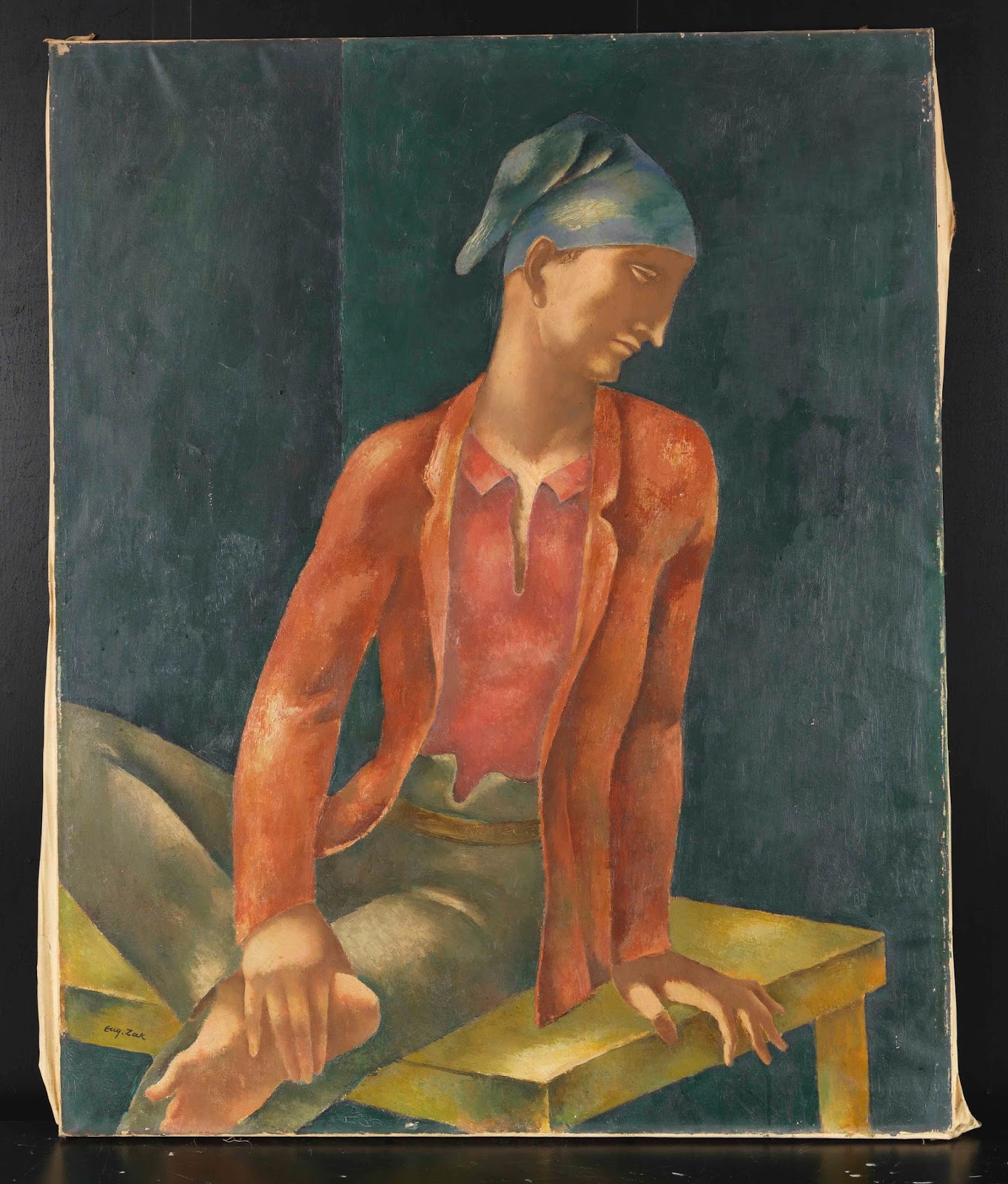
Fig. 1, Mann mit blauer Mütze
The emergence of this painting is the perfect occasion to explore a particularly important aspect in Eugeniusz Zak’s (1884-1926) oeuvre that partially facilitates provenance research of some of his paintings created between 1919-1923. In times past, unfortunately, it has not been examined correctly and thus led to confusion and misunderstandings especially due to the fact that a lot of his paintings were stripped of marks and labels and very often re-stretched into new frames. Crucial clarification of Zak’s artistic development is needed in order to understand the chronology of his oeuvre. Because these nuances have been missed and misinterpreted, they created perplexity in the ownership history of Zak’s artworks which are discussed in this essay.

As an important reminder, a lot of Zak’s paintings prior to the Second World War belonged to Jewish owners in Poland, Germany, and France. Since the 1980s, art collectors renewed their interest in the “École de Paris”. Zak’s paintings became more desirable, but unfortunately collectors did not pay much attention to their provenance.

That said, the appearance of Mann mit blauer Mütze constitutes a sensational event, as this picture
Fig. 2
was only known to art historians and collectors of works produced by members of the “École de Paris” as demonstrated by a reproduction in H. Ritter’s article “Ewige Romantik” in Deutsche Kunst und Dekoration, published in Darmstadt, in 1925. (Fig. 2)

More than ten years later a similar picture’s reproduction appeared in “Wiadomości Literackie”, a weekly published in Warsaw in 1936. The article “W dziesiątą rocznicę śmierci Zaka” written by Zygmunt St. Klingsland, a Polish correspondent in Paris, commemorated the 10th anniversary of the death of Eugeniusz Zak (1882 – 1926).  Klingsland wrote the article as a reminder to his Polish audience about the great artist. It is the closing of the exhibit of Zak’s artworks organized by Zak’s widow Jadwiga at Galerie Zak in Paris that prompted Klingsland to write those few words, illustrated by Zak’s artworks in black and white reproductions including the painting titled Studjum [Study]. (Fig. 3)

In 2004, Barbara Brus-Malinowska published an extensive, and one would think, detailed catalog of Zak’s artworks. This publication accompanied a monographic exhibit of Zak’s oeuvre organized at the National Museum in Warsaw (December 2003 – February 2004). Brus-Malinowska included the painting in the catalog (No. 196, p. 150) stating that the reproductions from Ewige Romantik (Deutsche Kunst und Dekoration) and W dziesiąta rocznicę śmierci Zaka (Wiadomości Literackie) are the same paintings. As photographic support, she used a black and white photograph from the artist’s archive which is located at the National Museum in Warsaw (DI 99830). (Fig. 4)

Fig. 3 Studjum
Fig. 4
Unfortunately, important facts were missed in Brus-Malinowska’s research. In June 1927, Galerie Marcel Bernheim in Paris had organized an Exposition Rétrospective Eugѐne Zak (1884 – 1926). The catalog listed twenty-nine works by Zak including: Jeune homme au bonnet blanc (No. 10) and Jeune homme au bonnet brun (No.26). Regrettably, there are no reproductions of these two paintings in Bernheim’s catalog. 

With this information, an examination of Zak’s development as an artist must be brought to light, especially in the period between 1916 when he had to return to Poland (a relocation, prompted by the events of WWI in France where he had resided since 1902), and 1922 when he left for Germany and subsequently returned to Paris in early 1923.

Most likely in 1918, and at the latest in early 1919, Zak painted a Young Acrobat, a prototype picture to the following three versions of the Young Man in a Hat (blue, white, and brown). The picture was exhibited for the first time in the Annual Salon of the Society for the Encouragement of Fine Arts in Warsaw, 1919 (Dec. 13, 1919 – Jan. 28, 1920). Later it was in the collection of Tadeusz Raabe of Warsaw and exhibited in 1926 during the posthumous Zak exhibit in Czesław Garliński’s Salon in Warsaw (presently it is still unknown if the prototype painting survived World War II). Probably, there was one more version of the Young Acrobat which was listed by Stefania Zachorska in her 1927 publication on Eugeniusz Zak. At that time, that painting was in William C. Bullitt’s collection (the archival documentation deposited at the National Museum in Warsaw indicates Bullitt as owner of Jeune acrobate, 1918). The painting was only once reproduced in the article Eugen Zak written by H. Ritter for Deutsche Kunst und Dekoration (vol. 50, 1922). (Fig. 5). In the National Museum in Warsaw there is a black and white photograph of the painting (ID 99828) in the artist’s archive.

It may be assumed that the Young Acrobat is one of the paintings that marked the beginning of the third creative phase in Zak’s artistic development. This is the time when Zak focused on one bigger, single human figure in a closed space of naked walls without any background disturbance. He began to paint lonely acrobats, drunkards, dancers, harlequins, magicians and various musicians. They are passive, disconsolate, dejected. The paintings emanate with melancholy, uncertainty, or perplexity. At that time, Zak lived in Częstochowa, a southern Polish town, far away from colorful, artistic Paris, where he likely heard tragic news about human fate during the world war. Therefore Zak’s romanticism of that time is very often linked to Watteau and his nestled-in lonely dreaming figures of social outcasts. 

Fig. 5
Mieczysław Wallis (Eugeniusz Zak in Sztuka Polska Dwudziestolecia. Wybór pism z lat 1921 – 1957) indicates two sub-periods within this phase; firstly when Zak focused on linear plasticity, secondly around 1924 he turned more to painterliness and colorism. The lines of the human figures are smooth and sensual. They gently intumesce into semicircular curves that oppose straight lines of walls’ corners, and objects such as a bench, a musical instrument, or a pipe. The forms are soft and elongated. There is a certain repetition of a rhythm within the composition of forms and lines that are smooth, long, and elegant (at that time, and also later upon his return to Paris, Zak exhibited with a group of Polish artists - Rytm). In this time, Zak’s figures are still outlined; as the contour disappeared, the intensely distinctive colors took over (after 1924). The paintings of this period emanate with characteristic atmosphere of elegance, fineness, and magicality, but also melancholy. Mieczysław Wallis (1927) and Stafania Zahorska (1927) wrote about the subtlety of Zak’s use of color emphasizing that he repeated the same compositions, meaning the same human figures in exact poses, or groups of figures in various colorations. These were Zak’s experiments with colors. Wallis described Zak’s use of toning practices by the use of white that suppresses color giving the impression of fresco tones. This phase is filled with coloristic dissonances, while naturalism is absent. Zak was leaning toward an expressionistic disharmony of colors in order to stress the strict decorative aspects of his paintings (after his return to Paris, Zak was close to Art Deco, as distinctively represented by Tamara Lempicka). The decorativeness of his paintings is expressed also in specifically closed composition built by rhythmic use of lines and surfaces that create flawless symmetry and balance. A fascinating aspect of this approach to decoratively closed composition was brought forth by Mieczysław Wallis (1927), who recalled that Zak did not like to show his paintings without frames, stating that once framed the artwork was completed. Zak often painted on an already framed canvas.

It is in this period that Zak ultimately defined his depicted human figures as airy, slim, and vertically extended. Their strongly narrow oval faces are reduced to their characteristic features as long dark eyebrows, elongated narrow eyes, straight overlong nose and sharp thin lips. Simple clothing tightly stretches on these slim figures, very often elongated by the use of a conical hat or pointed ballerinas. There is very intensive stylization of shape and movement. Exquisite postures and elegant gestures of the melancholic figures add to their eccentricity and withdrawnness.

(to be continued with Part Two)

List of illustrations:

Figure 1: Eugeniusz Zak, Mann mit blauer Kapper, Oil on canvas, 100 x 81 cm.
Figure 2: Eugeniusz Zak, Mann mit blauer Mütze (oil on canvas, c. 1922), illustration from Deutsche Kunst und Dekoration, vol. 56, 1925;
Figure 3: Eugeniusz Zak, Studjum (oil on canvas, c. 1923), illustration from Wiadomości Literackie, nr 42, 1936;
Figure 4: Eugeniusz Zak, Młodzieniec w niebieskiej czapce, photograph in the National Museum Warsaw (ID 99830);
Figure 5: Eugeniusz Zak, Der junger Akrobat (oil on canvas, 1918/1919), illustration from Deutsche Kunst und Dekoration, vol. 50, 1922;

26 April 2011

ERR database—Georges Bernheim

Georges Bernheim was a noted gallery owner and international art expert in pre-1940 Paris. Working under the label of the ‘Galerie Georges Bernheim,’ he had exhibited works by Francis Picabia, Raoul Dufy, and many others. Don’t be fooled, though. The number of Bernheims in the Paris art world is impressive. Although they are not related to one another, people often make that mistake and think it’s one big happy family. We have Georges Bernheim, Marcel Bernheim whose galerie ‘Galerie Marcel Bernheim’ was owned by Levy-Hermannos. And let’s not forget Bernheim-Jeune. These fixtures of the bustling avant-garde pre-1940 Paris art scene all have one thing in common: their galleries, apartments, secondary homes, bank safes, storage facilities were targeted for plunder in the early months of the German occupation of France. The man behind their combined losses: Bruno Lohse, deputy chief of the ERR, whose main offices were at 54, avenue d’Iéna, in the tony section of Paris, not too far from the Arc de Triomphe.

From a forensic standpoint, the Georges Bernheim case is frustrating, to put it mildly. According to the carding system used by the ERR at the Jeu de Paume, only 5 items were processed by Lohse’s colleagues in December 1942. If we go by the three crates that contained the items belonging to Georges Bernheim (G. Bern), the number of items rises to 18 and includes furniture and early Renaissance objects. To confuse matters a bit more, Georges Bernheim’s belongings were seized two years earlier in December 1940 and placed in one of the rooms set aside at the Louvre in November 1940 to accommodate the first major incoming shipments of plunder transferred to the ERR by the German Embassy in Paris. In other words, three crates containing Georges Bernheim objects d’art sat around at the Louvre for two years before being ‘processed’ further down the road at the Jeu de Paume.

The story would not be that complex if it ended here. However, a closer look at Georges Bernheim’s inventory of stolen art which he submitted to French authorities in 1946 perplexes and daunts, providing an alarming look at the full breadth and scope of the plunder. Since the Germans had seized his gallery records, inventories, photographs, and reference books, Georges Bernheim was forced to remember what he had lost and describe each item to the best of his ability. He managed to provide detailed descriptions for about 20 paintings, including prices and measurements, no small feat. But for the vast majority, he could only identify the names of the artists and the number of works he owned for each of them and provide a generic idea of the format of the paintings.

As it turns out, the total number of works seized from Georges’ apartment and gallery exceeds 210! In other words, 18 items were inventoried at the Jeu de Paume and 200 others simply fell through the cracks. Where are they? What are they? One thing is certain: they were never returned. If Georges Bernheim’s heirs recovered anything from that ‘invisible’ lot, no one is aware of it.

Here is a list of some the artists whose works Georges Bernheim owned and were apparently not recovered:

Marc Chagall, André Derain, Jean Dufy, Raoul Dufy, Othon Friesz, Mané Katz, Per Krogh, , Adrian, Moïse Kisling, Albert Marquet Francis Picabia, Chaim Soutine.

One painting that he recovered in October 1948 was an iconic work by Giorgio de Chirico: “Two Horses”

Two Horses, Giorgio de Chirico
Source: NARA via ERR Project
(You'll note that Hermann Goering desired this painting, thanks to the H.G. marking in the top right corner)