by Marc Masurovsky
When looking at an object which is the subject of a claim, one has to know why it is “claimable.”
In other words, the chain of ownership was allegedly broken at some point in its history and the presumed rightful owner never recovered his/her property.
A provenance might not reflect this particular incident whereby one owner loses control of his/her property/the object/through illicit means.
After all, the history of the Third Reich is not contained in a provenance for an object that circulated during the 1930s in Nazi Germany, but anyone reading the provenance should be keenly aware of the historical events that occurred as backdrop to the change of ownership of an object and ask: did those events exert an influence on how this object changed hands?
That is one aspect of contextual analysis.
In this regard, we mean that an object’s history must be viewed in the larger context of events occurring at the time that it changes hands so that we can determine whether that change of ownership was licit or not.
There are also the familiar patterns of complex relations between the presumed owner and colleagues, friends, and business acquaintances alike, which might have weighed in some manner on the ownership trail of the object. In other words, when looking at an object’s history, one must also look at the environment in which the object “evolves.” That is another aspect of contextual analysis.
When discussing forced sales or duress, whereby an individual has no other choice but to sell his property because of the degree to which this person is being exploited, abused, persecuted by representatives of institutions governed by principles that conflict with the owner’s ethos, identity, function and status in the society where he/she operates. The question here is to determine whether or not a forced sale took place. This is all about context. Here again, one has to understand the historical and societal pressures exerted upon the presumed owner of the object to determine whether he/she was in fact compelled to divest him/herself from property that otherwise would have remained unsold had conditions been different. Context and analysis of that context to flesh out the gaps or the spaces in a provenance between different listings of purported owners.
Back to contextual analysis:
Based on the above, can it ever be objective? After all, your forced sale might be my freedom to sell opportunity regardless of who is in power in Germany. What process would close the gap between those two divergent views? How much research would be needed to make a compelling argument for one or the other, but not both? In the Grosz v. MoMA case, inadequate research led to flawed outcomes. The same might be said for the Martha Nathan case against museums inToledo, Ohio and Detroit, Michigan, and maybe even for the Claudia Seger case against the Museum of Fine Arts in Boston, Massachusetts, and the New Orleans Museum of Art.
How much contextual analysis is warranted in provenance research? As much as is required to make a reasonable determination of theft or of consent in the way that an object changes hands.
Showing posts with label Museum of Fine Arts. Show all posts
Showing posts with label Museum of Fine Arts. Show all posts
23 May 2018
28 November 2016
The duty to memory
by Marc Masurovsky
Which is simpler—recovery of looted cultural objects or memorializing the loss of cultural objects? The short answer is: both are fraught with complications. Let's focus for now on memory.
Remembering what was once “ours”.
When natural disasters strike communities, the survivors get together, mourn their losses, both individual and collective, give thanks for being alive, and remember what was once “theirs.” It is part of the grieving process. Shrines are erected to honor the dead, plaques are affixed to the walls of buildings where a traumatic event occurred, or steles are set up in public squares or at a crossroads, to honor and remember. These acts of remembering are the outward expression of a tacit, implicit accord that we have a duty of memory, our responsibility as an organized citizenry to pay homage, to remind ourselves that, despite events in our common pasts, anchored in mass violence and traumatic upheavals, our communities survived and, although scarred, rebuilt themselves.
Whether it be the “Holocaust,”, the mass murders and tortures in Cambodia, the fratricidal violence in countless countries, the near-total extermination of indigenous groups worldwide, there is a collective duty to remember what we, as humans, are capable of inflicting on our neighbors, our friends, our relatives, and on total strangers. The memory of our “bloodlust” serves as a reminder of what we have lost and what we have done unto others.
In the case of culture, this duty to memory takes an odd turn.
Plaques
Rare are the plaques that memorialize sites of plunder.
 |
| Jeu de Paume memorial in Paris |
In France, it took the government nearly a half century before it felt that it could memorialize the depredations resulting from the Nazi-led cultural plunder of France. In 2005, a plaque was nailed to the side of the Jeu de Paume museum in the Tuilerie Gardens in Paris. It immortalizes the Jeu de Paume as a storage and transit center for art looted from Jewish victims of Nazi policies in occupied France and Rose Valland’s role in documenting those thefts. The plaque itself is sober. It also cites the number of works that Rose Valland is credited with recovering on behalf of the French State—45,000 in all—. One wonders whether all of those objects transited through the Jeu de Paume or if that figure represents the totality of works of art which the French government was able to repatriate from Germany and Austria after 1945.
In 1942, the Nazi government decided that it was time to expropriate all Jewish-owned property for the benefit of Germans living inside the Reich’s borders. The enforcement of the so-called “Mobel-Aktion” all across Western Europe resulted in the emptying out of tens of thousands of residences either rented or owned by persons of Jewish descent. Their goods were sorted, the most valuable were set aside, while the rest were put on trains to German cities damaged by Allied aerial bombing raids. In German-occupied Paris, a number of sites across the beleaguered capital were used to process expropriated Jewish household goods, a task performed by Jewish inmates from the transit camp of Drancy. One of those sites was called Levitan, once a furniture store at 85-87, rue du Faubourg Saint-Martin. A plaque was erected which honors the Jewish prisoners who worked there as slave laborers. It also reminds the reader that Jewish goods were sorted at Levitan. A good many of those goods were art objects which were inspected by Nazi agents and later sent to the Jeu de Paume for cataloguing and shipment to art depots in the Reich or for resale on the Paris art market.
.jpg)
 |
| Memorial at Levitan in Paris |
Similarly in Germany, there are few memorial plaques reminding the public of Nazi crimes against culture.
 |
| Kopenickerstrasse depot memorial in Berlin |
_entartete_Kunst.jpg)
One of the rare plaques honoring the work of an ardent critic of the corruption endemic to post-WWI German society marks the residence of Georg Grosz as one who stood against militarism and who satirized through his graphic work State-sanctioned corruption. Predictably, the Nazi authorities tagged Grosz’ works as “degenerate.” By 1933, Grosz had established himself in New York as a German exile.
 |
| Georg Grosz memorial plaque in Berlin, Germany |
If we view the Jeu de Paume commemorative plaque as setting a precedent for memorializing sites of plunder, shouldn’t similar plaques be established at former ERR depots in Germany and Austria where loot from across Axis-occupied Europe was amassed?
Here is a brief list of these sites:
Neuschwanstein/Fussen/Hohenschwangau
Buxheim near Memmingen
Alt-Aussee
Kogl
Thurntal
Herrenchiemsee
Amstetten/Seissenegg
Nikolsburg in the Czech Republic.
The ERR depots in Paris should likewise be marked with similar plaques, used for processing Jewish-owned collections and for amassing loot seized during M-Aktion.
6, place des Etats-Unis
17, place des Etats-Unis
12, rue Dumont d’Urville
26, rue Dumont d’Urville
77 Avenue de la Grande-Armée, garage Talbot—sous-sol et 1er étage
23, rue Drouot
41, quai de la Gare d’Austerlitz
43, quai de la Gare d’Austerlitz
Faubourg Saint-Martin : garage Levitan
Rue Fresnel : Garage Fresnel
104, rue de Richelieu
45, rue Labruyère
Maybe plaques should also be placed outside of the Hotel Drouot in Paris, to remind art shoppers that this was an important recycler of looted Jewish-owned property. Is that inappropriate to even suggest a public link between a leading broker of art sales and its managers’ opportunistic behavior during the German occupation of Paris?
How far does one extend the work of memory through memorials without provoking volatile reactions from the public and from the government, starting with the arrondissement, the city and the national government?
Clearly, the complexities associated with remembrance activities, especially those that leave a permanent presence such as physical memorial structures, abound. This fear of offending one part of the public and of rattling old skeletons is nothing new but it plagues the public discourse on cultural plunder during the Nazi years.
At this rate, we can go from one country to the next where acts of plunder occurred and draw up lists of sites of memory. The list is endless, perhaps because the memory of plunder has not yet been addressed properly.
Museum labels as “memory”
Inadequate labeling can create even more frustration than the absence of labeling associated with works of art on display. Several decades ago, there was widespread indignation at how the French government described the origin of specific works of art in State-owned museums.
Since then, there have been sporadic efforts in the United States to be more upfront about the troubled past of works in permanent collections. At the Museum of Fine Arts, in Boston, MA, a project called “Art with a Past” invited viewers to read a text that did not exceed several hundred words on a large-size plaque next to the concerned work of art. The text detailed that the work had been plundered by the Nazis and had since been restituted to its rightful owners before entering the MFA’s collection. A unique experiment in the postwar annals of museum labeling, the “Art with a Past” project shows how a cultural institution can guide the viewing public to explore further the history of ownership of an object and serve as a reminder that history, even traumatic history, can intersect and interfere with the lives of an object’s owners.
Provenance as memory
The history of ownership of an object participates in the duty to memory. After all, museum leaders already encourage their staff to produce a particular telling of the story of the objects in their collections. But they are averse to construct a story of the object as an “object lesson” in how history and art interact and affect the destiny of works and objects of art. The decades-long feud over how provenance is researched and written goes to the core of this duty to remember traumatic events that shape and direct the paths taken by objects and their owners through the sinews of history, both in space and time.
An inability and unwillingness to write these stories constitutes a crime against memory, an appeal to institutional amnesia-"appreciate” art simply as object of worship and study. The art world’s refusal to acknowledge the complex history of art objects blindsides historical truth and cheats the viewing public of a unique chance to learn more about how objects circulate, often without their owners’ consent, as a result of turbulence in the unfolding of history. Governments should encourage cultural institutions to engage their public by using art as an opportunity to teach history. After all, what better way is there to use their tax-exempt status which is there for a reason--to educate their public?

28 February 2015
Provenance research: let’s get real
by Marc Masurovsky
The din grows ever stronger in conferences, symposia, seminars, blogs, social media, museums, government agencies, whereby provenance research is a necessity, a duty. And yet, no concrete steps appear to have been taken in the private and public sectors to fold provenance research into their daily habits and to fund this highly-skilled service adequately.
Each institution that collects, acquires, and exhibits artistic, cultural and ritual objects should allow for at least one if not two full-time researchers to conduct their research in a professional and ethical manner in order to improve the quality of management of the collections, to raise the ethical bar of the institution and to better serve their public, general and specialized.
This lamentable state of affairs exists worldwide with few notable exceptions. It is simply outrageous to continue to encourage young and old, talented and enthusiastic, who want to work as provenance researchers, dangling the carrot of possibilities in front of their faces only to remind them that: sorry, no jobs, no opportunities, no funds.
In some sense, the Museum of Fine Arts in Boston, MA, has set the gold standard—relatively speaking, that is—by creating a full-time “curator of provenance”, a position masterfully filled by Victoria Reed. That’s one museum in the United States. Not the largest, not the smallest, and yet it was able to figure out how to raise the bar of accountability, research and diligence for its collection and the objects that it displays, curates and acquires. Was that so difficult? It must have been a rocky road leading to that moment. The point is that the MFA has turned the corner.
Should it remain the lonely exception to an otherwise dismal state of affairs exemplified by institutions that carry hundreds of thousands of items in their august bosoms and do nothing to ameliorate the landscape of research?
Believe me when I say that it is not a funding question. For every exhibit and acquisition that require major outlays of funds, a small portion of those funds could be allocated to provenance research. And yet they are not.
Perhaps, the only way to achieve this goal is to regulate the practice of research, mandate “professional” training in accredited institutions and programs, and deny accreditation to any institution that does not comply with minimum provenance research requirements. Why not? Does this proposal sound radical and off-the-wall? Perhaps, but it is the solution of last recourse. Unfortunately, no state or national/Federal legislature will have the guts to regulate provenance research. The big ‘R’ is one scary beast.
If you do not want to be regulated, I suggest that you commit yourselves to a long-term strategy of funding full-time positions for provenance research and to encourage universities and colleges to teach the subject. All it takes is one class in two parts for a full academic year. Cultural institutions are in desperate need of assistance and contribution from provenance experts who can help to tell the story of the objects in the collections and, more importantly, to weed out the chaff from the collections, the toxic residue that imperils their good name because of historical thefts and plunder tied to acts of genocide and mass slaughter.
The din grows ever stronger in conferences, symposia, seminars, blogs, social media, museums, government agencies, whereby provenance research is a necessity, a duty. And yet, no concrete steps appear to have been taken in the private and public sectors to fold provenance research into their daily habits and to fund this highly-skilled service adequately.
Each institution that collects, acquires, and exhibits artistic, cultural and ritual objects should allow for at least one if not two full-time researchers to conduct their research in a professional and ethical manner in order to improve the quality of management of the collections, to raise the ethical bar of the institution and to better serve their public, general and specialized.
This lamentable state of affairs exists worldwide with few notable exceptions. It is simply outrageous to continue to encourage young and old, talented and enthusiastic, who want to work as provenance researchers, dangling the carrot of possibilities in front of their faces only to remind them that: sorry, no jobs, no opportunities, no funds.
In some sense, the Museum of Fine Arts in Boston, MA, has set the gold standard—relatively speaking, that is—by creating a full-time “curator of provenance”, a position masterfully filled by Victoria Reed. That’s one museum in the United States. Not the largest, not the smallest, and yet it was able to figure out how to raise the bar of accountability, research and diligence for its collection and the objects that it displays, curates and acquires. Was that so difficult? It must have been a rocky road leading to that moment. The point is that the MFA has turned the corner.
Should it remain the lonely exception to an otherwise dismal state of affairs exemplified by institutions that carry hundreds of thousands of items in their august bosoms and do nothing to ameliorate the landscape of research?
Believe me when I say that it is not a funding question. For every exhibit and acquisition that require major outlays of funds, a small portion of those funds could be allocated to provenance research. And yet they are not.
Perhaps, the only way to achieve this goal is to regulate the practice of research, mandate “professional” training in accredited institutions and programs, and deny accreditation to any institution that does not comply with minimum provenance research requirements. Why not? Does this proposal sound radical and off-the-wall? Perhaps, but it is the solution of last recourse. Unfortunately, no state or national/Federal legislature will have the guts to regulate provenance research. The big ‘R’ is one scary beast.
If you do not want to be regulated, I suggest that you commit yourselves to a long-term strategy of funding full-time positions for provenance research and to encourage universities and colleges to teach the subject. All it takes is one class in two parts for a full academic year. Cultural institutions are in desperate need of assistance and contribution from provenance experts who can help to tell the story of the objects in the collections and, more importantly, to weed out the chaff from the collections, the toxic residue that imperils their good name because of historical thefts and plunder tied to acts of genocide and mass slaughter.
11 January 2012
The “three graces” of art restitution
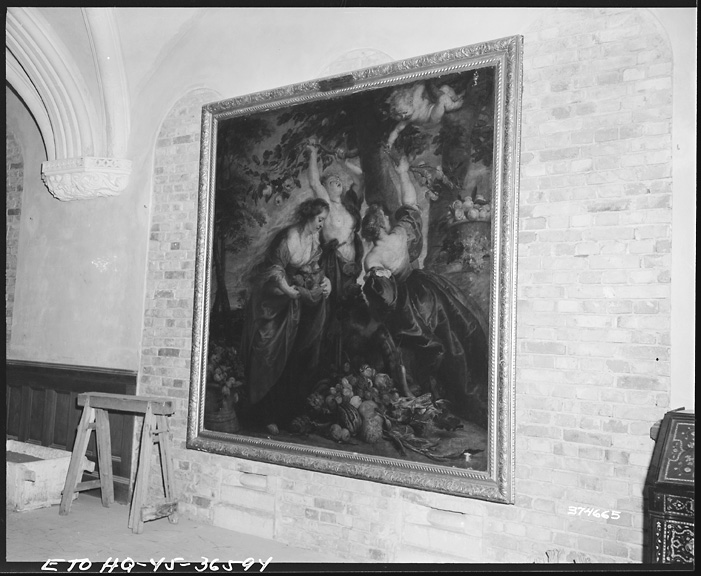 |
| "The Graces of the Gardens of the Hesperides", Rubens, taken by the ERR Source: Holocaust-Era Assets Portal, NARA, RG 111-SC-374665 |
Indeed, each one of them behaved in a unique way, faced with specific sets of challenges that on occasion may have seemed insurmountable to them. And yet, they persevered. Although Ardelia Hall and Evelyn Tucker left their respective duties with very mixed feelings, Rose Valland, in relative terms, fared far better and benefited from additional institutional support for her mission to recover items belonging to France and to individuals living in France at the time of the German occupation and the Vichy years. In true French style, Rose Valland was awarded some of the highest honors commensurate with engaging in feats of Resistance during the German occupation.
On the other hand, Ardelia Hall and Evelyn Tucker, the former at the US Department of State, the latter in the US zone of occupation in Austria, were given short shrift throughout their tenure in the US government and were forced to turn into one-woman armies with skeletal staff support in an all-male world. I emphasize this gender issue because it stands out as self-evident. The worlds of international diplomacy and Allied military occupation and civil administration were populated by men, while women, for the most part, served in auxiliary functions. Even the various Allied art recovery commissions established by France (Vaucher), Great Britain (Macmillan), and the United States (Roberts) were all-male casts of museum directors, art historians, curators, and civil servants.
While Ardelia Hall and Rose Valland were creatures of the prewar museum world, Evelyn Tucker was not. Ardelia Hall was a specialist in ancient China and began her museum career in Boston at the Museum of Fine Arts before moving on to the Metropolitan Museum in New York, from which she was tapped to serve in a small office of cultural affairs at the US Department of State in 1944. Rose Valland worked in a curatorial capacity in prewar Paris, and was referred to by a senior curator in France, as a “little mouse”[la petite souris du Louvre] at the Louvre, before she was thrust into the weird world of the Einsatzstab Reichsleiter Rosenberg (ERR) at the Jeu de Paume. Her tenacity earned her many postwar stars as an unwitting observer of institutional plunder for four long years. Following the Liberation of France, she served at Baden-Baden in the French zone of occupation of Germany where she coordinated restitution operations on behalf of the French government.
In some strange way, based on a comparative reading of the correspondence between Ardelia Hall, Evelyn Tucker and Rose Valland, Ardelia appeared to be the one on whom they both relied for strength, inspiration, and support, especially Evelyn whose continual run-ins with the US military administration in Vienna and Salzburg and confrontations with the leadership of the Munich Central Collecting Point (MCCP) made her tasks all the more arduous. This might explain why Evelyn Tucker became increasingly an advocate of Austrian interests, sometimes setting her at odds even with official US restitution policy.
More will appear in these pages about Ardelia, Evelyn, and Rose. Suffice it to say, for now, that without their extraordinary displays of bravura and stubbornness, we would not be blessed today with hundreds of thousands of pages of invaluable information regarding thefts, investigations, and recoveries of countless cultural items purloined by the Nazis in Europe. In a corny way, I feel compelled to doff my invisible hat and say to them: thank you for sticking by your guns and handing over to us and future generations a priceless legacy of historical information documenting one of the most complex events of the last century.
 |
| Les trois muses. Fragment de décoration de la maison de Titus Dentatius Panthera à Pompéi, (54-68 ap.J.C.) Source: Radio France Internationale (RFI) via Musée national d'archéologie de Naples |
05 June 2011
Van Gogh's 1889 depiction of his mutilated self smoking a pipe--PR 144
In a catalogue of works from the private collection of Mary and Leigh Block of Chicago, IL, the first painting that one sees is an iconic work by Vincent van Gogh, the result of an unfortunate absinthe-laced binge which led to the legendary self-mutilation of the chronically depressed visionary Dutch-born artist's right ear. Known as the “Dutchman Smoking a Pipe [Hollandais à la Pipe]” or « l’homme à l’oreille coupée », the Block catalogue merely refers to it as « Self-Portrait, » which ironically is also the title given to it by the art historical staff of the Einsatzstab Reichsleiter Rosenberg (ERR) in 1944.
As is so typical of art catalogues, no hint of a work’s peculiar history is provided, especially when it involves something so egregious as a Nazi-organized theft. And yet, it was exhibited at Boston’s Museum of Fine Arts from February 2 to April 14, 1968.
Van Gogh’s “Self-Portrait”, executed in 1889, one year before his suicide, belonged to the world-class Parisian art dealer, Paul Rosenberg. In a preventive move to safeguard most of his priceless collections of modern works of art from the vagaries of an inevitable continental war in 1939-1940, Rosenberg shipped the works to various locations in the southwest of France, including a château that he had rented at Floirac and a bank vault at the Banque Nationale pour le Commerce et l’Industrie (BNCI) at Libourne.
The “Self-portrait” was stored, unframed, at Libourne and bore Rosenberg’s inventory No. 2215. Following the Nazi takeover of half of France in May-June 1940, a specialized unit of German agents, informed by unscrupulous Paris-based art dealers, appeared at the BNCI branch in Libourne to remove more than 160 works belonging to Paul Rosenberg. They were first taken to the German Embassy's Paris depot on rue de Lille before being transferred to a storage area at the Louvre which had been set up to accommodate the initial seizures made by the Einsatzstab Reichsleiter Rosenberg (ERR) as well as those conducted by police units answerable to the German Ambassador, Otto Abetz.
Alois Miedl, one of Hermann Goering’s preferred bankers and intermediaries in illicit art acquisitions, was most famous for his role in the Aryanization and seizure of the Goudstikker Collection in Amsterdam. His relationship with Goering entitled him to gain access to choice pieces stolen from French Jewish collections including van Gogh’s “Self Portrait.” Together with a dozen other modernist works, Miedl shipped the stolen paintings to Switzerland by way of the German diplomatic pouch and the crate containing them was placed at the Volksbank in Zurich under the care of a Dr. Wiedekehr.
Subsequent to Miedl’s arrest in the late summer of 1944 as he tried to cross the Franco-Spanish border with his family, Allied intelligence operatives located the stolen works that he had sent covertly to Switzerland, leading to their eventual repatriation to Paris and subsequent restitution to Paul Rosenberg.
The only concrete evidence that we have of the painting’s presence at the Jeu de Paume is the card that the ERR staff typed under the number PR 144 as well as the photograph taken of the work.
The next time this painting is ever exhibited, the public might be interested in knowing the tortuous path that it followed from Paris to a bank vault in Libourne and from there to the German Embassy on rue de Lille, the Louvre, the Jeu de Paume, and finally Zurich, before returning to Paris and ultimately sold to a Chicago-based family.
 |
| Autoportrait à l'orielle bandée, Vincent Van Gogh Source: Wikipedia |
As is so typical of art catalogues, no hint of a work’s peculiar history is provided, especially when it involves something so egregious as a Nazi-organized theft. And yet, it was exhibited at Boston’s Museum of Fine Arts from February 2 to April 14, 1968.
Van Gogh’s “Self-Portrait”, executed in 1889, one year before his suicide, belonged to the world-class Parisian art dealer, Paul Rosenberg. In a preventive move to safeguard most of his priceless collections of modern works of art from the vagaries of an inevitable continental war in 1939-1940, Rosenberg shipped the works to various locations in the southwest of France, including a château that he had rented at Floirac and a bank vault at the Banque Nationale pour le Commerce et l’Industrie (BNCI) at Libourne.
 |
| PR 144 Source: ERR Project via Bundesarchiv |
Alois Miedl, one of Hermann Goering’s preferred bankers and intermediaries in illicit art acquisitions, was most famous for his role in the Aryanization and seizure of the Goudstikker Collection in Amsterdam. His relationship with Goering entitled him to gain access to choice pieces stolen from French Jewish collections including van Gogh’s “Self Portrait.” Together with a dozen other modernist works, Miedl shipped the stolen paintings to Switzerland by way of the German diplomatic pouch and the crate containing them was placed at the Volksbank in Zurich under the care of a Dr. Wiedekehr.
Subsequent to Miedl’s arrest in the late summer of 1944 as he tried to cross the Franco-Spanish border with his family, Allied intelligence operatives located the stolen works that he had sent covertly to Switzerland, leading to their eventual repatriation to Paris and subsequent restitution to Paul Rosenberg.
The only concrete evidence that we have of the painting’s presence at the Jeu de Paume is the card that the ERR staff typed under the number PR 144 as well as the photograph taken of the work.
 |
| PR 144 Source: ERR Project via NARA |
The next time this painting is ever exhibited, the public might be interested in knowing the tortuous path that it followed from Paris to a bank vault in Libourne and from there to the German Embassy on rue de Lille, the Louvre, the Jeu de Paume, and finally Zurich, before returning to Paris and ultimately sold to a Chicago-based family.
02 March 2011
Ardelia Hall
 |
| Ardelia Ripley Hall |
Ardelia Hall (1899-1979) is the quintessential personification of a one-woman campaign to track down looted art and restitute thousands of these missing works to their rightful owners. Her art restitution mission lasted for 16 years, from 1946 to 1962,while she served as a cultural affairs officer at the US Department of State. A trained art historian she specialized in ancient Chinese art and before the war worked at the Department of Asian Art at the Boston Museum of Fine Arts under whose auspices she participated in archaeological digs in China during the early 1930s. After a brief stint at the Metropolitan Museum of Art in New York, Ardelia Hall entered the government as a cultural officer of the US Department of State. In June 1946, she received the files of the recently-disbanded Roberts Commission, a wartime American organization that laid down the framework for American attempts to locate, recover, and return looted works of art in Europe and prevent their entry into the United States. Overnight, she became the point person on art restitution in the US government. Ardelia Hall managed to keep the issue of art restitution alive while most politicians and career government officials joined the increasingly fractious choruses of the Cold War. In retrospect, Ardelia Hall stands out as one of the few champions of the rights of Holocaust victims to reclaim their lost possessions and perhaps their only voice within the US government.
Her quest for missing works of art led her to France, Germany, Austria, Italy, and back to the United States which, by the 1950s, had once again become a thriving art market, a welcoming safe haven for art works wrongfully removed from their rightful owners at the hands of the Nazis only to be sold to and incorporated into leading American private and public collections by unwitting and unscrupulous art merchants alike.
The story of this unsung heroine has never been told, it has only been hinted at in a series of books and documentaries pertaining to the looting of Europe’s cultural heritage between 1933-1945. The story of Ardelia Hall resonates today in the wake of the depredations inflicted upon the cultural institutions of the Iraqi people. Had she been alive today, her voice would have resonated throughout the halls of the US government in protest over such devastation.
Once anointed with her new mission, Ardelia Hall’s team of art restitution experts scoured the European countryside in search of lost collections, gathered them at collecting points and ensured their safe return to the countries whence they originated. She also investigated on her own initiative dozens of leading art dealers in Europe and the United States whom she suspected of harboring stolen works of art for profit. Her quest for justice also led her to forge working partnerships with the US Army and its legal arm, the Provost Marshal’s Office, to flush out works of art that had been illegally brought back to the United States by returning servicemen and officers.
Ardelia Hall worked hand in hand with two other art restitution specialists, Rose Valland, in France, and Evelyn Tucker in Austria. Together, these three women took on the postwar governments of Western and Central Europe, the senior leadership of the Allied occupation military governments in Germany and Austria and the unrepentant representatives of the international art market.
Sources:
Photo of Ardelia Hall courtesy of https://stories.state.gov/ardelia-hall/
Subscribe to:
Posts (Atom)