06 April 2015

The Gurlitt Affair: A canary in the coal mine?

by Ori Z Soltes

Surrounded by all kinds of interesting and problematic details, there are three large issues that stand out in the now-notorious case of Cornelius Gurlitt and his extraordinary hoard of paintings. One is that, having stumbled on this cache, between September, 2010—when Cornelius Gurlitt came back over the border from Switzerland, loaded with the residual of the cash that he had earned by selling yet another one of those paintings left to him by his late father, Hildebrand; suspicious of the volume of cash, the German authorities obtained a warrant to enter his apartment in Munich and found it piled high with some 1379 works—and its seizure in March, 2012 with the dubious provenance questions that more than 500 of these raised, (given, in particular, the fact that Gurlitt's father, Hildebrand, had been a major art buyer for Hitler's LinzMuseum project, in spite of having a Jewish grandmother), it took the Germans another eight months to let the world know that the cache existed.

The second is that, having done so, the Germans announced that a committee would be organized to examine the paintings, since they obviously do present Holocaust-era plunder questions--however they both remained secretive as to who would be on this committee, excluded some of the most skilled and experienced provenance researchers whom I at least know, and their politicians tied the hands of those on the committee, to the extent that key members of it threatened to quit. The third issue is that, sometime after this process began—after this mysterious process with its various legal and moral sides and aspects began its plod, and after, in the course of it all, the 84-year-old Gurlitt died (in May, 2014)—it emerged that there was a second cache of more than 260 paintings and drawings that had been kept in Gurlitt's farmhouse outside Salzburg, Austria that first came to light in February, 2014, and that the entire hoard had been left, in his will, to the Kunstmuseum (Museum of Fine Arts) in Bern, Switzerland.

This third issue presents at least one question and one serious practical problem. The question is how it came about in the first place that the Bern Museum—rather than, say, some Museum in Germany, where Gurlitt lived and died—received such a substantial inheritance. How was the relationship that led to this outcome forged? What, for example, might have been the role of the museum in who knows how many transactions in the previous half-century and more, during which Gurlitt never held a job, but lived by periodically selling paintings from his collection—in Switzerland?

If this question may never be answered, the practical problem is at least as troubling. In accordance with the arrangements outlined in the will, the Bern Museum will use its own staff resources exclusively to explore the provenance histories of all of these paintings—in 90 days—and its opinions/decisions will be final. Those of us who have worked in the provenance-research trenches are all too aware of how slow the process can be and therefore of how unlikely it is that honest and forthright, definitive conclusions can be drawn so quickly about so many works by so small a group of potential researchers (of relatively limited experience in this matter) in such a short period of time. HARP’s letters to the Museum Director have not yielded anything resembling a satisfactory response.

But the question is: why should anyone care about these three issues? The answer in broad, emotional terms is that all three of them pull at the meta-issue of justice, and whether it will be—or can be—done. More specifically, they pull at justice as it pertains to the enormous matter of the Holocaust and the specific subset of that matter that focuses on the plunder of cultural property—and what that act of plunder, and the failure to see property that was plundered restituted to those from whom it was forcibly taken (or to their surviving heirs), signifies about justice and/or the lack of justice in a post-Holocaust world.

There are more specific historical concerns that these three issues raise, however. If, as Martin Luther King, Jr. once famously observed, "the arc of the moral universe is long, but it bends toward justice," the arc of the specific history of Germany, Austria and Switzerland as it pertains to Holocaust-related justice has been an instructive one. In general, as everyone knows, the Holocaust was an event that in the immediate aftermath of the war provoked some outrage and a desire to punish the perpetrators and some of the major figures, like Hermann Goering and Joachim von Ribbentrop were sentenced to death. But that first period past quickly, and the Holocaust was shortly all but ignored between the time of the Nurnberg Trials and the Trial of Adolph Eichmann in 1961.

The latter event, coupled six years later with the outbreak of the Six-Day War of June, 1967, between Israel and multiple Arab nations—just prior to which it appeared more than possible that Israel, with its 2.5 million Jews, would be annihilated; a few million Jews massacred while the world stood by and shrugged its shoulders, which possibility dredged up historical memory barely two decades old—began the process of bringing the Holocaust to the surface of particularly European and American Jewish and non-Jewish consciousness. This is the time-frame in which Yad VaShem came into existence in Jerusalem and within a decade of the June War the US Holocaust Memorial Museum was being planned in Washington.

Where Germany in particular is concerned, members of the Taetergeneration ("Perpetrator Generation"), who carried out the war, including thousands of former Nazis, after the first burst of show-trial sentencings had been carried out—by American, British, French and Russian judges, not by the Germans themselves—found plenty of jobs during the post-Nurnberg period in the civil service and even in the government, including some 25 Cabinet members and a President. This is what the journalist Ralph Giordano called Germany's zweite Schuld: "second guilt." Nobody was interested in the Nazi past; it was only in 1958 that West Germany established a central office for investigating war crimes--and with little real power, at that. The German judiciary did little with regard to former Nazis—how could it, since it was itself studded with former Nazis? The legal terms under which individuals might be found guilty of war crimes were narrow enough that very few could or would end up serving time for them. Of perhaps 6,500 members of the SS to survive the war, fewer than 100 were tried in German courts and only 50 were convicted.

All of this began slowly to change in the world at large as well as in (West) Germany by the 1970s, when the wartime pasts of a growing number of former Nazis living comfortably in the United States were uncovered. The culmination of change arrived to Germany with the trials of John (Ivan) Demjanjuk, an autoworker living and working outside Cleveland. After being deported from the United States, being tried and convicted in Israel for crimes allegedly committed in Treblinka and having his sentence overturned by an appeal to Israel’s Supreme Court, Demjanjuk was sent back to the US but with his citizenship revoked and ended up sent to Germany, where he was eventually found guilty of crimes committed at Sobibor.

The point is this: he had originally been accused and found guilty of being someone who in the end he was said not to have been—“Ivan the Terrible,” a brutal guard at Treblinka—but, by virtue of having been a guard at Sobibor, regardless of particular actions that he did or did not commit, he was found guilty of having been part of the “extermination machinery.” Although John Demjanjuk died (he was 89, by then) while awaiting the outcome of an appeal, the German authorities and media largely regarded this as a turning point in German legal history, since it suddenly opened up new possibilities with regard to punishing former Nazis. One might say the process begun in Israel with the Eichmann trial culminated in Germany with the Demjanjuk trial.

The further point is this: that although in the matter of such legal proceedings, the turning point came only early in the new millennium, the psychological groundwork was being laid for thirty years, evidenced by the explosion of Holocaust memorials, large and small throughout Germany, the renaming of streets in cities like Berlin to draw attention to prominent Jews whom the Nazi regime had destroyed, and by laws making it illegal to deny the Holocaust. Where Nazi-plunder art and cultural property is concerned, by the late 1990s and the beginning of the new millennium the Germans were ahead of the curve of most of the rest of the world in how broadly the term “plunder” was defined by them and in their willingness, indeed apparent desire, to address victims and their heirs who put in claims for restitution in an equitable manner.

At around the same time—from the mid-1990s to the end of the first decade of the new millennium, changes might also be felt elsewhere, as, for instance, in Austria and Switzerland. For half a century the Austrians had claimed that, in the Anschluss they were the Nazis’ first victims; by the end of the 1990s they were officially acknowledging how enthusiastically they had embraced the Nazis and how eagerly they had followed and even exceeded Nazi prescriptions for dealing with their Jewish neighbors. The Swiss had claimed to have remained successfully neutral due to the German fears of engaging their brave soldiers in the treacherous Alps. By the end of the millennium they were acknowledging that their role—particularly in the realm of plundered art, with regard to its sale and trade on the open market—had been essential for the Nazis, and that this had facilitated their unmolested neutrality. Swiss banks that had refused to turn over accounts to the heirs of Nazi victims (“Can you show me proof of your father’s death—perhaps his death certificate?” “They did not hand out death certificates at Auschwitz!”) were beginning to make the process of claiming such accounts more reasonable, in part under pressure from the US.

One of the concomitants of all of this was that, in general terms, anti-Semitism seemed to be on the wane; gradually from the 1970s through the new millennium’s first decade, it at least became increasingly unfashionable to make anti-Semitic statements or to engage in acts that could be called anti-Semitic—in general and particularly in Germany, Austria, Switzerland and other countries that had actively assisted the Nazi extermination of Jews.

So why are the three large issues associated with the Gurlitt affair so significant? Why, aside from the meta-issue of justice and whether or not it gets carried out, in general terms or in the specific terms of the Holocaust, its perpetrators and victims—or in the sub-specific matter of cultural property, provenance, theft and restitution? Because these issues suggest a disturbing pattern wherein the arc of history is curving back upon itself.

During the last several years—the years when the Germans remained silent for 8 months regarding Gurlitt; and when they opted for an obscure and unforthright path with respect to researching his collection’s provenance history; and when the museum in Bern has seen fit to violate legal/moral assertions championed in 1998 in the so-called Washington Principles as well as the principles regarding provenance research and its concomitants heralded by ICOM (of which august international museum organization the Bern Museum is a member)—there has been a precipitous rise in anti-Semitism. What was unsayable a decade ago can be heard with ever-growing frequency. What cannot be directly said is said by proxy in some quarters—most often by condemning Israel for behavioral patterns that are exhibited in many places across the planet but ignored by those same Israel critics.

As troubling as the Gurlitt affair is in its own capacity, what it signifies with regard to the turning back of Germany—and Switzerland—toward a very dark place from which they both seemed to have emerged not that long ago is very disturbing indeed. Placed against the backdrop of a large look at the world and what appears to be an unshakably negative attitude towards Jews and Judaism to which far too many individuals resort whenever socio-economic or political conditions become difficult or complicated, the Gurlitt affair feels like a canary in the coal mine, whose quiet death warns us and asks the question: when will the breathable air run out?

Provenance was optional at 2015 TEFAF in Maastricht

by Angelina Giovani


The 28th edition of the European Fine Arts Fair, TEFAF, closed its doors on March 22, 2015, in Maastricht. It welcomed 75,000 visitors and collectors from 65 countries. It took place at Maastricht’s main convention venue, the MECC, which was splendidly decorated with floral assemblages, bringing together a total of 136,000 flowers. For those of you who have never been to a fair of this magnitude or never had a similar experience, it felt like fragments of history on parade.

TEFAF is where you go to view the finest works of art outside of museums. It offers you the possibility to walk away with a Picasso, a Rembrandt, or whatever you can afford. Almost all prices are available upon request and cannot be found on tags accompanying the images. One definitely needs more than just a day of wandering through the fair to get a feel for what really goes on. It is overwhelming and fascinating at the same time.

In most cases very little information accompanies the works of art, such as the name of the artist and the date of creation. In the instance where either of the above is missing, they are replaced with school and approximate date.

Provenance information is lacking in most of the 109 fine arts stands, including those in the paintings section color-coded in green and the Modern section in purple. Antiquities, marked in blue, are not included in the statistics below. A cursory study into the kind and amount of provenance included in the 59 stands of the Paintings area highlighted five categories in which to fit provenance information:

provenance on the wall,
provenance in the catalogue,
provenance in the gallery book,
partial provenance and
no provenance.

33 of the 59 painting stands included provenance information on the wall, next to the relevant work of art.

Out of the remaining 26 stands, 11 had no provenance information whatsoever, neither on display, nor in the catalogues.

Not every stand had catalogues. Most of those that did have one handed them out for free. Others were available for purchase at an average price of 20-25 euros.

10 stands offered partial provenance, meaning that there was ownership history only for part of the collection.

4 out of 59 stands confined their provenance information exclusively to the exhibition catalogue and only 1 of them was limited to the gallery book, which is not for sale.

The Modern section, in purple, is a different story. The provenance issue here is less acute because of the nature of the art. Although there were works by Ernst, Kokoschka, Kirchner, Klee, and an overwhelming number of works by Picasso and Matisse, most of the art was created in the post-1945 period, making the lack of provenance information barely justifiable.

Out of 50 modern stands only 6 had provenances on the wall and only 2 included partial provenance information. One of the dealers at the fair explained that the choice of what goes on the tag, is driven by aesthetics. “We like to keep our space clean and minimal, without a lot of text to distract the visitors from the actual pictures”. The Art Loss Register apparently vets all the works on display at each TEFAF but if history is any indicator, we should not hold our breath. The effort to document the ownership history of objects on display should be institutional and individual.

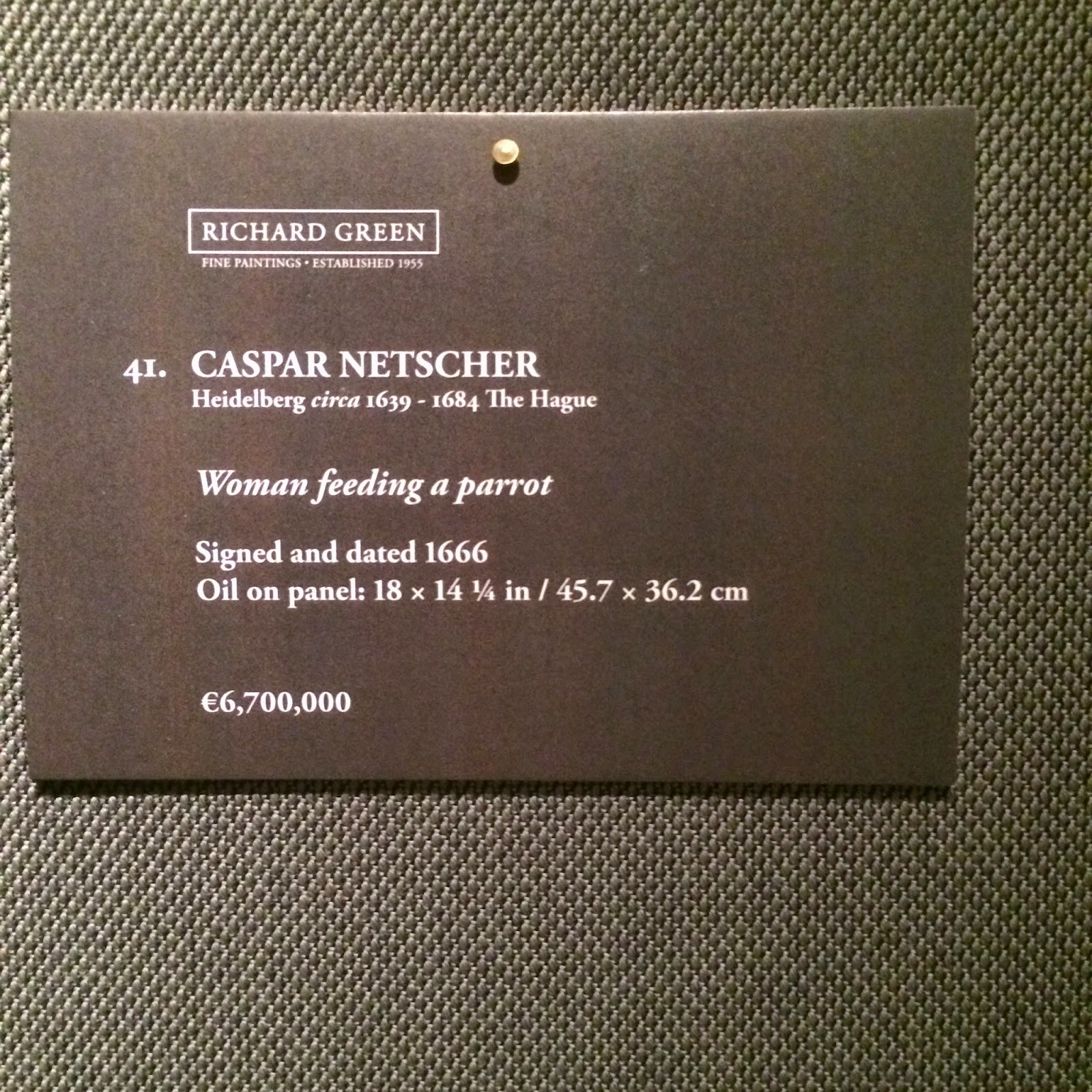
I looked for Caspar Netscher’s “Woman Feeding a Parrot” [Frau mit Papagei, or Lady with a Parrot] having become familiar with it during ESLI’s Provenance Research Training Program (PRTP) in Vilnius. I felt a sense of relief upon spotting it. 
"Lady with a Parrot" at Maastricht


HA 9-Frau mit Papagei
This painting had once been the property of a Belgian Jewish family, Hugo and Elizabeth Andriesse, who had to flee Belgium before the German invasion of April-May 1940. Recently restituted, the heirs—several American charities—decided to sell the painting through Christie’s in New York. Barely a year went by and the new owner, in an apparent attempt to cash in on the market highs, offered it for sale at Maastricht. Hope springs eternal, especially where millions of euros are involved.

There is something about standing in front of a work of art you know a lot about. But then I looked at the wall. The label accompanying the painting only contained basic information, even though unlike most works, it included the price, at € 6,700,000. But it somehow felt ‘naked’, without a story attached to it. The full provenance, sure enough, was included in the catalogue, which you had to ask for, since it was not on display. The painting is nr. 13 on the catalogue and the text retraced the Andriesse painting’s journey from Brussels, the ERR’s seizure of the work, its transfer to the Jeu de Paume in Paris, before going to Goering, the Bunker Kurfürst and leading up to the Wuppertal museum until it agreed to restitute it to the Andriesse heirs, without putting up as much as a whimper in 2014. Strangely, the work is not included in the fair’s sold highlights: did it actually sell?

This being said, melancholy sets in when one stands in front of a work of art that you admire, and the thought hits you that it could be the last time you will ever see it up close, before it ends up in someone’s private collection, probably in some faraway land.


30 March 2015

Happy birthday, Vincent van Gogh! Portrait of Dr. Gachet, a book review

by Angelina Giovani 

Portrait of Dr. Gachet, van Gogh (1890) First version

[Editors' note: One way to celebrate Vincent van Gogh's birthday is to reminisce about one of this most important works of art, Portrait of Dr. Gachet. Angelina Giovani reviews Cynthia Saltzman's captivating history of a painting executed by van Gogh shortly before his untimely death in mid-1890.]

The Portrait of Dr. Gachet, by Cynthia Saltzman, came out in 1998. This unusual book traces the provenance history of a portrait that Vincent van Gogh painted of his doctor in 1890, shortly before he took his own life. Saltzman provides us with the context and circumstances of the portrait’s creation, focusing on the first of two versions which van Gogh painted, the profiles of the people involved in the many transactions that marked its history and the state of the art market in Western Europe at the beginning of the 20th century.

The story begins when Vincent van Gogh is 37 years old and had already created a large body of work, amounting to over 600 paintings and drawings. Even though he had not made any profit from his paintings, his brother Theo received his works, while he was based in Paris, acting as Vincent’s dealer. Their close relationship comes out clearly in the letters that Vincent and Theo exchanged during the years, which also shed light on other close relationships that van Gogh had built with other artists of his time, such as Gauguin, Signac, Pissarro, etc. Pissarro recommended that Dr. Gachet look after Vincent’s health which had deteriorated. There are still many theories on van Gogh’s diagnosis. Although we will probably never know exactly what he suffered from, the more plausible theories center on acute mania with hallucinations, depression and melancholia. He met Dr. Gachet on May 20, 1890 and immediately realized that Gachet could not help him; at times Vincent was concerned that the doctor might be more ill than he was. Nevertheless, by June 3, van Gogh had started painting his portrait. Art historical analysis and research into the iconography and history of styles tells us that the portrait is not a simple objective portrait of the doctor. Van Gogh drew his inspiration for this work from two sources. The first one was Delacroix’s Tasso in the Hospital of St. Anna, Ferrara (1839) and the other was Puvis de Chavannes’s Portrait of Eugène Benon (1882). Ever since its conception, the painting has never been viewed as just a portrait. It embodies the artist’s philosophy regarding his work. The general consensus is that it should be read on a symbolic level.
Vincent van Gogh

The period from January to July 1890 was a troubled time for Van Gogh. His condition worsened in the days that led up to July 28th when he shot himself with a revolver. Van Gogh died the next day, soon after Theo had reached Auvers-sur-Oise, a small town north of Paris. Theo inherited approximately 600 works produced by his brother, from which about 70 were produced during his time in Auvers. The Portrait of Dr. Gachet was among them. Theo moved the Auvers paintings to Paris, together with the 600 paintings and 350 drawings already in his possession. Theo struggled between trying to sell his brother’s works and trying to get him the recognition he believed he deserved while keeping his own health. Paul Durand-Ruel refused to help Theo sell any paintings, so Theo’s only option was to hang the works in hi
s apartment at 54, Rue Lepic. With the help of Emile Bernard, Theo managed to hang 350 paintings. A list of the works was compiled by Theo’s brother in law, Andries Bonger. As the story goes, Theo did not live to see these paintings sold, as he passed away, six months after his brother’s death on January 25, 1891.
Theo van Gogh


Johanna van Gogh-Bonger
After Theo’s death, his wife Johanna van Gogh-Bonger inherited all of Van Gogh’s works. Troubled and uncertain about what would come next, she decided to leave Paris and together with her son, Vincent Willem van Gogh, moved to the Netherlands. In the span of a few months she managed to bring most of the paintings with her. She was convinced that the paintings would find a broader audience and that the local art scene would embrace van Gogh ‘as a painter in the Dutch tradition’. Her instinct proved right, since by February 1890, Van Gogh’s work had already seeped into the Dutch art market. Ten paintings were on display at Buffa Galleries in Amsterdam and another twenty at the Oldenzeel Gallery in Rotterdam. A few months later in 1892, a retrospective of forty-five paintings was organized at the Hague and in 1893 an even larger show took place at the Kunstzaal Panorama, in Amsterdam. Finding a market for the paintings was an immense undertaking, but it came second to Johanna’s most major undertaking which was collecting and transcribing Theo’s and Vincent’s correspondence, which amounted to over 600 letters. She put the letters in chronological order and organized them in an edition which she completed on July 28th 1914 a few days before the outbreak of World War I, 24 years after van Gogh had shot himself. Johanna’s edition was published initially in French and Dutch, then in German. She worked on an English version until the end of her life in 1925. That edition was published in 1928. The letters played an important role in how the world would come to view van Gogh. The letters and her careful selection of what to reveal to the world helped create a myth around van Gogh, which romanticized his condition and depicted him as the tortured genius misunderstood by the society of his time.

In 1893, the first request to exhibit the Portrait of Dr. Gachet came from a Danish group called Free Exhibition (Den Frie Udstilling) founded in 1891 and headed by Johan Rohde. He considered van Gogh to be 'the greatest Dutch painter of the century’. The portrait was selected along with twenty other paintings and was singled out by critics who interpreted it as symbolic rather than an accurate description of the sitter. The choice to include works from van Gogh and Gauguin in the exhibition in Copenhagen, was not only a testimony of growing interest in these artists, but also of a rising appreciation for the French avant-garde throughout northern Europe. Most of the works on display were for sale, but The Portrait of Dr. Gachet was not one of them.

Durand-Ruel could not or did not want to sell van Gogh paintings. Even when he agreed to take some works on consignment from Johanna, he ended up returning all of them. The only other person in Paris selling van Goghs was the Tanguy family who owned a paint shop and to whom Theo had consigned works which they ended up keeping, since there was no full inventory of these works. But in the French art market, these works were fetching less than half the price of their equivalents in the Dutch art market. At a Hôtel Druout sale organized to benefit Julien Tanguy's widow, two van Gogh paintings came up for sale and Ambroise Vollard bought one of them. At that time, Vollard had barely entered the Paris art market. His gallery space was tiny but strategically placed among the more important galleries, close to Durand-Ruel and Benheim-Jeune. Soon Vollard contacted Johanna and asked her for some paintings with the intentions of exhibiting them. He sold one of these paintings, Salle de Restaurant. A larger exhibition was organized in November 1896, and included the Portrait of Dr. Gachet, which hadn’t been seen in Paris since it hung in Theo’s apartment before his death. Vollard bought the portrait along with 5 other paintings and 10 drawings for 2000 francs. The sale of these paintings market the end of Johanna’s dealings with Vollard. That being said, Vollard kept selling van Gogh’s that he was acquiring from other sources, filling the gap left in the market by Theo’s death.

Alice Ruben was an artist and occasional member of Copenhagen’s Free Exhibition Group when she first came across van Gogh’s work. Upon a visit to Paris, Alice Ruben saw the portrait in Vollard’s new gallery in 1897 and bought it. Vollard’s sparse records indicate at least one payment of 200 francs on April 30, 1897 but there are no further records concerning the finalization of the transaction. Alice and her husband brought the picture back to Denmark. Her family’s upper-middle-class roots gave her financial stability that allowed her to collect contemporary art. She spoke a number of languages and had multiple connections in the art world. She knew Johan Rohde and many avant-garde Danish artists. It still is not known to us why Alice chose the Portrait of Dr. Gachet in particular, but she certainly appreciated it a great deal. The photograph below depicts Alice lying in bed. Resting on her night stand is the Portrait of Dr. Gachet along with a painting of mother and child by Maurice Denis.

Alice Ruben in bed next to Dr. Gachet
Mogens Ballin and his wife, by Felix Vallotton
Both paintings in the picture were transferred before 1904 to Mogens Ballin (1871-1914). Like Alice, Mogens was also an artist and collector. He also came from a well-established Jewish family in Copenhagen. Curiously, Mogens had been one of the few people interested in van Gogh’s oeuvre right after his passing, and had visited the apartment where Theo displayed Vincent’s works. Mogens considered bringing the portrait back to Paris to sell it. Aware that there still was little interest in van Gogh’s work and that Gachet might end up in storage, he decided to take it to Berlin.

(to be contined)...

25 March 2015

Murambi: a death camp by any other name

by Marc Masurovsky

The Murambi memorial site is, literally, in the middle of nowhere.
view of the entrance to Murambi
After reaching Butare, the second largest city in Rwanda, you take a side road that extends for 27 km, along a dirt road, winding round villages where the unfamiliar Muzungu (roughly translated as “lost and confused” to designate white foreigners) stand out like sore thumbs. No matter. Stares accompany us with the occasional motley crew of boys on bicycles trying to steer us in the right direction in exchange for coins.

We finally reach Murambi, at a dead end. The road goes nowhere else. That ought to tell you something already. A finality in and of itself. The memorial site is surrounded by villages comprised of a dozen huts and houses each, made out of the proverbial mud brick and found materials stitched together to produce a semblance of shelter.

Nothing prepares you for Murambi in the same manner as nothing can prepare you for Birkenau. The only difference is that the horror of Murambi is hiding in plain sight, whereas the horror of Birkenau is a horror left to the imagination to toggle and to sift through once the landscape of dying and suffering has been explored.

Murambi is a place flanked by bucolic landscapes of rolling hills, verdant sceneries, much like the rest of Southern Rwanda. At this place, tens of thousands of Tutsi civilians from surrounding areas were corralled to await their fate.

There are building structures at Murambi, red brick shells that look more like barracks than classrooms for a future state technical training center that was never completed, so goes the official story. One can only imagine young men and women studying to be the future engineers and technicians of a modern Rwanda at the end of a dead-end road far from everything and flanked by dead poor villages with no commercial infrastructure to support such a technical center. The story makes no sense. By default, we are left to speculate and to leave open the possibility that our worst thoughts are closer to the truth than the official “spin” of an unfinished school. Let’s say, for a moment, that there was such a plan to build a school in the middle of nowhere, difficult to reach, and that the project was nixed for one reason or another. If that were the case, the abandoned red brick shells constituted the proper edifice in which to park men, women, and children, who had reached—in more ways than one—the end of their road.

Murambi became a killing ground where every square inch was used to hack, shoot, dismember, rape, and murder men, women and children. No one is sure about the numbers, but 20,000 is the minimal safe number. Some speak of as many as 55,000 bodies buried at Murambi.

The memorial building itself houses an exhibit that resembles the one housed in Kigali, Rwanda’s capital. Nothing new to offer. The only interesting presence is the absence of bodies from casings inset in the floor covered by clear panels in which were supposed to be displayed the remains (or whatever is left of the remains in their accelerated state of deterioration) of men, women, and children, frozen in the position that they yielded to as they exhaled their last breath.

Several barracks house the remains of approximately 1500 people who were disinterred from mass graves and put on display. The corpses of the victims are lying on wooden racks atop improvised platforms in successive rooms. Children with one arm extending over the corpse of an adult man or woman, adults with a finger pointing nowhere as if they had tried in vain to dissuade their attackers from hacking them into death, children with smashed skulls, women with small patches of hair still clinging to the thin skin layer peeling off their skulls, children curled up as if trying to get some sleep. It is all so poignant and yet so desensitizing to be faced with the final moments of Tutsi victims’ lives, frozen as their bodies desiccate and gradually vanish at the relentless mercy of the elements.


We climb up some steps and enter another part of this desolate site where ghosts abound.


As we walk through the grass and in between neatly laid out rows of red brick barracks, a flash memory crosses our minds as we recognize some of the timeless architectural elements of a Nazi concentration camp. We enter one of the barracks. Some walls show evidence of bullet impacts. But the most striking feature of these rooms is their redness, red from the dust of the rich loam that covers Rwandan fields blending with the fading dark red stains left by victims’ blood, spilled on the floors and splattered on the walls. Those who maintain the site tried in vain to eliminate all traces of the blood and one can see the crude brush strokes of off-white paint splashed on the walls as added evidence of the grisly nature of these rooms. Death rooms, hacking rooms, rooms of torture and unremitting, cruel death. These rooms succeed themselves one after another and one should not even try to imagine what took place there as thousands of human beings were crammed into them, awaiting their fate, hungry and thirsty and panicked.

Victims' belongings, in the background, the  killing rooms

In some of the rooms, teenagers and adults living in the villages surrounding the memorial site have scrawled haphazard designs of cars and planes, words and sentences in Kinyarwanda. One can only wonder if they were even mildly aware of the function of these rooms. A form of unwitting desecration has taken place at Murambi. The sheer state of neglect that prevails at this death camp is simply unacceptable.

One can only hope that the Rwandan government will take urgent measures to rectify the situation, secure these killing rooms, stabilize the remains of the victims, perhaps rebury them in a dignified way so as to memorialize them the way that most people honor their dead and, just as important, recount the story of Murambi so that the visitor is not left to her own imagination to understand what happened in that hellish space.

Murambi is a death camp where breathing is labored, the mind goes numb, and death hangs in the suffocating air amid fields, rolling hills and the banality of human survival and existence in a forgotten corner of Rwanda.

The neighborhood of Murambi