19 January 2014

Time for a reckoning with the Cornelius/Hildebrand Gurlitt saga—Part One

Gurlitt
Source: the week.co.uk
Now that we are barely three weeks into 2014, the unfolding of the Gurlitt saga has turned into an international circus, one part media, one part international organizations, one part German government and one part other governments.

Where are we today, exactly?

Research:

Due to continued opacity on the part of the German government and the Gurlitt Task Force which is just as opaque, there is NO information whatsoever on how much research has been done to date on the 1400 or more items in the Cornelius Gurlitt collection. All we know is what is published on the lostart.de website, overseen by the Koordinierungsstelle Magdeburg. Truly impressive photos taken of the front and back of each object that the Gurlitt Task Force is willing to release to the general public for its viewing pleasure.

The people recruited to sit on the distinguished Gurlitt Task Force do not appear to be doing research. And even if they were, we would not know about it. That is the classic definition of opacity and the administrative definition of “classified information.” In other words, a gag order binds all members of the task force to secrecy. Can’t blame them, after all. All of those items in the Gurlitt collection are State secrets, right

If the Gurlitt Task Force is not responsible for actually conducting research, WHO IS? Where are the funds coming from to conduct such research? Is there enough money to undertake thorough research that might entail travel to different cities, extended stays in archival repositories, or to put it in professional terms, budget for significant billable time? Speaking of budgets, is there a budget to address that particular aspect of the research effort?

If there is an intention to research each and every item systematically, does that mean that no item from the Gurlitt collection will be released before such research is concluded? From what we gather, it does not really matter what the Gurlitt Task Force think or does, since the fate of the Cornelius Gurlitt collection remains in the hands of the prosecutor in Augsburg, Germany. So, what are we dealing with here? A public relations stunt?

Due to the sheer opacity that cloaks the Gurlitt Task Force, no one in their right mind should trust any statement coming from the German government and from any member of the Task Force on this and related matters because, much like NSA officials and other individuals working for organizations cloaked in secrecy, they are not paid to tell the truth, only what they are authorized to disclose, which is a shambles of a reflection of the truth. We should wonder what the truth is these days…

International representation on the Gurlitt Task Force:

As of now, Israel has three representatives:

Project HEART,

Shlomit Steinberg, Curator, Israel Museum, Jerusalem
Shlomit Steinberg
Source: Google
Yehudit Shendar, Deputy Director and Senior Art Curator,Yad Vashem.
Yehudit Shendar
Source: Google
Other groups represented include:

Agnes Peresztegi
Source: Google
the Commission for Art Recovery represented by Agnes Peresztegi, its Director of European affairs,

and the Claims Conference, represented by Ruediger Mahlo, director of its Frankfurt office.

Ruediger Mahlo
Source: Google

The only provenance researcher on the Task Force whose name has been made public is Sophie Lillie, who is based in Vienna, Austria, and a specialist in researching acts of cultural plunder in Nazi-occupied Austria.

Sophie Lille
Source: Google

Where are the representatives of countries which hosted visits by Hildebrand Gurlitt and where he indulged himself in shopping sprees worth tens of millions of Reichsmarks? Or have those countries forgotten that they were actually victimized by the National Socialist government of Adolf Hitler, his Wehrmacht, his SS, his Gestapo, and all other relevant emanations of the Third Reich specifically geared to oppress, suppress, arrest, confine, deport, exterminate, retaliate, steal, plunder, requisition and do all sorts of other things that ideological conquerors do when wishing to establish a New Order by force?

France and Holland?

Maybe the Dutch could take a pass on this one, but the French, well, the French cannot afford to take a pass on the Gurlitt Task Force. That’s tantamount to saying: we do not need to repatriate any additional works of art that were removed from French territory to the years of German occupation from June 1940 to August 1944. According to the international agreements of the time, that is, those enforced at least through the immediate post-1945 years, France and any other country occupied by the Nazis could repatriate any object that could be proven to have been removed from its territory by the German authorities. If that is the case, the French government should abolish the MNR category and return all items to those from whom they were either acquired or stolen. Why not? Or this is a flippant remark?

Could it be that France’s culture minister, Aurélie Filippetti, will make some kind of announcement about the Gurlitt Task Force at a January 30, 2014, symposium on the state of art restitution in France,organized by “Green” Senator Corinne Bouchoux?

Aurelie Filipetti
Source: Google

Aurelie Filippetti, French Culture Minister

Hildebrand Gurlitt paid regular visits to German-occupied France within months of the arrival of German troops on parade along the Champs-Elysées. He consorted with dozens of art dealers who were only too willing to sell their paintings, works on paper, furniture and other cultural objects to covetous agents of German museums, institutes, galleries, agencies, dealers and collectors. Many of those sellers in happy Paris were also recycling art looted from countless Jews who had fled the capital so as to avoid capture, internment, and deportation. Most did, some could not, and the fates were sealed. Is that important to the Gurlitt Task Force? Or does it consider that there is no blood soaking the art that the son of Hildebrand Gurlitt possesses?
Hildebrand Gurlitt
Source: Google

We do know that an invitation was issued to France for it to send at least one representative to the Gurlitt Task Force. But, as of now, France has not replied. Will it ever? Or is it too concerned about President Hollande’s growing harem? Or maybe the French government does not really care about what its own citizens did between June 1940 and August 1944 to a quarter million Jews and as many, if not more, men, women, and in some cases children who expressed their discontent with Vichy and the German occupation force? In the current atmosphere that plagues French citizens, the antisemitic, racist, and immigrant-hating National Front is expanding its reach amidst a disenchanted electorate, a not insignificant segment of France’s revered intellectual class shows its increasingly corrupt ways and cannot even think straight about what its recent history means for today and tomorrow, preferring to muddy the waters of antisemitism. We are not too surprised, therefore, if the current mood among French museum officials and government bureaucrats and cabinet members is simply to forget Vichy and to pretend that it is now just another “incident de parcours.” By the way, those very same French museum officials are not too happy with anyone asking questions about the provenance of many items in their collections that they hold sacred, as indelible pieces of the French cultural geist, organic components of the “patrimoine culturel de la nation.” An irrevocably untouchable part of France’s hallowed treasures.

Poor France! How easy it is to flush the truth down the proverbial toilet of selective amnesia!

Hildebrand Gurlitt was a major presence on the Paris art market, regardless of what one reads in historical monographs about Nazi art looting. That is the objective truth and the objective reality, however one wishes to measure it. One art dealer in Paris had a special room set aside where paintings were stored for Mr. Gurlitt to pick up, pay for, and have shipped to Germany. Mr. Gurlitt had regular customers throughout the Left Bank and the Right Bank—in those days, it did not matter where you shopped as long as there was someone willing to sell to you. Mr. Gurlitt is mentioned fairly regularly in postwar testimonials provided by Goering’s people like Walther Andreas Hofer, Gustav Rochlitz and others. Mr. Gurlitt was a significant player in the Nazi art trade. Period. Since the historical evidence is overwhelmingly compelling in this regard, why is no one doing anything to explain to the general public the true extent of Hildebrand Gurlitt’s reach into the fruits of Nazi plunder, starting from the purging of German State Collections, the hundreds of forced sales that brought to Mr. Gurlitt and his ilk truly fascinating and collectible works by German Expressionists, those “degenerates” so lovingly purged by Goebbels, himself a secret admirer of Expressionists, and his henchmen.

If one had to summarize Hildebrand Gurlitt, he was one of many dealers and eminent members of the German museum and gallery world who profited from the Nazi hypocrisy regarding modern art and the Nazi hierarchy’s lust for cultural assets that did not belong to it. More importantly, Hildebrand Gurlitt is the quintessential member of the cultural establishment in Axis-occupied Europe and the poster child for a postwar successful career in the arts and culture, both in Germany, but also in other parts of Europe and even in the United States and Latin America. How quickly everyone forgets especially when “Europe’s cultural treasures” are involved!

Hildebrand Gurlitt’s pedigree as a former museum director, gallery owner, and internationally known dealer, collector, and art specialist, made him nearly untouchable by the time Allied troops entered into Germany in spring of 1945 and liberated it from those Nazi scoundrels. Indeed, in the eyes of American conservative officials at the Departments of State and War, in the upper reaches of the American military, especially in the central office of the Occupied Military Government United States (OMGUS), he represented the future of a redeemed Germany, despite the fact that his best friends were all Nazi collaborators. He had Jewish blood, did he? So he said. God, that sounds vaguely “Aryan” in its resonance. A bit like other Nazis who had “Jewish friends” whom they protected and shielded from an inevitable fate. A cynical calculation to look like saints in an ocean of sinners…
Gurlitt, center, at the Kunsthalle, Dusseldorf, Germany, 1949, completely rehabilitated by the Americans
Source: Google
Why does having a Jewish relative make you a saint or someone unlikely to do “bad things”? As Theodore Heinrich, the former director of the Wiesbaden Collecting Point and “Monuments Man extraordinaire”, argued when asked about how he vetted “bad” Germans from “good” Germans, if a German art official was not a member of the Nazi Party and had a Jewish relative in the family, he had to be acceptable. No questions asked, please. Otherwise, you’ll insult the poor man, he’s suffered enough, hasn’t he? In the name of Kultur!!!

That’s how easy it was to get a clearance with the American cultural advisory group known as “Monuments Men.”

Let’s not get lost here.
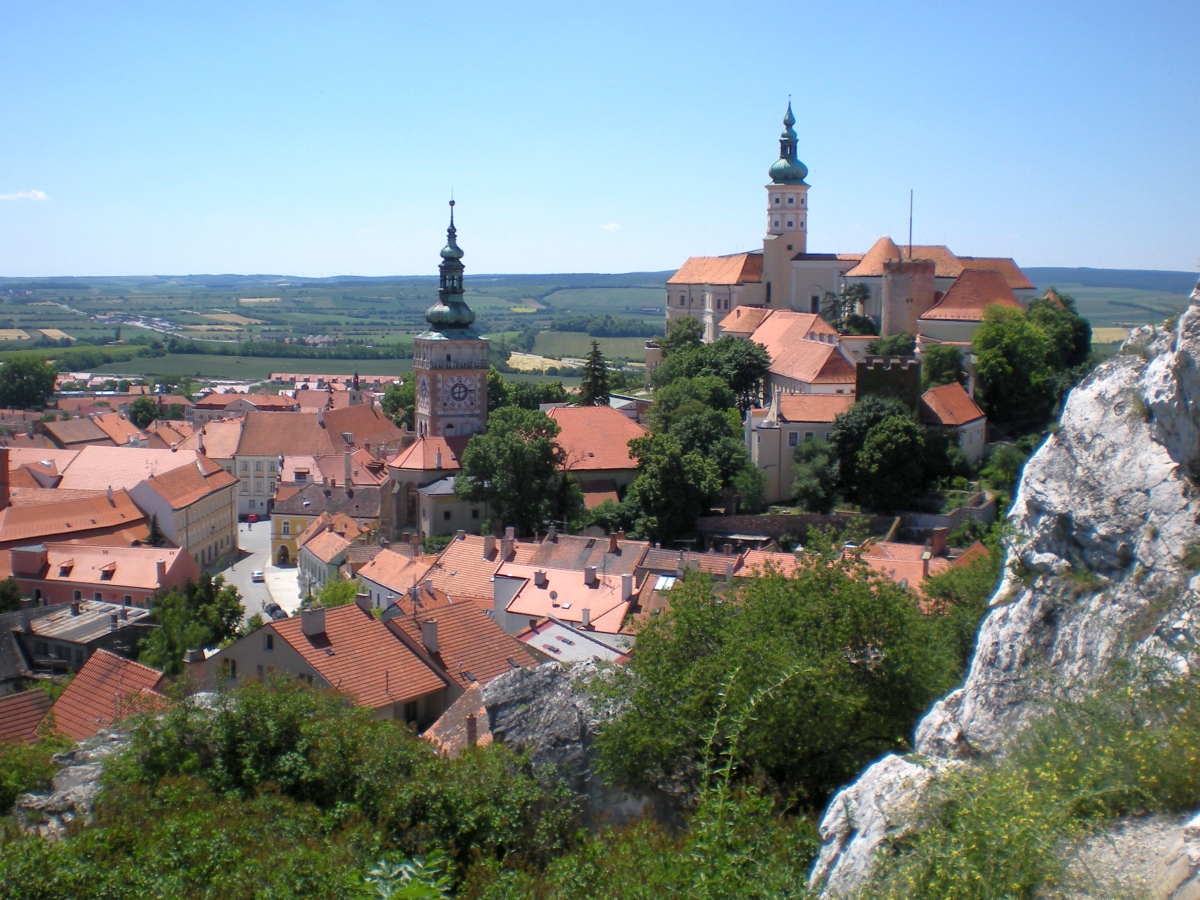
Nickolsburg Castle
Source: Wikipedia
As the French so lovingly say it, Hildebrand Gurlitt refashioned himself a whole new virginity—il s’est refait une virginité. Like a savvy marketing guy who knows his brand better than anyone else, he knew how to sell himself and to whom he should address himself, whose protection he should seek and… voila. Guess who fell for it? American and British art connoisseurs, those heroes who waltzed into cities and towns ravaged by twelve years of racially-motivated dictatorial follies, many of them almost razed to ground level. From the cultural side, many museums barely kept their walls standing, those very museums that the American and British art connoisseurs were tasked to put back together, reopen and restock with “Europe’s cultural treasures.” Most of those treasures were safe and sound deep inside mine shafts and in the cellars of countless castles that were not bombed. Of course, there always are exceptions like that poor castle at Nikolsburg, in today’s Czech Republic. But again, it was an exception. German museums recovered most of their goodies, except for those that were stored in eastern portions of the Reich which Soviet troops overran.

Basically, unless you had blood on your hands and you gave the Nazi salute every five minutes, you were likely to get a job with the American cultural advisory group in the US zone of occupation in Germany … as an expert! Obviously you were an expert since you were directly involved in partaking in the recycling of loot all parts of the Reich for close to a decade! Priceless experience!! If I had been a Monuments Man, why, I would have hired folks like Hildebrand right there, on the spot!! Made my job a lot easier, believe me, and, best of all, he could point me to all of his other expert buddies so that we could ask them for their expert opinions. How much fun was that! Why waste time looking for a pedigreed anti-Nazi art specialist.

Stay tuned for Part Two…

or go see “The Monuments Men” for some serious entertainment. "Inglorious Bastards" revisited, as Clooney promises a rapt potential audience?

Once upon a time...


US Soldiers toast victory at Berchtesgaden
Source: Wikipedia via US Army
Once upon a time, an American private first class entered Adolf Hitler’s lair in Berchtesgaden, tantamount to taking a stroll through Ali Baba’s cave. He and his commanding officer could not resist and assembled an elaborate, yet simple scheme to misappropriate objects of all kinds, from Hitler’s desk, cabinets, works lying on the floor, against walls and so forth. They sent these items including an engraving by Cranach, to the US via the military postal system—APO. An untold number of objects left the lair in that fashion. Only one was recovered, only because the soldier, who had registered as a graduate student at a New York City college in the late 1940s, had admitted his wayward behavior to his counselor who reported it to the dean who alerted the State Department. Next thing we know, after arduous negotiations, the student ceded the stolen item without revealing the existence of the other items. To this day, he has protected the identity of his commanding officer, fumbling and stuttering when explaining the reasons for his action. This individual became a leading Holocaust scholar and one of the foremost academic opponents of restitution as an ethical concept, as a teachable concept, as a historical phenomenon following acts of genocide and plunder driven by ideological crimes against an entire people, and as a strategy of justice for Holocaust victims and their heirs. This irrational behavior regarding his crime mirrors strangely the comportment of Jewish officials, Holocaust museum directors, Holocaust studies faculty and administrators, curriculum designers and Holocaust educators as they reject a cardinal principle of the Third Reich policy against its Jewish victims, as well as a pillar of antisemitic behavior--the forcible removal of all property belonging to Jews as the first step towards their dehumanization and marginalization as productive members of civil society.

Art world officials have behaved in similar fashion when confronted with the realization that they might have to part with objects in the collections that they steward. They behave much like the former PFC from Berchtesgaden, with an inflated sense of proprietariness, a very kindisch behavior that one might expect more from an outraged, self-righteous child. And yet, the grandstanding indignation of museum officials and curators and dealers and collectors and their attorneys and even art historians and so-called provenance research specialists in those very institutions, all behave as if they are the self-anointed guardians of Kultur.

It’s all very weird.

18 January 2014

Where were you...?


Drancy Concentration Camp
Source: Wikipedia via Ghetto Fighters' House

Where were you when the trains left Drancy?  How do 45 trains carrying altogether more than 40,000 children, women, and men of all ages, classes, occupations, convictions, dispositions, and origins, leave the station in the northern suburbs of Paris without notice over the course of ten months in the year of 1942?  Sometimes one train left every day packed with more than 1000 people, 1000 future dead bodies.  A daily event.  The routine of death warmed over.  Where were you?  Did anyone notice?  If so, what did he do? What did she do?  What was going on that day when the train left the station?  What were people doing while Germans and Frenchmen were busy assisting nearly 1000 people into cattle cars, bound for “the east”—destination unknown?  What was going on in the world at that very moment? What happened that the names of these men, women, and children were inscribed on the scroll of death?  What were Parisians thinking at the time?  Where were they?  What did America do?  What were Americans doing in Paris? Watching the trains go by? Waving perhaps?  Another cattle train.  My, there is a lot of activity on those tracks.  What were Americans thinking when 12,000 Jews were rounded up in Paris on the 16th and 17th of July?  Were they even friends with those Jews?  The foreign Jews, that is, the ones that the French Jews didn’t really like.  The party spoilers.  Who among the Americans was strong enough to understand what was taking place in Paris at the time?  Was it even possible to understand what was taking place in Paris at the time?  Could one be a witness? An eyewitness? And if so, what was one to do? Except watch? Try not to think? Bury the head in the sand? Shrug the moment off as a bad dream, something inevitable. Blame fate. Blame the Jews, they brought in on themselves, blame the French, they’re such anti-Semites.  Why are you friends with them in that case? Yes,  you, Florence Gould. You, the managers of the Chase Bank, of the Morgan Bank, of the other banks, of the companies, and the galleries, and the businesses, you, the tourists, the writers, painters, sculptors, you the inventors, the secretaries, the students.  What were you doing on the day that they took these children away, and their mothers and their fathers and grandparents and uncles and aunts, their classmates, their teachers, their nurses, their bakers and tailors, and butchers?

What were you doing? I don’t know.  I can’t recall.  I can’t remember.  My mind is drawing a blank.  That’s strange.  It was.. was it a beautiful day? Was the sun shining? Was it hot and steamy or hot and dry?  I simply do not remember.  Where was I? did I have breakfast? Did I go to work? Did I read the newspaper?  What was I doing? What was I thinking? Was I with anyone? I don’t remember.  You say a train left Drancy and went east.  East to where? Nancy? Meaux? Where was it going? You say it rode through Paris?  Did I hear the rumble of the packed cattle cars on the tracks along the Seine and across the river? Did the train cross the river? Was that just my imagination?  Honey, do you know what this gentleman is talking about?  I frankly can’t remember anything.  How droll!

The apartments.  Did they take the apartments before they left or after they left? When did they meet with their lawyers?  What paintings did they prefer, place settings, rugs, furniture? Did they like the room with the view?  Did they buy the buildings after the owners fled or did they not hesitate to humiliate them into selling for less than their worth or their hide?

Do deportation trains whistle in the dark?  Or do they slumber along on the tracks sounding a somber cadence that puts me to sleep as I stare out the windows of my berth watching the cypresses in the distance serrating the crests of hills like bread knives, fields of wheat in the foreground announcing a bounty of a crop not for everyone, though.  I stare out the window, dreaming of a forlorn past, wishing that today had never happened.  Yes, today marks the anniversary, the numberless anniversary of the day that the train left for the east with more than one thousand children, women, and men.  I look for their ghosts in the midst of the white wisps of clouds high above the train that takes me to the mountains, to my seasonal enjoyment on the slopes of the Marmolada above Bergamo and below the Austrian frontier and the Tyrols, last holdouts of Nazi butchers, frosty escape routes for fleeing fugitives carrying inside their jackets a lifetime insurance of protection against capture, prosecution, imprisonment, and execution.  What sweet sinecure awaits these husky SD and SS operatives, these AMT sixers and AMT fours and AMT threes, these fake stalwarts, radio operators, smugglers, two-bit murderers and thieves, men who do not hesitate to dangle impaled babies on their bayonets outside Jewish cemeteries in the Ukraine.  Brave men of the reich, the crumbling reich, and here I am watching from a distance whence they came like cowards stealing through the starry nights the milky way’s hundred million stars oblivious to the agonies and shrieks that dotted the landscape of Europe for ten long, terrible, mind-bending, suffocating, inhuman, beastly years, thirty thousand days and nights of suffering.  How can anyone possibly survive these calamities brought upon by our fellow man, my dear fellow who sits across from me, dressed in green tweed, maroon corduroy, an academic no doubt, let’s see his shoes, earth shoes? What year is this anyway?

08 November 2013

THE HOLOCAUST ART RESTITUTION PROJECT CALLS ON THE GERMAN GOVERNMENT TO IMMEDIATELY DISCLOSE A DETAILED AND COMPLETE INVENTORY OF THE CORNELIUS GURLITT COLLECTION AND SET UP A COMMISSION TO HASTEN RESTITUTION OF NAZI-LOOTED ARTWORKS TO HOLOCAUST VICTIMS AND THEIR HEIRS.

Press Contacts:
For HARP: Marc Masurovsky, (00) 1 202 255 1602 , plunderedart@gmail.com

For Immediate Release

Washington, DC, USA – November 8, 2013 - The Holocaust Art Restitution Project (HARP), based in Washington, DC, chaired by Ori Z. Soltes, has called on the German Government to immediately publish a full, detailed and complete inventory of the Cornelius Gurlitt art collection, and to set up a Commission to hasten the restitution process of Nazi-looted artworks to Holocaust victims and their heirs.

Following the disclosure by the weekly magazine Focus that the German Government has been in control of the Cornelius Gurlitt collection for several years, HARP, through its legal counsel, sent a letter to the German Ministry of Finance, Wolfgang Schäuble, calling on the German Government to immediately disclose a full, complete, and detailed inventory of this collection, and to establish a Commission to hasten the process of identification and restitution of any Nazi-looted artwork found in this collection.

“Any delay in implementing these steps would constitute grave injury to both the art market which requires that full and complete diligence be performed on any transaction, and to Holocaust survivors who have been looking for their artworks since 1945,” the letter states, which was also shared with Reinhard Nemetz, the Head of Augsburg State Prosecutor’s Office in charge of investigating Cornelius Gurlitt.

HARP is a not-for-profit group based in Washington, DC, and chaired by Ori Z. Soltes, dedicated to the identification and restitution of looted artworks require detailed research and analysis of public and private archives in North America. HARP has worked for 16 years on the restitution of artworks looted by the Nazi regime.  HARP was notably involved in the "Portrait of Wally" case, where a Schiele painting was seized by the U.S. Government, as well as in the restitution of an “Odalisque”, a painting by Henri Matisse, to the Rosenberg family.